




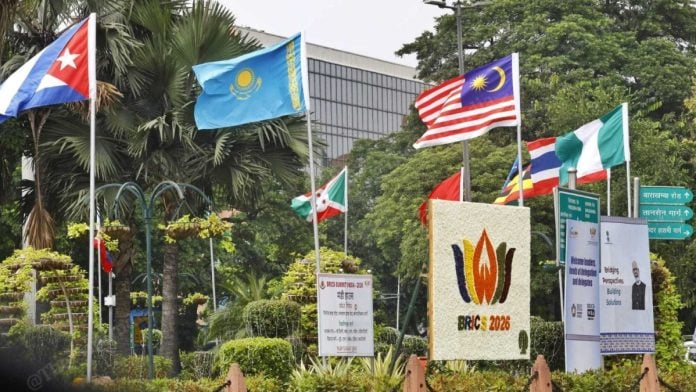

New Delhi: New Delhi’s BRICS moment arrives at a critical moment in geopolitics, even as the expanded grouping grapples for consensus over a range of issues — from conflicts in West Asia to reform of the United Nations Security Council. Chinese President Xi Jinping, Russian President Vladimir Putin and Iranian President Masoud Pezeshkian are among the leaders attending the BRICS 2026 summit, in a show of diplomatic force among non-Western economies. The scale and scope of the diplomacy in the offing make BRICS ThePrint’s Newsmaker of the Week.
India’s fourth chairship of the grouping has been a rather low-key affair. The pomp and show seen during the last major geopolitical summit hosted by New Delhi – the G20 Leaders’ Summit in September 2023 – has been largely missing.
The G20 summit witnessed months-long city beautification drives, colourful murals around the national capital and huge billboards of Prime Minister Narendra Modi welcoming the delegates. In contrast, the preparations have been far more subdued this time around, as Bloomberg noted in a report.
BRICS has also come under the scanner of the US, with President Donald Trump promising steep tariffs if the grouping’s 11 member states – Brazil, Russia, India, China, South Africa, Egypt, Ethiopia, Indonesia, Iran, the United Arab Emirates and Saudi Arabia — move towards “de-dollarisation.”
The organisation is also beset by internal contradiction over the ongoing conflict in West Asia, with Iran and the UAE on opposing sides. These developments point to a more unwieldy grouping that has little to show in terms of substantive outcomes since the New Development Bank was established 11 years ago.
Nevertheless, the forum offers India a moment in the geopolitical limelight. For New Delhi, the main challenge will be to bring its two bilateral partners — Iran and the UAE — together and forge consensus on a joint leaders’ declaration. New Delhi’s quiet confidence that it can achieve this would underline its role as a neutral arbiter between countries in West Asia.
Such a consensus would come after months of Pakistan claiming success in mediating between Iran and the US, followed by the Islamabad memorandum of understanding that collapsed within days of coming into effect.
A successful Indian diplomatic effort would build on New Delhi’s success in bringing Russia, the US and the European Union together on common language regarding the war in Ukraine at the G20 three years ago.
It would also strengthen New Delhi’s diplomatic pivot and its pitch to bring Russia and Ukraine to the negotiating table. Modi last month, in the Kyrgyz capital of Bishkek, called on Putin to move from an “endless war to the end of war”. Days later, External Affairs Minister S Jaishankar visited the Ukrainian capital of Kyiv and underlined the necessity of dialogue and diplomacy to end the war, now approaching half a decade.
All of this adds to the geopolitical stakes for the Indian presidency. Modi met Putin Friday afternoon and Iranian President Pezeshkian later in the evening. The discussions with both leaders partly focused on global conflicts and their impact on food, fertilisers and fuel.
BRICS 2026: A grouping at crossroads
BRICS was originally an acronym derived from a Goldman Sachs research paper published in 2001, titled “Build Better Global Economic BRICs.” The paper argued that the developing economies of Brazil, India, China and Russia (BRIC) and their weight in the global economy would only increase in the years that followed.
China has since grown into the world’s second-largest economy and a manufacturing powerhouse. Brazil, Russia and India have also seen varying levels of economic growth over the past 25 years.
In 2006, the foreign ministers of the BRIC countries met for the first time. In 2009, the group held its first leaders’ summit, and two years later expanded to include South Africa. The five-member grouping found common ground on further economic cooperation and, within four years of South Africa joining, established the New Development Bank (NDB) as a new financial institution offering development assistance — and a first significant break from what had traditionally been a role played by Western countries.
Ambassador Ashok Kantha told ThePrint Thursday that the NDB was the brainchild of former Prime Minister Manmohan Singh. The grouping also agreed to establish a Contingent Reserve Arrangement to provide emergency short-term funding to member states facing balance-of-payments problems.
However, just as the prospect of economic cooperation grew, geopolitics began to intrude. India and China clashed at Galwan in the summer of 2020, Russia and Ukraine entered a full-scale war in 2022, and Trump returned to the White House in January 2025.
Amid these global shifts, BRICS decided to expand in 2023. Brazil and India had pushed for norms governing the organisation’s expansion. One of the core conditions was that new members should recognise the goals of Brazil, India and South Africa for permanent seats on the United Nations Security Council.
It should also be noted that while Saudi Arabia was invited to participate at the BRICS summit as a full member of the grouping, it has sent its foreign minister to attend only the outreach summit. This time around, Saudi Arabia’s foreign minister is arriving in New Delhi late Saturday evening, after the leaders’ deliberations are completed – another quirk of the grouping’s informal nature.
The new member states agreed to the conditions. However, that consensus quickly broke down, with Egypt and Ethiopia refusing to sign a joint statement in September 2024 that highlighted support for a permanent seat for South Africa. It was the first sign of things to come.
Last year, while the Brazilian presidency was able to find consensus for a leaders’ declaration, earlier meetings, including the foreign ministers’ meeting in April 2025, failed to produce a joint statement.
This year, India has been unable to issue a single chair’s statement during a variety of meetings, including the foreign ministers’ meeting held in May 2025. While India continues to argue against any further expansion of the grouping, the core question remains: what do the BRICS member states actually want to achieve?
The spectre of Trump, China’s growth and the growing number of conflicts have all turned attention towards BRICS as a measure of what some of the largest developing economies are thinking about global issues. For India, a status-quo result would be a feat of diplomacy, but it would not solve the broader question facing the 11 member states.
(Edited by Prashant Dixit)