



New Delhi: Twenty-five years ago today, the morning of 11 September 2001 began slowly in the Indian news cycle.
The primary headlines of the day concerned the en-masse resignation of 102 MLAs from the Mulayam Singh Yadav-led Samajwadi Party, the Congress-led “Haryana Bachao Rally” in Faridabad, discussions about the Satluj-Yamuna Link (SYL) canal, and then-Punjab CM Parkash Singh Badal’s meeting with PM Atal Bihari Vajpayee.
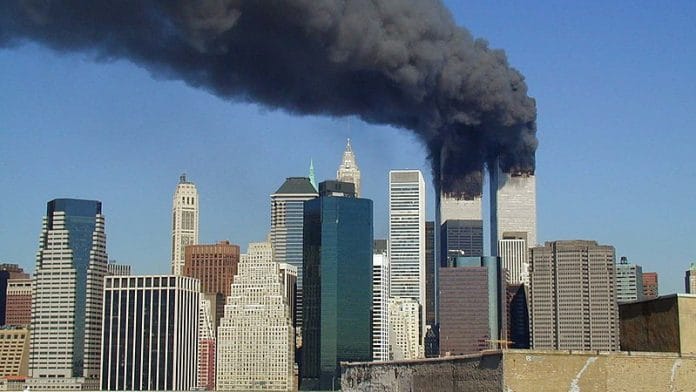
The slow-paced news cycle got flipped around when images of the World Trade Center towers collapsing in New York started pouring in.
The coordinated attacks by al-Qaeda hijackers — which involved two flights crashing into the Twin Towers, one flight into the Pentagon, and a fourth plane going down in Pennsylvania — killed nearly 3,000 people. The 9/11 attacks were seen as the biggest terrorist attack in the United States.
In the days leading up to the attacks, India was grappling with its own security challenges.
The government under Atal Bihari Vajpayee was still navigating the fallout from the failed Agra Summit with Pakistani President Pervez Musharraf in July 2001. The news of cross-border terrorism in Jammu and Kashmir was persistent in headlines. Economic concerns over a global slowdown were also featured.
However, most Indians went about their routines under the late-monsoon haze typical of early September.
News of the attacks reached India in the evening, at approximately 6:16 pm IST. By 6:33 pm, when the second plane hit the South Tower, it had become clear that it was a coordinated terrorist attack
The same evening, Vajpayee convened an emergency meeting of the Cabinet Committee on Security at his residence, attended by External Affairs and Defence Minister Jaswant Singh, Home Minister LK Advani, the three Chiefs of Staff, and intelligence heads.
“The present is the moment for all mankind to condemn, in unequivocal terms, this dastardly crime, for the victims are all innocents, and this crime of terrorism is against all humanity,” Singh said in a statement after. “India offers to the United States its deepest sympathy.”
He further ordered heightened security around American embassies, consulates, and other installations across the country. State police forces, especially in Delhi, were put on high alert.
Vajpayee also wrote a letter to George W Bush, condemning the terrorist attacks and expressing solidarity with the United States.
“Mr. President, I am confident that you and the American people will find the strength and resilience to overcome this tragedy,” he wrote. “We stand ready to cooperate with you in the investigations into this crime and to strengthen our partnership in leading international efforts to ensure that terrorism never succeeds again.”
President KR Narayanan, too, sent a message of condolence to President Bush, calling the attacks “a crime not just against the United States, but against all humanity.”
Also read: 9/11 reshaped America’s view of Muslims. 25 years later, Pew finds bias remains
Diplomacy and panic
Across Indian cities, people crowded around television sets and cybercafés to check on their relatives abroad. The Times of India reported that some cybercafés saw a 25 to 50 per cent increase in customers. Television viewers abandoned regular programmes to watch CNN, BBC, Star News, Aaj Tak, and Doordarshan.
The Ministry of External Affairs estimated that more than 107 Indian nationals and many more of Indian origin were missing and presumed dead, with 77 admitted in local hospitals. Many Indians worked in finance and technology at the World Trade Center.
On 14 September, three days after the attacks, Vajpayee delivered a formal address to the nation. He described the strikes as another blow against humanity and the civilised way of life, recalling that India had long warned the world about the global reach of terrorism.
“For years we in India have been alerting others to the fact that terrorism is a scourge for all of humanity, that what happens in Mumbai one day is bound to happen elsewhere tomorrow,” he said. “The poison that propels mercenaries and terrorists to kill and maim in Jammu and Kashmir will impel the same sort to blow up people elsewhere.”
Linking the tragedy to India’s experience, he noted that over 53,000 Indian families had already suffered from terrorist violence over two decades.
In the same period, the Cabinet Committee on Security decided to offer the United States full cooperation and facilities for any military operation. External Affairs Minister Jaswant Singh confirmed that Delhi would provide logistical help or act as a staging ground for a US military strike.
“There have been contacts at all political, executive and operational levels about this,” Singh was quoted as saying by BBC.
At a press conference at the White House in November 2001, Vajpayee confirmed complete support.
“This terrible tragedy has created the opportunity to fashion a determined global response to terrorism in all its forms and manifestations, wherever it exists and under whatever name,” he said. “I assured President Bush of India’s complete support in this.”
He added that the fight does not target any particular religion.
“At the same time, as material leaders, pluralist democracies, we should clearly spread the message that the war against terrorism is not against any religion, but against terrorists whose propaganda misuses religion,” he said.
(Edited by Aamaan Alam Khan)