



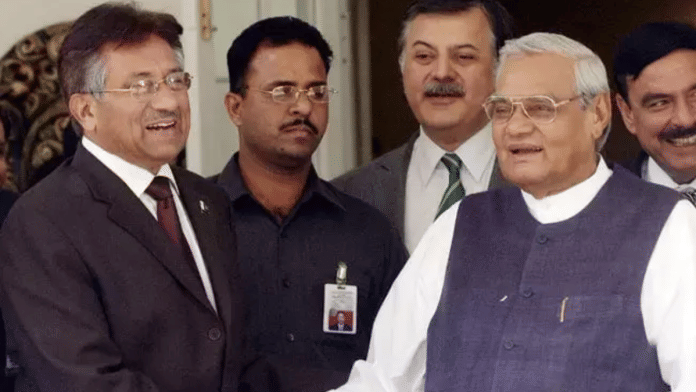
Agra, a town in western Uttar Pradesh famous for the Taj Mahal, was designated the venue for the summit. Elections to the legislative assembly of India’s most populous state were expected in a few months and the idea to showcase the state as a venue for global diplomacy had been proposed by the prime minister’s politically-savvy media adviser, Ashok Tandon. I was packed off with security teams to recce the Agra hotels, including the new Oberoi property, where the Taj Mahal could provide a backdrop to the talks.
Musharraf landed in Agra in July 2001 after promoting himself as president of Pakistan, throwing out then President Rafiq Tarar, a Nawaz Sharif acolyte. Musharraf was coming on an official visit and needed to claim protocol equivalence with his host, India’s president and veteran diplomat, K. R. Narayanan; else, he would not receive the guard of honour.
The media wanted the summit to play out like a high-octane cricket match, with a huge appetite for a ball-by-ball telecast. Private TV channels had started in India a decade earlier and were then seeing a mushrooming of round the clock news channels hungry for content. The first televised foreign policy show was to unfold after the first television war of Kargil and the first televised communal riots in Gujarat that were to follow. It was television that was to prove the undoing of Musharraf’s diplomatic foray.
In Vajpayee’s PMO, the media coverage of the visit was a hot topic. Media adviser Ashok Tandon was making the case for hourly briefings in Agra. Foreign Minister Jaswant Singh was sceptical of a ‘media circus’, and suggested a traditional diplomatic format—such as the ones that were in place for summits in Tashkent or Simla or Camp David—with leaders emerging with smiles and handshakes to release a brief outcome document in stilted prose. But India–Pakistan relations in the twenty-first century were a different game, and round the clock TV demanded round the clock briefings, on minutiae if not on substance. Jaswant Singh later felt the media pinch of a failed summit, but became its greatest explainer.
The question playing in Vajpayee’s mind, and before the diplomats, was whether Agra could become the peace conference that transmogrified the bitterness, humiliation, and tragic loss of lives of Kargil, just like Tashkent was for the 1965 war and Simla for 1971. Could something come out of talking with the new dictator?
Apart from the formal conversations with prepared statements in the delegation-level talks, the bulk of the diplomacy took place at the apex level, with Vajpayee and Musharraf in conversation, with only their notetakers present. The entire Cabinet Committee on Security, including Advani and Jaswant Singh, waited in anterooms along with officials, as the two principals met in a banquet hall improvised as a room for summitry at the Jaypee Palace Hotel, Agra.
Towards the end of the delegation-level talks, Musharraf launched into an exposition of his plans to bring grassroots democracy to Pakistan and garrulously explained how important this was. In a break before the official lunch began, I walked up to Principal Secretary Brajesh Mishra and said that I hoped everyone got the irony of Pakistan’s dictator explaining democracy to India’s cabinet. Mishra laughed and said I should present my view to the cabinet myself. We walked to where Vajpayee, Advani, and other cabinet members were seated, and Mishra said to Vajpayee that his private secretary had an important observation to share. I did repeat my take to the prime minister and his cabinet colleagues. Vajpayee chuckled. He was letting Musharraf do most of the talking, he wanted to read the man.
On the second day of the summit, Musharraf met with editors of major newspapers and TV networks for a breakfast conversation. The event was filmed by NDTV, with an apparent understanding with the Pakistani embassy that the event was not to be telecast. NDTV however soon decided to telecast the entire conversation. Musharraf had let loose his hawkish position on Kashmir and equated terrorists with freedom fighters. This public telecast sounded to observers like a mid-summit report on the talks, where Pakistan’s hard views were being inflicted on India, while India’s positions were unclear.
In our makeshift PMO at the hotel, Brajesh Mishra and I watched the proceedings with dismay. Mishra turned to me and said that the PM needed to be informed of this development, since he was sitting in conversation with Musharraf oblivious to everything happening outside the meeting room. Mishra scribbled a few lines. I had them quickly typed up, adding a couple of sentences of my own. The note basically said that a press conference by Musharraf was being telecast, where he had repeated his hardline positions, harping on the Kashmir issue and had talked of terrorists as freedom fighters. It fell upon me to walk into the room where the two principals and the two notetakers were sitting. My arrival interrupted the conversation as both leaders looked up. Musharraf had been talking and Vajpayee was listening, apparently with great interest. I handed over the paper to the boss and said that there had been some important developments. After I left the room, Vajpayee looked at the paper and then read out from it to Musharraf, saying edgily that his behaviour was not helping the talks. India Today reported that the summit went downhill from the point I had handed over the note to the prime minister11; I was playfully accused by some colleagues of torpedoing the Agra initiative.
Advani was quite aware of the slant in the media reporting, making him the villain of the piece. The simplistic narrative emerging from the meetings, fuelled by Pakistani leaks, was that while Vajpayee and Jaswant Singh were for an understanding and OK with Pakistan’s convoluted draft of the Agra joint statement (linking progress in bilateral ties to forward movement on the Kashmir issue), Advani the hawk had vetoed it since he did not want any progress with Pakistan. Later Pakistani writings tend to highlight the almost agreed upon draft.
The reality was different. Jaswant Singh walked in to Vajpayee’s hotel suite to show him the paper he had negotiated with his counterpart, Sattar. Vajpayee asked his other cabinet colleagues to come to the suite. Brajesh Mishra was already present. Pakistan’s initial formulations linking a Kashmir settlement to other bilateral matters had been diluted, but the first operative paragraph still referred to ‘progress towards settlement of (the) Jammu and Kashmir issue.’ The draft ended with calling for addressing all issues ‘in an integrated manner.’13 The draft also asked for a sustained dialogue at the political level on terrorism, but made no promises of Pakistan curtailing it.14 While the overall formulations seemed innocent enough, the draft was sending a political message that India was letting Musharraf get away lightly on the terrorism issue. Several red flags went up in the room.
Jaswant Singh recalled that the ‘collective view expressed there was that without sufficient and clear emphasis on terrorism, also accepting categorically that it must cease, how could there be any significant movement on issues that are of concern or are a priority only to Pakistan? And none that are in the hierarchy of priorities for India? How can we abandon Shimla or Lahore? Or forget the reality of Kargil? I went back and reported failure to Sattar.’15 As Jaswant Singh walked out of the room, Advani sighed and said, in English, that he would now be the ‘fall guy’.
Musharraf asked for a last meeting with Vajpayee to see if he could save the failing summit. To Vajpayee, this move had echoes of Bhutto’s gambit in Simla in 1972, when he had asked for a last call on Indira Gandhi, at a time when the Simla Agreement was deadlocked. Bhutto had pleaded with Gandhi and persuaded her that he would not survive if he did not carry back an agreement. Musharraf famously claimed that he bluntly told Vajpayee that there seemed to be ‘someone above the two of us who had power to overrule us’. But Vajpayee ‘just sat there speechless’.13 Vajpayee had in fact let Musharraf speak and refused to cave in to the dictator’s pleas. He then gently said it was too late to retrieve the situation. The meeting ended on that note. When Vajpayee walked out grimly, Advani joked he was going to send someone to check ‘kya guppen lada rahen hain (what the tittle-tattle was all about).’ Vajpayee would refer to this remark when he spoke later in parliament. Jaswant Singh, who was also waiting for the meeting to end, later recalled, ‘I knew that a mistake was being made by our guest, for when I later asked Vajpayee what had happened, he said quietly, “nothing”. He said it in Hindi, in effect to mean, “the visiting general sahib kept talking and I kept listening”. This is an art at which Vajpayee, so often and so disconcertingly to the unfamiliar, specialises.’
Musharraf’s overreach in terms of publicly broadcasting hawkish positions on Kashmir—and his insistence on a formulation linking progress on all issues with progress on Kashmir—had led to the unravelling of the summit. Another factor was that both countries attempted to summit a mountain with little planning or even Sherpas to help them. Negotiating a joint statement at the level of the prime minister and foreign minister was not the smartest choice by Pakistan. There had been little diplomatic bargaining, no backchannel dialogue, and limited diplomatic attempts to choreograph the summit’s outcomes to bridge the vast chasm in the two positions on Kashmir and terrorism.
The night of Musharraf’s sudden departure saw some tense moments in the Indian camp. Global media, including Pakistani journalists, were awaiting India’s position on the collapse of the talks and Musharraf’s premature departure. The new external affairs spokesperson, Nirupama Rao, stepped up to ask Jaswant Singh if he would address the media. Singh said that he would not, but added dramatically in his baritone that she should make an appearance in the media room with the message: ‘The caravan has left but was yet to reach its destination.’18 Rao went in past midnight to battle a roomful of journalists baying for information. She had to go on with this woefully inadequate brief, just that Urdu phrase rendered into English about a travelling caravan. She announced that the longer press conference would be held the next day at ‘a level above’ hers since the leaders had not decided on this issue. The waiting media howled in protest. Rao was even jostled and heckled by Pakistani journalists. The next day, Vajpayee asked Jaswant Singh to handle the press conference, nixing Singh’s gentle suggestion that Advani do it instead.
Jaswant Singh was in command of the 17 July press conference, where he repeated his analogy of the departing caravan and wordily countered the suggestion that India had not shared details with the media:
India does not believe that discussions or negotiations between two heads of government are ever or can ever be conducted in public or through the press. We abided by that impeccably. However, when we found that there was a kind of approach from the other side of engaging with the media as an additionality … it was found necessary that for the sake of the public of India the essence of what Prime Minister Vajpayee had emphasized and said be made also known to everybody.
India had officially released Vajpayee’s formal opening statement at the delegation-level talks. Singh focused on themes of cross-border infiltration and firing at the LoC, as also India’s attempt to take forward the ‘peace process’ of November 2000. He deftly parried some aggressive questions, and refused to call the summit a failure.
Since the talks seemed to have collapsed because of the divergence of views in the draft joint statement, I felt then that we could easily have brought into play the blander version, which would not mention the ‘K-word’ and simply say that Pakistan’s president came for talks and these would continue. But it was also true that if terrorism had continued in subsequent years despite the joint statement, Musharraf’s Agra visit would have felt like another betrayal. A few months later, I raised this issue in a dining table conversation with Vajpayee and Brajesh Mishra: if India had gone with a bland text to declare the summit a success and then cross-border terrorism had continued, would we not have appeared even more gullible than we did when the summit was declared a failure? Mishra agreed that would have been a worse outcome. Would Musharraf have then put a lid on cross-border terrorists? More likely, Agra would become another Lahore, where risen hope had been dashed by Kargil. Still, the invitation to Musharraf served a purpose, Vajpayee did manage to read Pakistan’s loquacious dictator, and this experience would help him evolve his Pakistan policy over the next three years. The summit did not succeed, but diplomacy had worked. It had worked for both countries.
 This excerpt from ‘Anger Management: The Troubled Diplomatic Relationship between India and Pakistan’ by Ajay Bisaria has been published with permission from Aleph Book Company.