




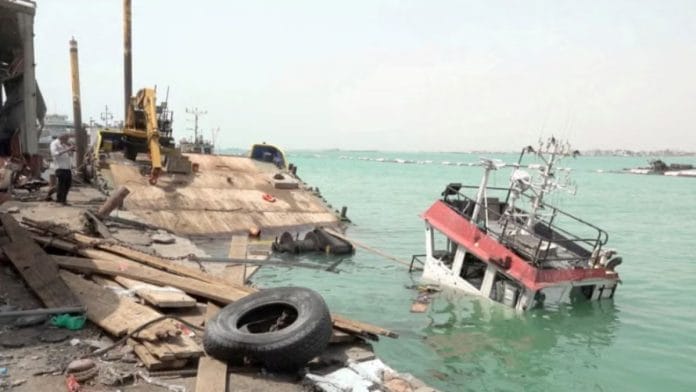

Iran-backed Houthis have continued to attack Saudi Arabia’s southern cities since 8 September, attracting regional responses condemning the attacks. Neighbouring Bahrain, Kuwait, Qatar, the United Arab Emirates, Oman, Egypt, Jordan, Yemen, Lebanon, Sudan, and Syria, Türkiye, India, and Pakistan, as well as key European partners— France, Spain, Germany and the United Kingdom—have expressed anguish.
Interestingly, the US has not issued a substantial response on whether it will become directly involved. Perhaps Washington, DC, is not willing to open another front amid ongoing conflict with Iran.
Meanwhile, Saudi Arabia has responded with airstrikes on Houthi strongholds in the Red Sea. What is actually more surprising is the response of countries like Pakistan, which, first, is a regional ally of Saudi Arabia and relies on Saudi assistance and remittances, and, second, more importantly, a signatory to the much-talked-about Mecca Pact, signed by Saudi Arabia, Turkiye, and Pakistan on 7 August 2026. The pact is projected to be the most consequential ‘security’ alliance, though its details remain under wraps. However, the backdrop of crisis in the Middle East and the individual capacities of each member country—Saudi’s economic power, Türkiye’s military might, and Pakistan’s Nuclear capability —were supposed to provide the strongest “deterrence against any aggression.”
But has the Mecca Pact passed its crucial test with crisis at hand, where Saudi Arabia is being attacked, or was it all words?
Pakistan says not a defence alliance, but why?
Soon after the Houthi attacks, questions were raised about whether the Mecca Pact will come into action and whether Pakistan and Türkiye would get involved as a collective front.
Within 48 hours, Islamabad has reportedly responded, “There is no such thing under discussion right now…When the time comes, we will act under the agreement.”
This may have disappointed optimists of the Mecca Pact, but for Delhi, it was not surprising. Also, this may not be the bluntest or most final response from Islamabad or Rawalpindi, yet it is more conclusive in many ways—at least it stops the media buzz.
But one wonders whether Saudi Arabia would have signed a pact, or, to say, the so-called military pact—the Mecca Pact—involving Pakistan, knowing the latter shares an active border with India and that Delhi is among Riyadh’s key trading partners, with total bilateral trade crossing $41 billion in 2024-25? No, because Delhi offers a strong economic partnership, with investments and oil trade being the cardinal factors, and Riyadh would do its strategic calculations before joining something that may seem counterproductive to its relationship with India.
Moreover, if the pact was to be viewed through the Islamic unity angle, then fighting a common enemy—Iran—also fit within the Islamic binaries. The sharp contradictions within the so-called “Mecca Pact” make it less tested and wordier, and Riyadh may have known its limits.
Meanwhile, in August, if there was one regional news story on the security front that took over Indian media in Delhi, it was the Mecca Pact. Key questions in newsrooms were: was it an alliance against India, with Pakistan and Türkiye as key members; was it a military alliance; were there elements of collective security like the North Atlantic Treaty Organisation (NATO). Some went even as far as concluding the Mecca Pact had clauses like Article 5 of NATO, discussing “collective defence”, which in its entire NATO history was invoked just once in the aftermath of the September 11 attacks on the United States.
On the face of such queries, Pakistan led the answering part through a press release on the pact titled, “Makkah Al-Mukarramah Summit for Joint Defence”, adding, “The Agreement is intended to strengthen collective deterrence against any act of aggression, and stipulates that any armed attack against any one of the three States shall be regarded as an attack against them all.”
The statement was followed up with added information that the pact “further provides for the enhancement of all aspects of defence cooperation among the three States.”
No doubt, Delhi had its worries, and the spokesperson of India’s Ministry of External Affairs (MEA) at a press conference on 11 August stated, “We are examining its implications both from the perspective of our national security, as also considerations of regional peace and stability and India, we remain fully committed to safeguarding our national interest and taking any step that may be required in that direction.” But India seems to have left it there—or perhaps not.
But, at least Delhi knows one thing clearly: if Pakistan is projected as the strongest pillar, precisely because of its nuclear capability, it is also the most unreliable and unstable, given the challenges Islamabad has faced within and the confusion it creates around its affairs with the United States and China.
Also read: America is still following a script written by terrorists in 9/11
Bangladesh still interested?
Bangladesh was among the first few countries to condemn the Houthis for attacking Saudi Arabia. Dhaka, in a statement on 8 September—the first day of attacks—stated: “Bangladesh expresses its full solidarity with the Government and the brotherly people of the Kingdom…Bangladesh reaffirms its unwavering support for the sovereignty, territorial integrity and security of the Kingdom of Saudi Arabia.”
Did Dhaka make this statement keeping its reported “Mecca Pact” ambitions in mind? Well, Bangladesh has not made an official statement on the Mecca Pact, so park it there for a moment. At the outset, Bangladesh clearly sees Saudi Arabia as a key economic partner, with remittances from the Bangladeshi diaspora forming the strongest link. Prime Minister Tarique Rahman has received an invitation from Saudi Crown Prince and Prime Minister Mohammed bin Salman to visit Riyadh, but the visit remains under discussion and may not be the right time given the conflict in the region.
Back to the Mecca Pact, Dhaka would need strong reasons to be in a grouping which has historical rivals like Pakistan—a country that Bangladesh liberated itself from in 1971.
However, can Dhaka’s deteriorating ties with Delhi be treated as a reason for Bangladesh to join the Mecca Pact? Many in Islamabad would agree, as Pakistan pitches itself as a trusted Islamic world partner to Dhaka. Least to suggest, even if the political leadership in Dhaka forges a super unique deepest military alliance with Islamabad, the people of Bangladesh would still see Pakistan through the prism of the 1971 Liberation War and the brutalities that the Pakistani Army carried out on the people of erstwhile East Pakistan.
The trust deficit between Dhaka and Islamabad is historic, proven, and has endured for seven decades; anything that suggests otherwise must be backed by common interest and, if India were to be one, Dhaka has multiple factors to consider—top ones being shared culture, societies, and economic engagement.
To conclude, the Mecca Pact is an alliance among unequals—lacking common ground for threat formulation, ethnically very diverse, lacking economic parity among members, and with each member having different versions of Islam, contrary to Islamic unity. Therefore, Pakistan’s silence on treating Houthi attacks on Saudi Arabia as a threat against all three pact members must be seen as a wider reality of such alliances.
Conversely, the buzz around Bangladesh joining it must be grounded in sound reasoning. But if Dhaka were to join the Mecca Pact, it would be mainly for validation and internal political messaging, as Rahman’s government faces strong resistance in parliament from the 11-party opposition led by Jamaat-e-Islami over July Charter reforms.
Rishi Gupta is a commentator on global strategic affairs. The opinions expressed in this article are those of the author alone and do not reflect the views of the author’s current or past affiliations in any form.
(Edited by Ratan Priya)