




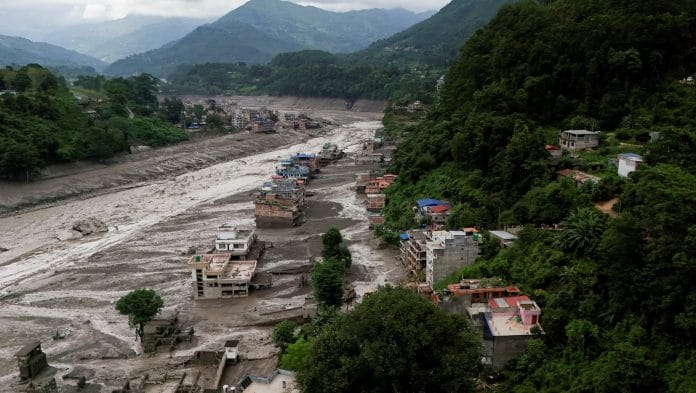

New Delhi: On 26 August, Nepal woke up to one of the most devastating floods in its recent history. By Friday, the death toll had climbed to at least 547, with around 1,500 people still missing, including 290 Indian tourists.
According to the latest satellite imagery, the tragedy originated beyond Nepal’s borders. High in the upper reaches of the Himalayas near the Nepal-Tibet border, a massive section of a glacier broke apart and plunged 1,200 metres into the valley below from a starting altitude of 5,200 metres.
Satellite images captured by ISRO’s National Remote Sensing Centre showed that about two-thirds of the glacier collapsed, triggering a colossal avalanche of ice, rock, and debris as it roared down the mountainside. The sheer force of the impact was so immense that, in the initial hours of the disaster, the US Geological Survey mistakenly attributed the resulting shockwaves to a magnitude 4.4 earthquake.
It was later revealed that the glacier had slammed into the valley floor with such force that it generated “earthquake-like” seismic energy equivalent to a magnitude 5.2 event.
For Nepal, the worst is far from over. The coming days will severely test the country’s early warning systems, disaster response capabilities, healthcare infrastructure, and, above all, community resilience.
Yet, this disaster may just be the harbinger of a far greater crisis unfolding across the wider Himalayan region, one that will not stop at Nepal’s borders. As temperatures rise, glaciers melt, and rivers swell far beyond their carrying capacities, this devastation is poised to become the new normal for the Himalayas.
Despite the looming threat, governments remain ill-prepared for this eventuality. The enormity of the catastrophe, the structural factors that triggered it, and the critical lapses in early warning and forecast communications are why the Nepal floods are ThePrint Newsmaker of the Week.
Also read: Nepal’s Rasuwa floods were triggered by a glacial collapse, not an earthquake
How did the disaster unfold?
Just minutes after the first reports of floods hitting Tibet and Nepal, horrifying visuals of houses, bridges, and roads being washed away started doing the rounds. Panicked local residents were seen gaping in awe at the swelling river one moment, and running to save their lives the next.
Satellite images show that days before the floodwaters reached the doorsteps of Rasuwa district—the worst hit by the deluge—the disaster was already brewing hundreds of kilometres away, beyond the reaches of human habitation.
“So far, the evidence indicates that an avalanche above Syabrubesi blocked the river and the flood followed,” said Sarthak Shrestha, a remote sensing and geoinformation associate at the International Centre for Integrated Mountain Development (ICIMOD).
While the final assessment of what exactly transpired is yet to be released, the initial understanding is that after the glacier collapse, a torrent of rocks, ice, and debris charged through the valley before crashing into the Lhende Khola—a tributary feeding the Bhote Koshi river. The accumulated debris and rocks created a temporary landslide dam, trapping water behind an unstable wall. When this natural dam breached, the pent-up water gushed downstream with immense force, destroying everything in its path.
A statement issued on Thursday by ICIMOD, a regional intergovernmental learning and knowledge-sharing centre, noted that water levels on the Trishuli River at Galchhi reportedly rose by as much as nine metres within 30 minutes, while levels at Malekhu increased by seven metres over a similar `.
“Several water monitoring stations along the Trishuli River were reportedly damaged or washed away during the event, although the Galchchi monitoring station remains operational,” the statement added.
Arjun Remal, an eyewitness whom ThePrint spoke to in Nepal, said he was working on a bridge in Rasuwa when his phone buzzed with an emergency alert from the National Disaster Risk Reduction and Management Authority (NDRRMA).
“It was so sudden that we didn’t even have time to process (what was happening),” Remal said.
Also read: An SMS alert gave workers in flood-hit Rasuwa 30 seconds to run—‘Water was rushing in’
Climate change and lapse in early warning system
The Nepal disaster is proof of how climate change-induced events are becoming both more frequent and more violent. It also underscores the urgent need for robust early warning systems and transboundary coordination between nations when managing natural disasters.
Across the Hindu Kush-Himalayan region, the need for proactive disaster preparedness is more palpable than ever. A research paper published earlier this year by scientists from the Indian Institute of Science (IISc), IIT Bhubaneswar, and the Defence Geoinformatics Research Establishment highlighted how a rapidly shifting climate has structurally weakened Himalayan glaciers. This has led to the formation of unstable blocks of ice hanging from steep cliffs—known as hanging glaciers—that are ready to collapse.
Another report by ICIMOD warned that glaciers in the Hindu Kush Himalayas are shrinking at a much faster rate than previously estimated. The study revealed that the region lost 12 per cent of its total glacier area and 9 per cent of its ice volume between 1990 and 2020.
Despite these blaring warnings, the response from most nations sharing these young mountains remains reactive rather than proactive. Even after several catastrophic natural disasters over the past decade, Nepal has yet to develop a comprehensive early warning system capable of issuing advanced forecasts before a crisis catches communities off guard.
In fact, during the current floods, multiple voices within Nepal, including journalists and former ministers, alleged that China did not provide timely downstream warnings to the Nepalese government.
On Friday, however, a fresh alert was sounded regarding a new barrier lake forming along the Tibet-Nepal border, which could potentially breach in the coming days and trigger another catastrophe. Crucially, this time, the advisory was issued before it was too late.
Future preparedness
The Nepal floods are a cruel reminder that the climate crisis is not a distant threat of the future. The unprecedented warming of the Himalayas and the accelerated melting of its glaciers will only increase the risk of such disasters in the coming years.
Furthermore, unplanned development along vulnerable floodplains, combined with the lack of functional cross-border disaster mitigation plans, will inevitably lead to higher casualties. The 2023 Glacial Lake Outburst Flood (GLOF) in India’s Sikkim, the 2021 Chamoli disaster, and the 2025 flash floods in Dharali were all trailers to the far grimmer picture that awaits the region.
Nepal will undoubtedly rebuild and rise from these floods, just as it has from over a dozen such calamities in the past. Yet, the critical question remains: will this latest disaster finally spark meaningful, systemic change, or will it simply become another forgotten tragedy in the long and growing list of Himalayan catastrophes?
(Edited by Prashant Dixit)
Wouldn’t restoration of SAARC help.