





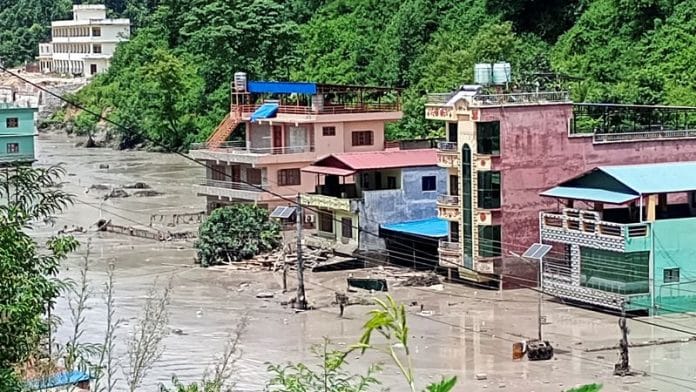

Kathmandu: Hours after flash floods in the Bhote Koshi river devastated Nepal’s Rasuwa district, authorities said an ice-rock avalanche may have triggered the disaster, according to an initial assessment by Nepal’s National Disaster Risk Reduction and Management Authority (NDRRMA).
The NDRRMA shared the first satellite images of the Rasuwa region and the Bhote Koshi river, a tributary of the Trishuli, after the incident. It said an initial study indicated that a glacial-related flood had occurred in the Lhende river following a snow-rock landslide, approximately 20 km north of the Nepal-China Rasuwagadhi crossing.
The Lhende is a tributary of the Bhote Koshi, originating in Tibet’s Gyirong County. It enters Nepal at Rasuwa, where the flooding occurred. The Lhende and Kyirong Tsangpo rivers meet in Rasuwa to form the Trishuli, which flows through central Nepal, including Nuwakot, Gorkha and Chitwan districts, passing close to Kathmandu but not through the capital.
The Trishuli eventually joins the Narayani at Devghat. The Narayani then enters India through Bihar as the Gandak river. Together with the Kosi, another river originating in the Nepal Himalayas, it drains into the Ganga in Bihar.
A Glacial Lake Outburst Flood (GLOF) was initially suspected as the cause of the flooding, given the glacial origins of the Lhende and Nepal’s high exposure to GLOF events. However, scientists from the International Centre for Integrated Mountain Development (ICIMOD) and the NDRRMA now believe the event may have been triggered by an ice-rock avalanche.
This could mean that a large mass of ice and rock debris, possibly originating from a glacier, fell into the Lhende upstream, generating a sudden surge of water that swept downstream towards the Rasuwa border area. Nepali and Chinese authorities are working to determine the exact cause of the avalanche. An earthquake has not been confirmed as the trigger.
The United States Geological Survey (USGS) initially reported the event as a magnitude 4.4 earthquake. However, after analysing nearby seismic stations, long-period seismic waves and satellite imagery, it revised the magnitude to 5.2 and determined that the seismic event was actually a glacial collapse and debris flow, not an earthquake.
As the river lies along the border between Nepal and China’s Tibet Autonomous Region, the suspected source of the avalanche is in Tibet, near the mountainous border region.
Satellite images shared by Planet Labs, a US-based satellite monitoring company, showed that the Bhote Koshi river in Rasuwa “quintupled” in size after the flooding, inundating surrounding areas with water and sediment deposits.
Experts from ICIMOD, a Kathmandu-based international organisation, said water levels in the Trishuli river at Galchhi, around 100 km downstream from Rasuwa, rose by 9 metres within 30 minutes. While most upstream water-monitoring systems were damaged in the floods, ICIMOD said the monitoring system at Galchhi, in Dhading district, remains operational.
The latest rescue update from the NDRRMA said 144 bodies had been recovered so far, including 64 in Chitwan district, almost 300 km downstream from Rasuwa. Around 384 travellers remain missing, according to the Nepal Tourism Board, while 245 Nepali citizens, including police and armed forces personnel, are also unaccounted for.
(Edited by Prashant Dixit)