



Throughout this year, a school teacher in a small town somewhere in India has been consistently investing a portion of her salary, several thousand rupees, in an equity fund through a systematic investment plan (SIP). During the same period, some of the world’s largest funds have been withdrawing their investments—which she may or may not be aware of.
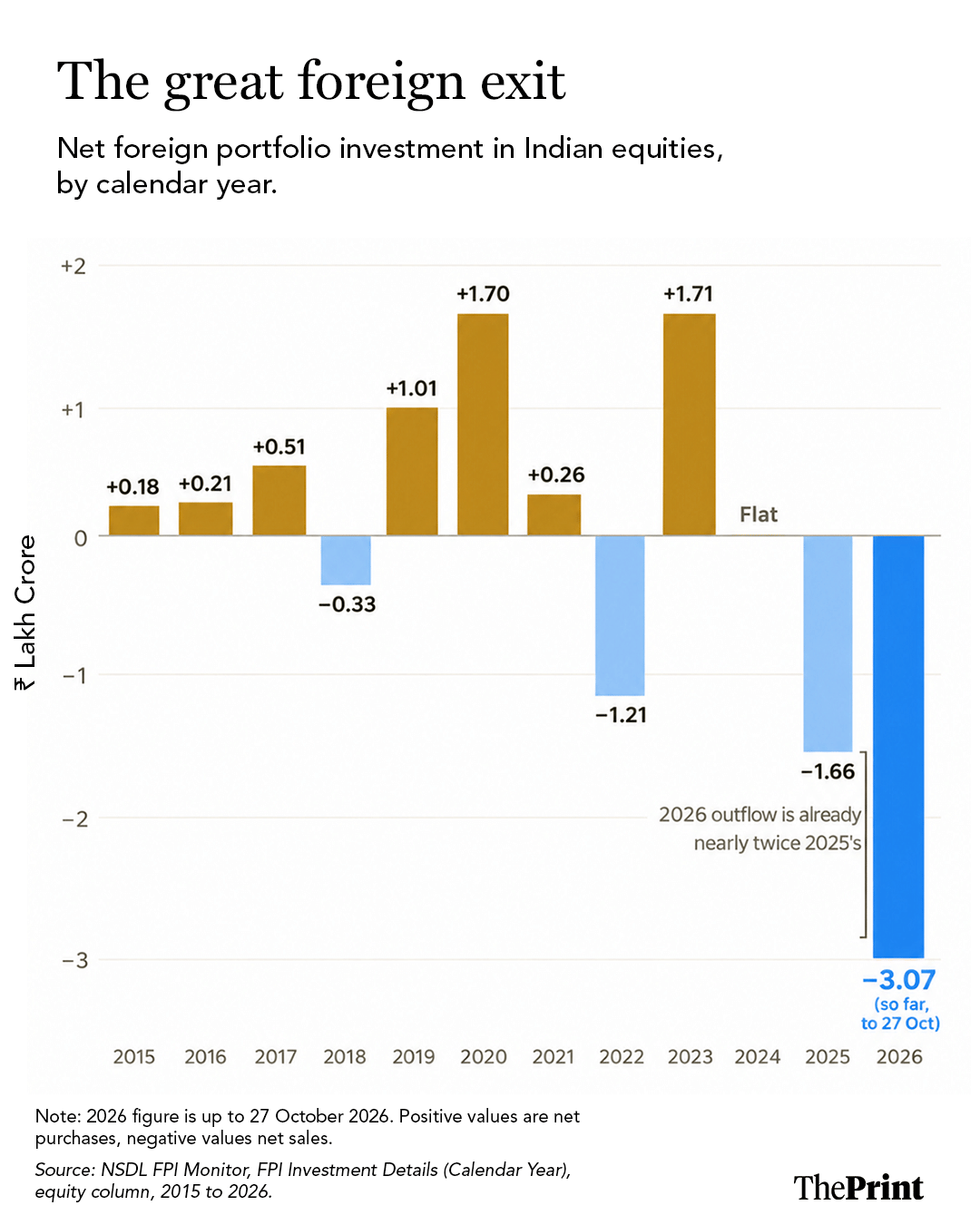
Foreign portfolio investors have divested a net Rs 3.07 lakh crore from Indian equities so far in 2026—the largest outflow in at least 12 years, and nearly double the Rs 1.66 lakh crore withdrawn in 2025. But despite a decline of about 15 percent, the Indian market has remained resilient because millions of domestic investors like her continue to buy.
This shift in investment dynamics has prompted the Indian government to shift its focus. On 13 October, Finance Minister Nirmala Sitharaman said she would seek inputs on long-term capital gains (LTCG) tax, while proceeding cautiously and recognising its potential overlap with the securities transaction tax. A 12.5 percent LTCG tax is levied in India on sale of equities by domestic and foreign investors without indexation benefits. It is applicable on profits of more than Rs 1.25 lakh per financial year on listed shares, with no such limit on sale of unlisted shares.
A decade ago, the primary concern would have been preventing the exodus of foreign capital. Today, India can consider a more strategic question: how to attract global patient capital, not out of necessity, but for the purpose of accelerating growth?
Also Read: Fast money is leaving, patient money is arriving—and RBI quietly rewrites the rules
Indian households & the ‘falling knife’
In 2026, Indian households engaged in what market experts refer to as “catching a falling knife” by investing during a significant market decline.
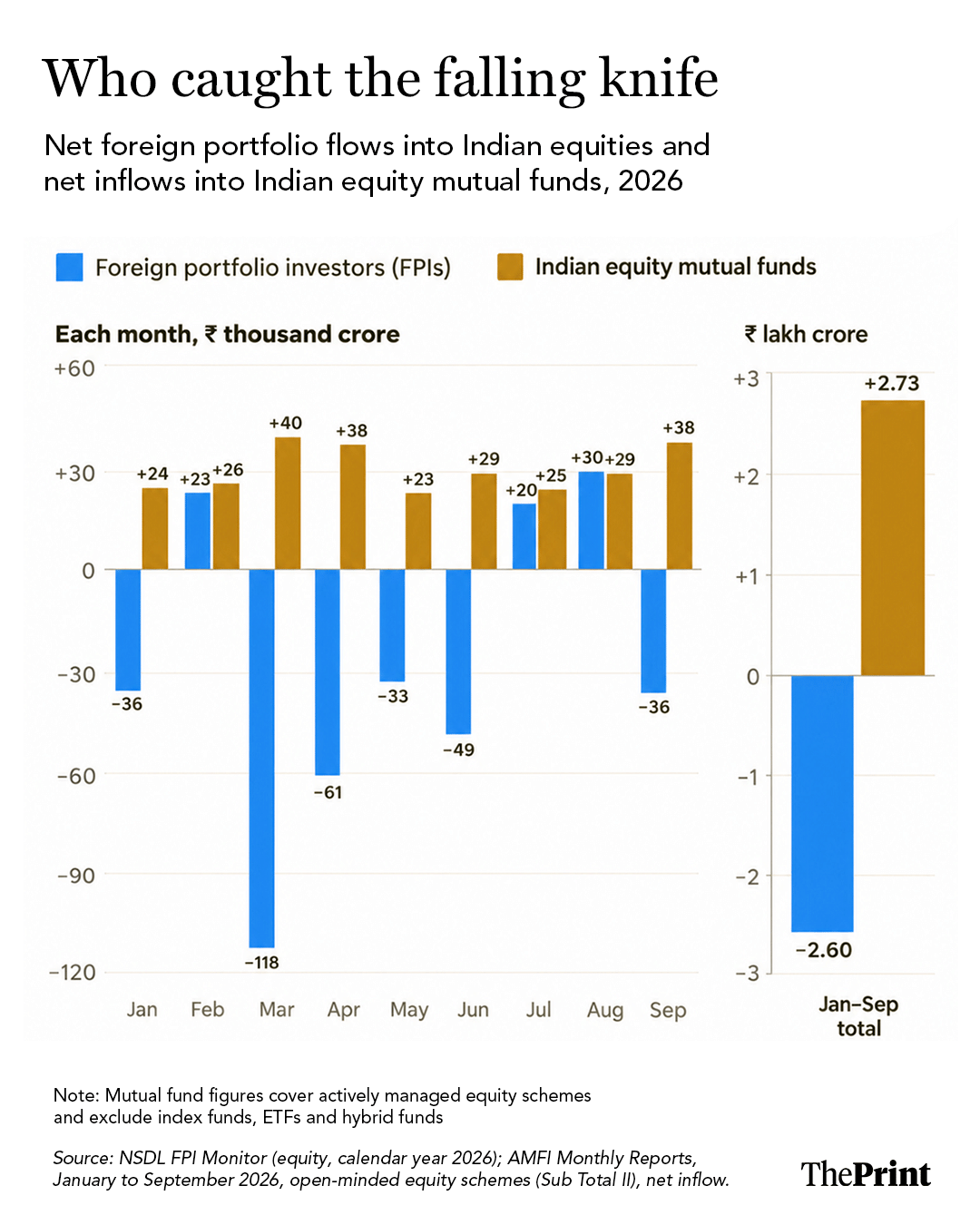
From January to September, foreign investors divested a net total of Rs 2.6 lakh crore from Indian equities. Concurrently, actively managed Indian equity mutual funds experienced an inflow of Rs 2.73 lakh crore. Notably, in March, which marked the peak of foreign investor sell-offs with Rs 1.18 lakh crore exiting the market, Indian equity funds recorded their highest monthly inflow of the year at Rs 40,450 crore.
The disparity with 2008 is notable. That year, foreign investors withdrew about $13 billion, and Sensex lost over half its value. In contrast, this year, foreign investors have withdrawn more than double that amount, yet the index has declined by only a fraction of the previous loss.
India has developed a domestic investor base robust enough to withstand a significant foreign withdrawal—a rarity among emerging markets.
The departure of foreign investors was primarily influenced by factors unrelated to India.
In 1993, Guillermo Calvo, Leonardo Leiderman and Carmen Reinhart demonstrated that capital flows into emerging economies are predominantly driven by “push factors” in developed countries, such as American interest rates and the global risk appetite, rather than domestic conditions. Two decades later, Hélène Rey of London Business School termed this phenomenon the global financial cycle.
In the current year, these push factors have acted in concert against India: the US Federal Reserve raised interest rates in September, oil prices exceeded $100 per barrel, and the dollar appreciated, drawing capital back to American assets.
In contrast, tax policy does not account for the timing of this shift. Although India increased the LTCG tax rate from 10 percent to 12.5 percent in July 2024, foreign investors did not immediately withdraw; they concluded 2024 with a modest net inflow of Rs 427 crore. The significant outflow commenced in 2025 and accelerated in 2026, coinciding with the onset of global financial instability. This global turbulence precipitated the ensuing exodus.
But while tax policies did not drive the capital outflow, they will play a crucial role when the global financial cycle reverses and international funds reassess their investment destinations. At that point, after-tax returns will be a decisive factor, and India can enhance its attractiveness by optimising its tax offerings.
Also Read: IMF’s map of a broken world has one asterisk—India
India’s capital gains tax policy vs other countries
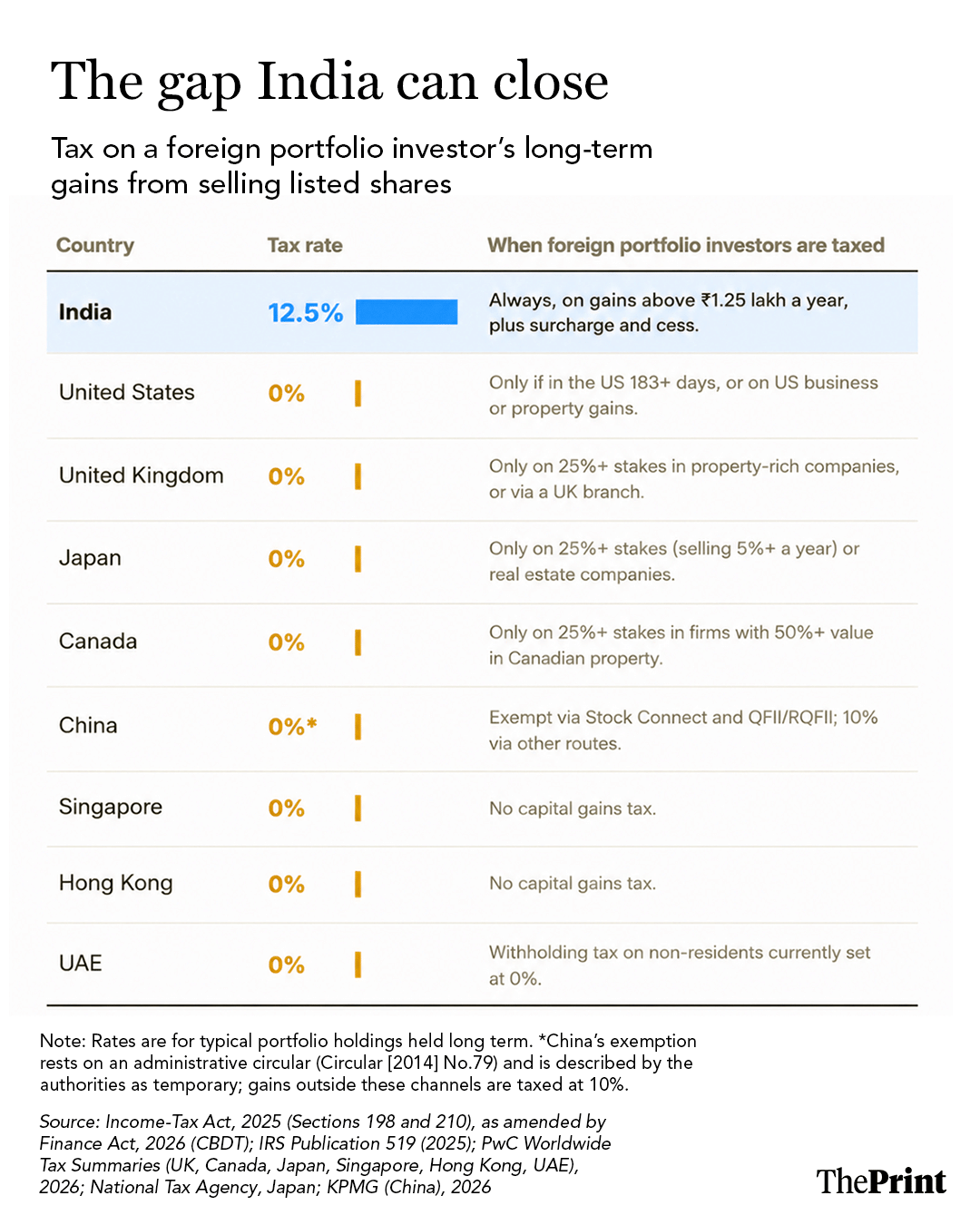
The United States imposes taxes on a foreign investor’s gains from American shares, only if they reside in the country for at least half of the year or operate a business there.
In contrast, the United Kingdom, Japan and Canada levy taxes on foreign investors solely under specific circumstances, such as when they hold substantial stakes in companies with significant property assets. Singapore and Hong Kong do not impose a capital gains tax, while the United Arab Emirates currently maintains a zero withholding tax rate for non-residents. Additionally, China provides exemptions for gains realised through Stock Connect and its authorised foreign-investor channels.
In India, a tax rate of 12.5 percent is applied to gains exceeding Rs 1.25 lakh annually, with additional surcharges and cess.
This pattern is intentional. In 1986, economist Roger Gordon demonstrated that a small open economy should generally refrain from taxing highly mobile capital at its source. This is because capital tends to demand a higher pre-tax return, thereby shifting the tax burden to immobile factors, such as labour and land.
Consequently, Japan imposes a tax exceeding 20 percent on share gains for its residents, while largely exempting foreign portfolio investors. Canada taxes only half of a resident’s gain.
India, commendably, applies the same tax treatment to both foreigners and citizens. Although this principle is equitable, it makes India one of the few major markets that tax patient global capital upon exit.
The most significant aspect, however, has largely gone unnoticed. Gains for foreign portfolio investors are calculated in rupees, and the rupee has depreciated this year from approximately Rs 90 per dollar to around Rs 95. Consider a fund that invested $100 in January, with its Indian shares valued at Rs 9,000. If these shares increased by five percent to Rs 9,450, while the rupee depreciated by the same percentage, the fund would still be valued at $100, effectively earning nothing. Nevertheless, it incurs a tax on a Rs 450 rupee “gain”, resulting in a net value of approximately $99.40. Thus, India effectively taxes foreign investors for the rupee’s depreciation, with the impact being most pronounced when India seeks to retain such investments.
A scalpel, not a sledgehammer
Abolishing LTCG tax altogether would be an expensive and indiscriminate solution. In fiscal year 2024-25, tax on equity gains generated Rs 1.29 lakh crore, up from Rs 72,249 crore the previous year. Exempting only foreign investors would undermine India’s principle of equitable treatment. A more effective approach would eliminate barriers that discourage long-term investment, while maintaining the tax base.
Firstly, taxation should focus on real gains rather than currency fluctuations. Section 72(6) of the new Income-Tax Act permits non-residents to calculate gains on certain Indian shares and debentures in the foreign currency of their investment. Extending this provision to listed equities held by foreign investors would eliminate taxes on nominal gains without affecting real gains.
Second, implement a tapering tax rate for shares held beyond three to five years to incentivise long-term investment, while ensuring short-term trading remains fully taxed.
Third, the finance minister should address the overlap, allowing investors to face a single, well-structured levy, instead of both LTCG and transaction taxes.
Fourthly, the government should commit to stability. The recent exemption of foreign investors from capital gains and withholding tax on government bonds, effective from April through a June ordinance, sets a precedent. A credible, multi-year plan for equities would be more effective than a singular tax reduction.
The significant development in 2026 is not the withdrawal of foreign capital, but India’s reduced reliance on it for economic stability. This robust position allows for policy reforms that prioritise quality over quantity, attracting capital committed for the long-term rather than short-term gains. The domestic investor, exemplified by the schoolteacher with her monthly SIP, has already demonstrated confidence in India’s prospects. A more strategic tax policy could similarly attract global long-term investments.
(Edited by Mannat Chugh)
Also Read: Dasharatha’s dilemma: What economics Nobel teaches central banks about keeping promises