



New Delhi: The International Monetary Fund’s (IMF) latest World Economic Outlook includes a key figure in its commodity special feature that captures the impact of the ongoing US-Iran conflict more effectively than any headline. In late March, as shipments through the Strait of Hormuz nearly ceased and oil prices surged to $126 per barrel, the price differential between Dubai crude, the benchmark for Gulf oil sold to Asia, and Brent, its Atlantic counterpart, widened to $54.
This disparity underscores the severe crude oil shortage in Asia, which relies heavily on Gulf supplies. Yet despite this strain, particularly for Asian oil-importing economies, the IMF raised India’s 2026-27 growth projection by 0.5 percentage points to 7 percent in its forecast published on 13 October. This was the largest upgrade among major emerging markets in the IMF’s headline table.
Same corner, different engine
Titled ‘Resilience Under Strain, Urgent Choices’, the report uses a framework built around two dimensions: a country’s position as an energy exporter or importer, and its integration into the artificial intelligence (AI) boom. Energy exporters geographically distant from conflict zones enjoy an advantage, while AI hardware hubs such as Taiwan benefit from technological advances. Energy-importing economies with limited participation in the technology value chain face the greatest challenges.
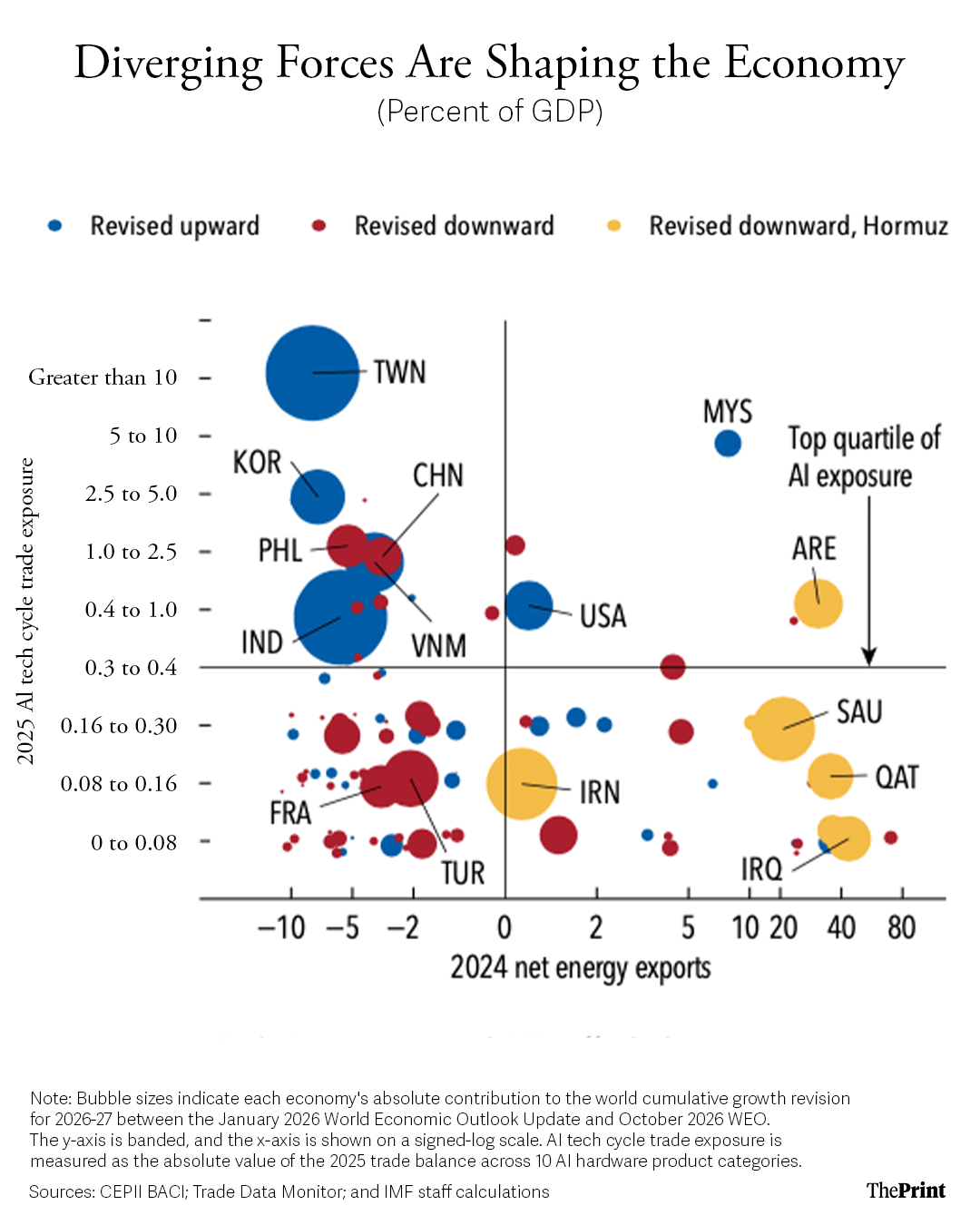
India is vulnerable on the energy front but ranks in the top quartile for AI exposure, alongside Taiwan, Korea, China and Vietnam. The similarities end there. These economies benefit from the AI cycle primarily through exports, tying them to a boom that the IMF warns “could stop abruptly” if expectations of AI profits are revised. India’s growth, by contrast, is “supported by domestic demand and services.” This reflects the home-market effect formalised by economist Paul Krugman in 1980: firms benefit from scale and tend to cluster where their largest markets are, making a substantial domestic market a springboard rather than a constraint.
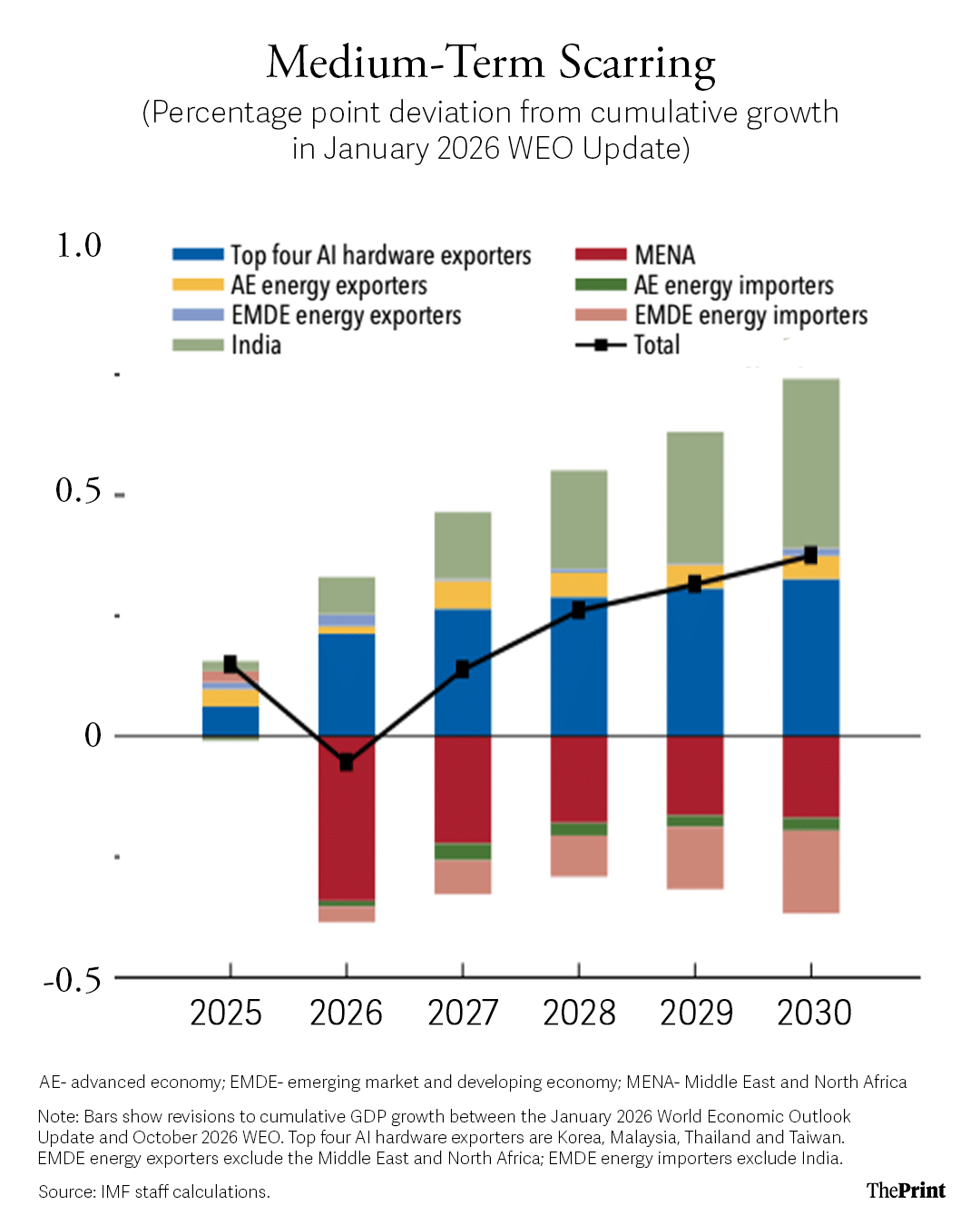
In reassessing medium-term prospects, the IMF downgraded conflict-affected economies and energy-importing emerging markets, “excluding India,” which “stands out with upward revisions.” Its chart shows the scale of this divergence: by 2030, India’s cumulative growth upgrade exceeds that of the world’s four leading AI hardware exporters combined and roughly matches the net upgrade for the global economy.
‘Not all oil shocks are alike’
The report’s most innovative, though less discussed, contribution is a new Commodity Price Tracker. It applies insights from Lutz Kilian’s influential 2009 paper, which shows that oil price shocks are not homogeneous. The tracker distinguishes between a fear premium and a physical shortage.
In January and February, rumours of a US attack on Iran pushed oil prices up by approximately 10 percent, even before supplies were disrupted, as markets priced in the risk of a shortage. The subsequent near-halt in shipments through the Strait of Hormuz turned that risk into an actual supply shock. The IMF finds that price increases caused by physical disruptions have “larger and more persistent” effects than those driven by geopolitical fears alone. Central banks should therefore assess the source of a shock before tightening policy.
This distinction leaves little room for complacency. Global reserves are being depleted at about 2.7 million barrels per day, and the IMF warns that they are approaching stress levels that “could lead to nonlinear price adjustments.”
Refined fuels have been hit harder than crude oil: prices remain 70–95 percent above prewar levels, as refinery damage has cut international supply by about one-fifth. Agriculture is also feeling the effects through fertiliser prices. Since March, phosphate prices have risen by 22.4 percent, while nitrogen fertiliser prices have fallen by 31.5 percent amid increased Chinese exports.
The 22-times lesson
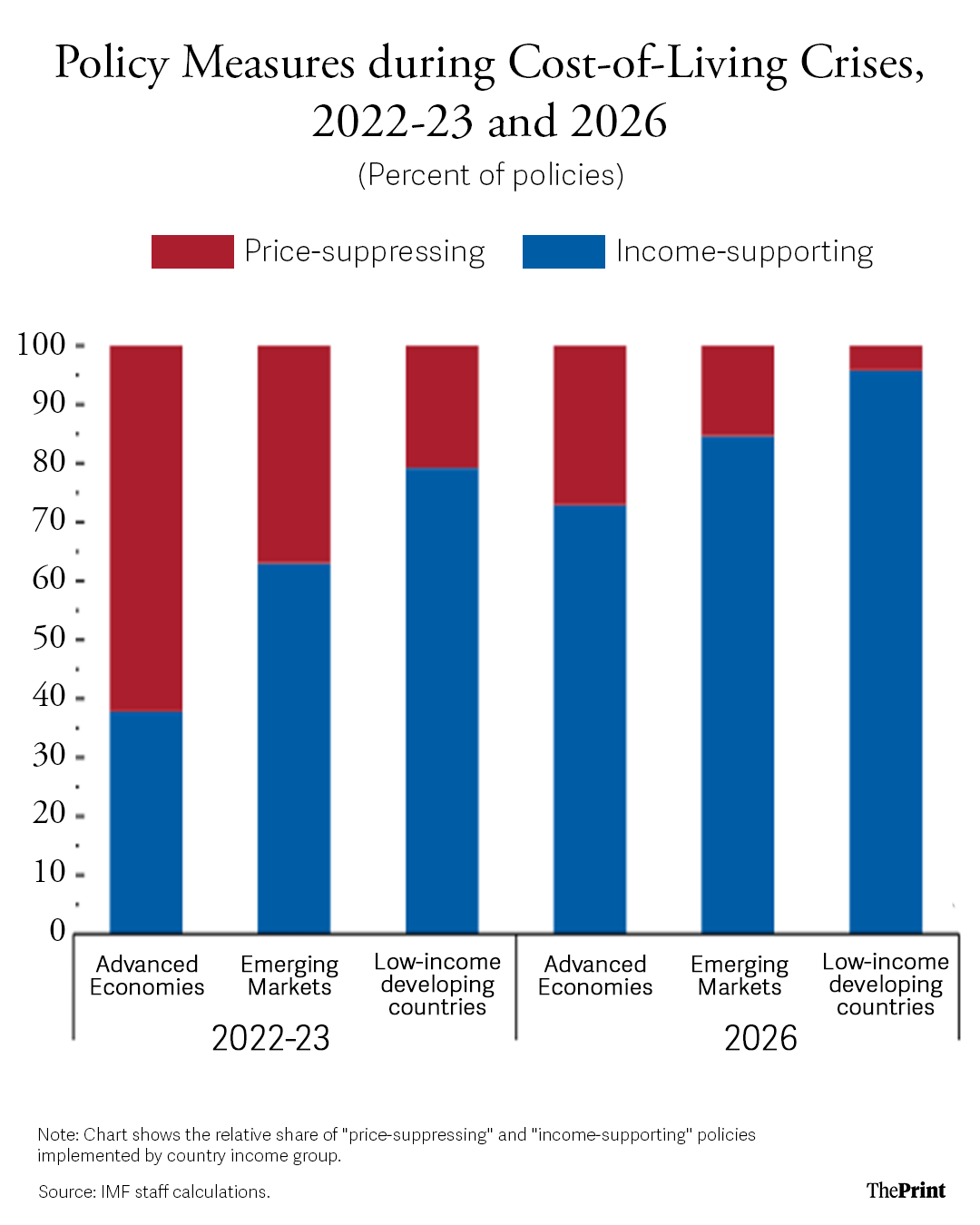
Chapter 2 of the report offers a particularly important finding for India’s response to cost-of-living pressures. According to the IMF, protecting households by suppressing prices rather than supporting incomes can cost three to 22 times more to achieve equivalent protection. Such measures also become less effective when several countries introduce subsidies simultaneously.
Yet policy responses have moved in the opposite direction. In emerging markets, price-suppressing measures rose from about three-fifths of policy responses during the 2022-23 crisis to more than four-fifths by 2026.
India, meanwhile, is in a relatively strong fiscal position. The IMF finds that stabilising public debt at 2025 levels would require more consolidation than most large economies currently plan, with India as the exception. In 1944, economist Evsey Domar showed that debt need not become an ever-increasing burden if national income continues to grow. An economy expanding at 7 percent and already stabilising its debt has the capacity that much of the world has exhausted. The challenge is to preserve that advantage. India’s direct benefit transfer system offers a way to cushion future price spikes through targeted income support rather than costly subsidies.
The IMF’s broader recommendations reinforce this approach: diversify energy sources and trade, and build reserves of fuel, food and essential inputs. India is already making progress on trade. The IMF highlights the European Union’s and the UK’s agreements with India as developments that could reduce trade barriers and bolster global activity.
Maps often divide countries into clear categories, and the IMF’s map of a fragmented world does much the same. Yet on fiscal space and medium-term growth, the IMF identifies India as an exception. This distinction is the key takeaway from the report.
In a world where the price of oil in Asia can differ by $54 from that in Europe, reserves are dwindling and price suppression can cost up to 22 times more than income support, the most limited resource is neither cheap energy nor semiconductor capacity. It is the capacity to manoeuvre and India remains among the few large economies with that advantage.
(Edited by Chingkheinganbi Mayengbam)
Also Read: Pakistan just set a reserve record. Much of it is borrowed money