



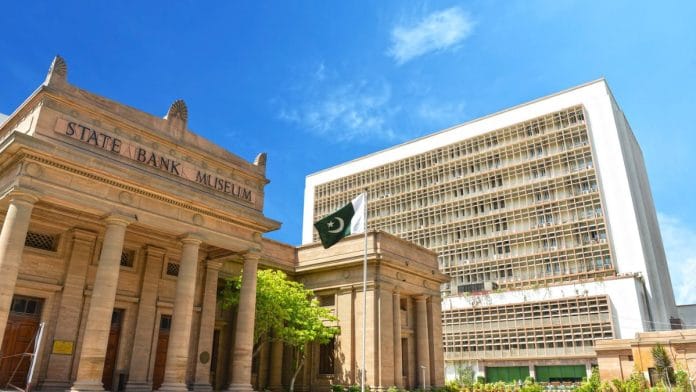
In February 2023, Pakistan’s central bank reported foreign reserves of $2.92 billion, while the nation of 24 crore people faced severe economic challenges. Fuel shipments remained at ports because authorities could not confirm dollar payments. Additionally, police escorted flour trucks and managed distribution centres following stampedes at several sites. The Pakistani rupee experienced significant depreciation, and the finance minister engaged in diplomatic efforts between the US and Saudi Arabia, seeking financial assistance.
This situation contrasts sharply with the developments reported on 11 September, when the State Bank of Pakistan announced foreign reserves of $21.4 billion, marking a historical peak. Prime Minister Shehbaz Sharif thanked Allah and his economic team for the achievement, noting a sevenfold increase from the 2023 low.
However, this story of economic recovery may be misleading, as the reported figures may not accurately reflect the underlying economic conditions.
What’s really in the vault
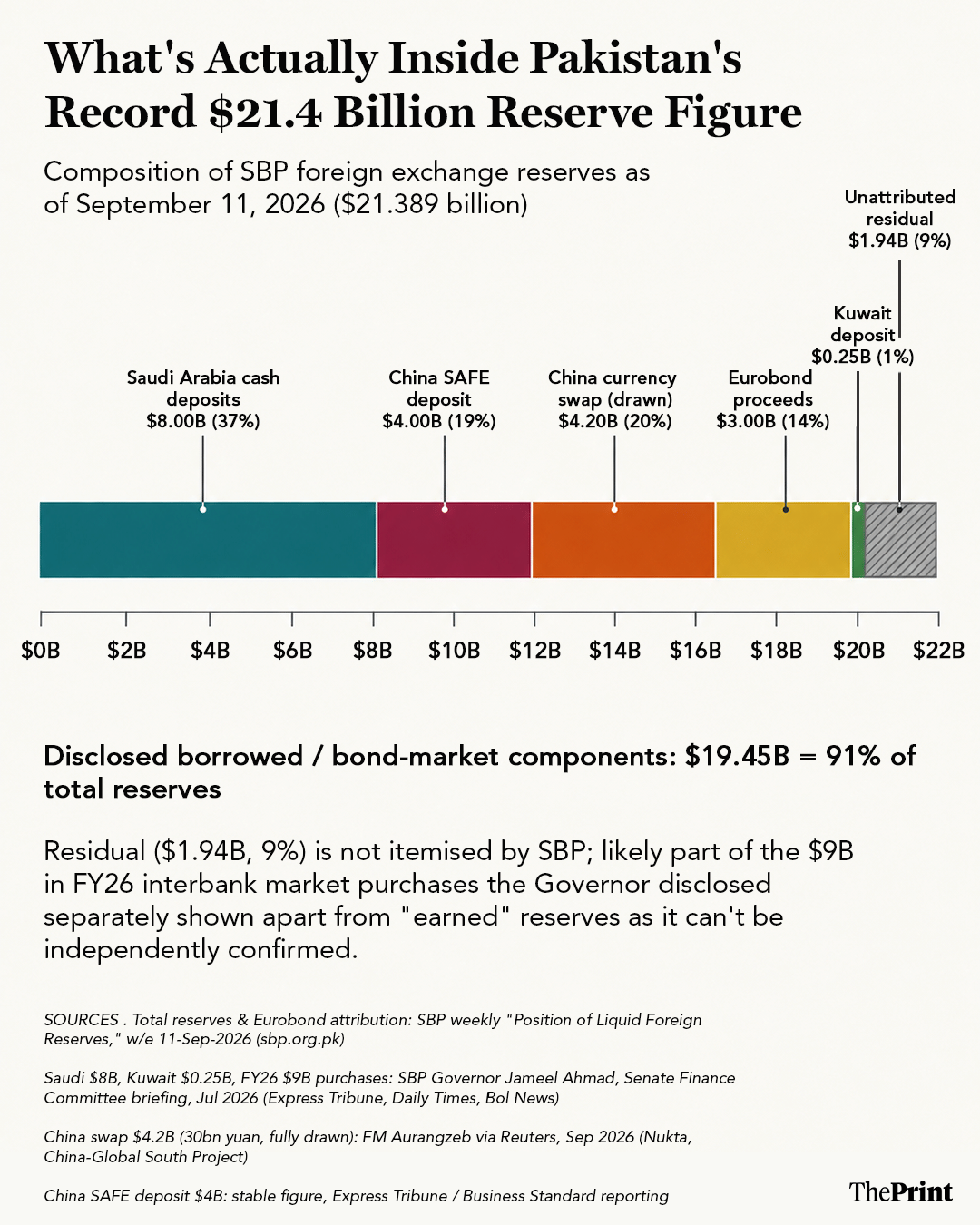
The breakdown of the $21.389 billion shows that 91 per cent, or $19.45 billion, is attributable to five entities not directly linked to Pakistan’s economy. Saudi Arabia has contributed $8 billion in cash deposits with the State Bank of Pakistan (SBP). China has provided a $4 billion deposit alongside a $4.2 billion currency swap, which has been fully utilised. Kuwait has deposited $250 million.
Additionally, a Eurobond issued in September raised $3 billion, with funds secured by assuring international investors of repayment with interest, rather than through revenue generated from exports. Even the approximately $1.9 billion remaining, which should ostensibly represent the clearest evidence of an economy sustaining itself, cannot be entirely verified as being organically generated.
This issue is not new, and accurate terminology is crucial. Economists Barry Eichengreen and Ricardo Hausmann refer to it as “original sin”: the inability of most emerging economies to secure international loans in their own currency. For instance, Pakistan is unable to issue rupee-denominated bonds to a pension fund in Frankfurt and expect them to be purchased. As a result, it resorts to borrowing in US dollars, which it does not produce, under conditions dictated by creditors who possess significant leverage. When repayment is due, the only recourse is further borrowing. This situation does not indicate a deficiency in Pakistan’s character; rather, it is a common predicament for nearly all developing economies. Thus, a $21 billion figure constructed in this manner does not reflect Pakistan’s economic strength; rather, it illustrates the extent of favours it has managed to secure in a given month.
A more stringent evaluation is embedded in the details, specific to Pakistan and not applicable to economics broadly. In 2023, during negotiations between the IMF and Pakistan to establish the technical framework for the country’s bailout, the agreement clarified this point. It explicitly categorises deposits from foreign governments and central banks as liabilities against Pakistan’s reserves, irrespective of the repayment timeline. For example, Saudi Arabia’s $8 billion, extended to 2028, is well beyond any standard definition of immediate risk. Nonetheless, Pakistan’s commitment to the IMF already classifies it as debt. The government is celebrating a figure that its own bailout documentation does not fully acknowledge as reserves.
Also read: Stop asking, can Bengaluru become Silicon Valley for AI? Key lies in its difficult problems
A magic trick performed five times
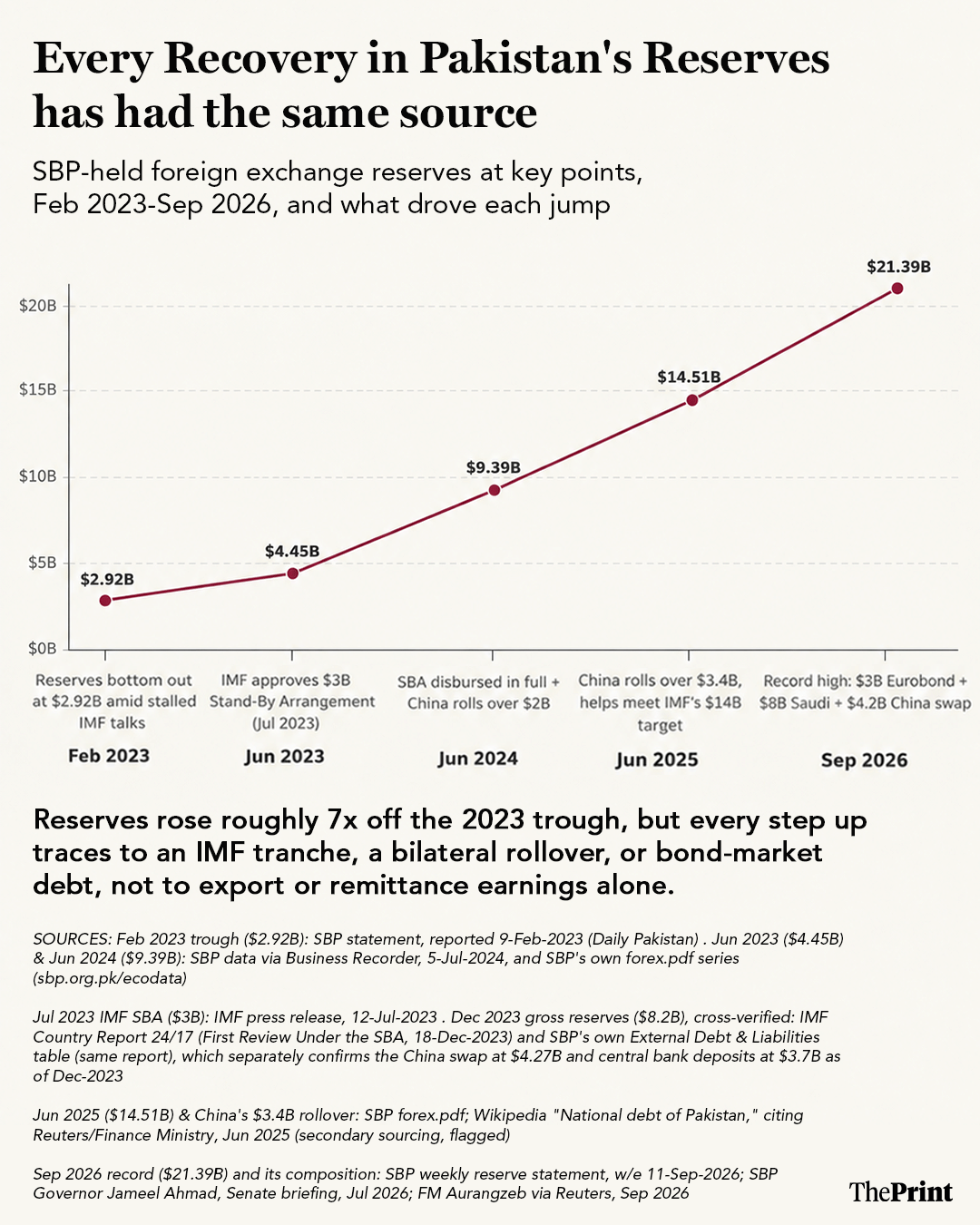
The evidence that this is not an isolated incident lies in the pattern. Consider the progression from the $2.92 billion low in February 2023: a $3 billion IMF rescue in July of the same year, followed by a $2 billion Chinese rollover in February 2024, and a $3.4 billion Chinese rollover in June 2025, which notably exceeded the IMF’s $14 billion reserve target for that review. Subsequently, there were Eurobond and Gulf deposits in September. These five instances of financial intervention were not primarily driven by Pakistan increasing its exports relative to imports.
Economist Guillermo Calvo dedicated his career to examining what he termed “sudden stops,” which occur when the continuous inflow of foreign capital abruptly ceases, not because a country is bankrupt, but because of a shift in confidence. A nation may appear solvent on paper yet remain vulnerable to crisis triggered by adverse headlines, as solvency does not equate to liquidity when creditors demand payment. In response to this vulnerability, economists Pablo Guidotti and Alan Greenspan recommended in 1999 that a country’s reserves should fully cover its short-term external debt on a dollar-for-dollar basis to prevent a sudden stop from escalating into a collapse.
Pakistan’s debt-servicing obligation for this year amounts to $21.5 billion, while its reserves stand at $21.389 billion. This situation indicates that the country possesses just enough to meet its obligations for one year, assuming all creditors remain patient simultaneously. This scenario does not constitute a financial cushion but rather represents a precarious balance.
Also read: Mark Carney is showing the centre still has a place in an age of extremes
Someone else’s playbook
Pakistan is not unique in facing this risk. Turkey employed a similar strategy for years, wherein the central bank utilised currency swaps, initially with domestic banks and subsequently with Qatar’s central bank and China’s PBOC, to artificially inflate headline reserves while the underlying critical figures deteriorated. In May 2023, after excluding these swaps, Turkey’s net reserves became negative, amounting to minus $151 million, marking the first occurrence of such a situation since 2002. Consequently, the lira depreciated by 44 percent within that year alone.
Sri Lanka exemplifies the potential outcome of this trajectory without corrective measures. By May 2022, the finance ministry acknowledged that the country had approximately $25 million in usable reserves, rather than billions, while facing billions in maturing debt. Consequently, fuel ships remained anchored off Colombo because the country lacked dollars to unload them. The country subsequently defaulted on $51 billion in external debt weeks later.
In Pakistan’s favour, substantive developments have emerged. The current account deficit significantly narrowed in July and August of this fiscal year. Remittances reached $3.66 billion in August, representing a substantial and increasing inflow of funds that require no repayment. Import cover also exceeded three months for the first time since 2020. These figures do not reflect a stagnant nation; rather, they indicate a country that has begun to finance its expenditures more independently and rely less on external assistance.
Regrettably, the narrative in Islamabad does not reflect this reality, as it is less immediate and appealing than the portrayal of the Prime Minister expressing gratitude for a situation largely sustained by external patience. A rented mansion appears identical to an owned one until the landlord demands its return. Pakistan has begun establishing its own foundation and should avoid presenting temporary measures as permanent solutions.
Bidisha Bhattacharya is ThePrint Consulting Editor (Economics) and an Associate Fellow, Chintan Research Foundation. She tweets @Bidishabh. Views are personal.
(Edited by Prashant Dixit)