





In the current age of populism, the space around the ideological “centre” is shrinking. The age of globalisation – of open economies and liberal societies – is practically over.
The world is in an angry, insular mood where instruments of prosperity, such as (free) trade and immigration, have been weaponised and almost casually deployed against both friends and foes.
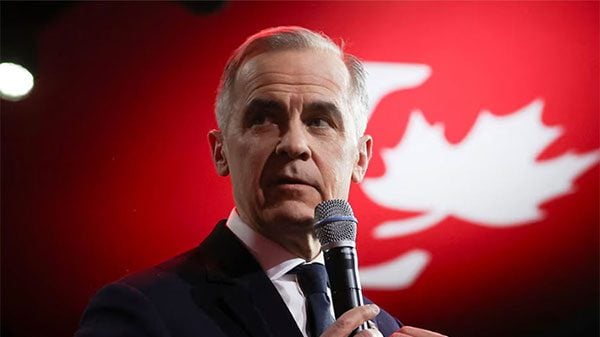
Every major country seems to have accepted that less interdependence and more self-sufficiency is the way forward. In a reactive way, perhaps that seems the only practical path. But strategically, it is a road to ruin. History tells us as much – just study the world between the two World Wars. Politically, it’s hard to buck a trend where populism and strongmen/women have captured public imagination. But one man seems to be doing it with great success: Canadian Prime Minister Mark Carney, who makes the news with almost every speech he delivers. Is he the exception bound to fail or a rare voice of reason in a rollercoaster world?
Carney, in a famous speech at the World Economic Forum in Davos in January, spoke eloquently about the new world order (of Great Power Rivalry) and the flaws of the old order of globalisation, which opened the door to populism of all kinds. The era of globalisation delivered prosperity like no other, at least for a quarter of a century from the early 1980s to the mid-2000s. Not just for the West, but for poor nations as well.
The two most populous and poorest countries in the world, China and India, lifted nearly a billion people out of poverty with impressive economic growth following their own opening to the world in 1978 and 1991. But the order began to come undone in the aftermath of the global financial crisis – it began to be perceived as unfair that banks and rich bankers (on Wall Street) were bailed out of self-inflicted crises while ordinary people suffered austerity. Covid was the final blow. If the 2008 financial crisis and its aftermath exposed the West, Covid exposed China, possibly the biggest beneficiary of the old order.
Also Read: ‘Dear Mark…’: EU commissioner pitches Canada as first associate member as Ottawa seeks new alliances
Targeting the straw man
The political mood of the West altered. Nowhere was this more apparent than in the United States, where the centre-right Republican Party morphed into the populist-right, Trump being its flag bearer. In response, the centre-left Democratic Party seems to be inching to the populist-left, Mamdani being the flag bearer. In the UK, the populist Reform Party of Nigel Farage is leading the centre-right Conservatives. In response, Labour has chosen to elect a populist leftist, Andy Burnham, as its torchbearer. France and Germany are witnessing the rise of the populist right at the expense of more centrist politicians. The list is long enough to be a serious global trend.
On the ground, both sides of the populist spectrum are offering balm for what is actually a deep wound. The populist right targets immigration as the fundamental cause of problems in advanced countries. By doing so, they channel popular anger, but only to a straw man. Immigration is, after all, necessary in countries with declining populations.
The populist left targets a different straw man – the rich, channeling popular anger in that direction. But wealthy entrepreneurs are needed for growth and innovation. Both sets of populists may offer some more redistribution – or freebies as they are known in India. But none of this addresses the real problem of low growth, stagnant wages, loss of jobs — which will only grow as AI penetrates different professions.
Mark Carney stands out because he refuses to construct straw men to distract from the real issues. He also stands out for standing up to populists and arguing for a different path for his country and the world. Some of his popularity stems from the fact that he is the Anti-Trump in a country that is bearing the brunt of Trump’s fanciful policies. But he isn’t retreating into insularity. He is trying to build other bridges, most notably with Europe. He has also reached out to India, abandoning his predecessor’s careless populist dalliance with Khalistani extremists.
More importantly, at a time when good economics has been sacrificed at the altar of good politics, Carney still puts economics first. Perhaps that is because he is a trained economist with a PhD from Oxford. Or because he ran two central banks, Canada and the UK, both through difficult times (global financial crisis and Brexit). There may be several reasons, but the fact is that he is an unusual politician in these times – a man with considerable intellect, serious policy thinking, and a quiet but plain-speaking style, looking for real solutions, not balm, for a better world.
Carney may not have all the answers. But at least he is showing that it is possible to be popular without being populist. And that the centre is still relevant in an age of extremes.
Dhiraj Nayyar is Chief Economist, Vedanta. His X handle is @nayyardhiraj.
(Edited by Raunaq Lekhi)