




In early October, several stakeholders, including families with children studying abroad, importers awaiting shipments, and motorists monitoring fuel prices, experienced heightened anxiety. On Friday, 9 October, the Indian rupee closed the week at about Rs 96.7 to the dollar, near the record low seen in May. At the same time, India’s foreign exchange reserves had declined for five consecutive weeks, foreign investors had consistently divested from Indian equities, and oil prices had exceeded $100 per barrel. Subsequently, the Reserve Bank of India quietly implemented strategic changes, and, within a week, the rupee appreciated to nearly Rs 95.
The RBI’s intervention targeted rapid capital movement. It reduced the permissible size of currency derivative transactions lacking an underlying trade from $100 million to $5 million, prohibited companies from cancelling and rebooking hedges for speculative purposes, mandated banks to maintain a 20 per cent cash reserve with the RBI against large forward dollar purchase contracts, and established a special facility to sell dollars directly to state-run oil companies, thereby excluding their transactions from the open market. Although these measures were not explicitly termed capital controls, they effectively function as such, and their effectiveness will influence the rupee’s trajectory in the coming months.
Six weeks that emptied the cushion
To understand the rationale behind the RBI’s actions, it helps to examine developments during the summer. Between mid-July and early September, foreign exchange reserves increased by approximately $110 billion over seven weeks, reaching a record high of $785.7 billion on 4 September. This significant increase reflected a major capital influx, including special dollar deposits from Indians abroad, which, as I noted in my September column, attracted far more funds than anticipated.
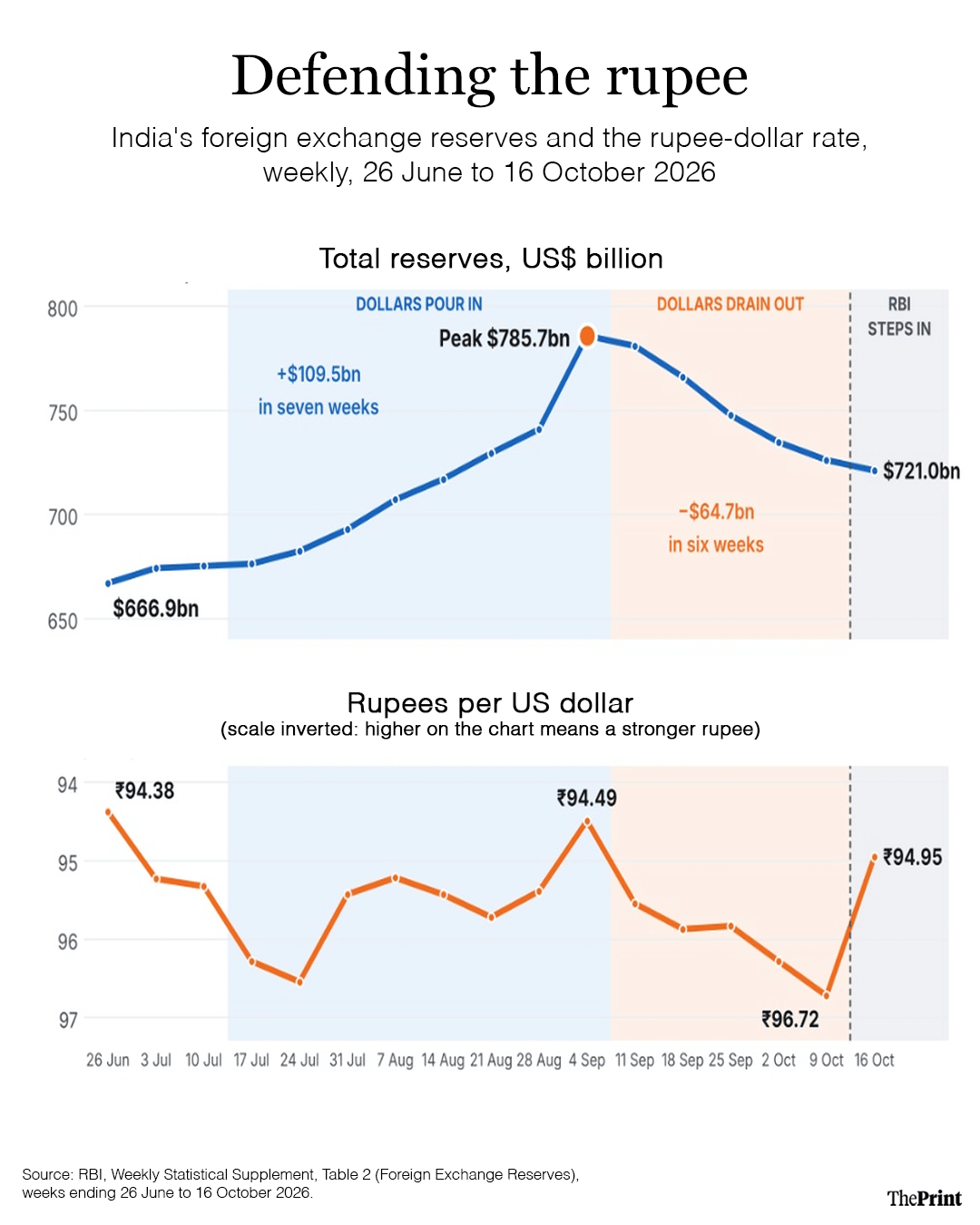
Over the next six weeks, the financial cushion shrank as reserves fell by $64.7 billion, or 8.2 per cent, to $721 billion by 16 October. This decline occurred as the RBI intervened by selling dollars to stabilise the rupee amid an escalating oil bill driven by the Gulf crisis. By mid-October, foreign exchange reserves had returned to levels similar to those observed in mid-August.
In the early 1960s, Robert Mundell and Marcus Fleming demonstrated that a nation cannot simultaneously maintain a stable currency, free capital movement, and an independent interest rate policy. This principle, known as the “impossible trinity,” necessitates the relinquishment of one of these three objectives. The RBI aimed to stabilise the rupee while independently setting interest rates for India, rather than aligning with Washington’s policies. Consequently, on 10 October, it imposed restrictions on capital flows.
Also read: Rupee’s story is not just its exchange rate with the US. It’s about REER—a corrective lens
Not all foreign money is the same
Proponents argue that such restrictions deter investors; however, foreign capital takes two distinct forms.
Between April and August, portfolio investors who trade listed shares withdrew about $9.9 billion from Indian equities. An additional $8.8 billion was withdrawn in September and October. In contrast, during the same April-August period, net foreign direct investment inflows, characterised as patient capital that builds factories and takes long-term stakes in companies, rose to $13.8 billion, up from $9.6 billion the previous year.
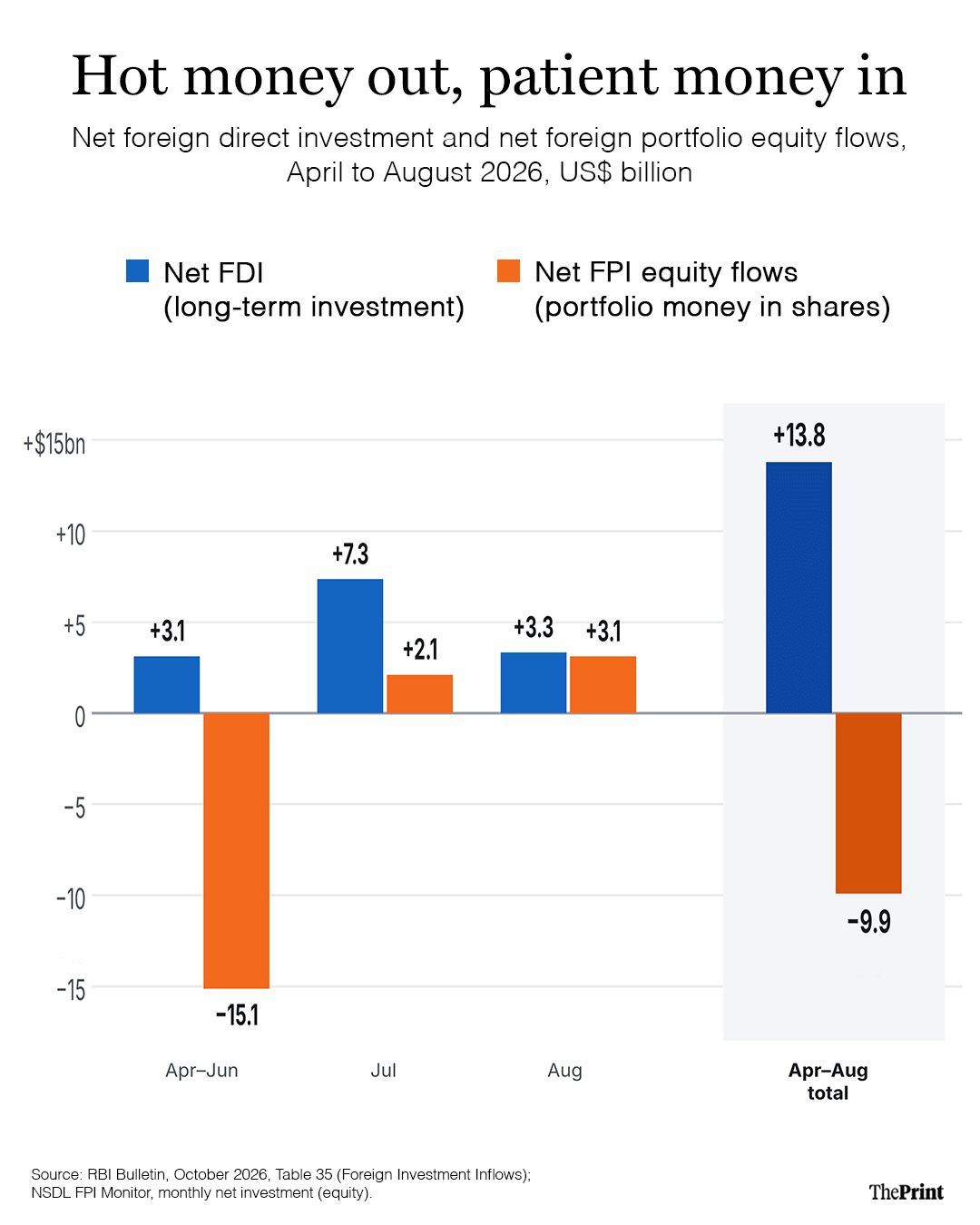
Hélène Rey of the London Business School explained this divergence in a notable 2013 lecture at Jackson Hole. She argued that portfolio capital operates within a “global financial cycle” influenced by US interest rates and global economic apprehensions, regardless of a country’s economic performance, including India’s. Her analysis concluded that the trilemma is essentially a dilemma: a nation seeking to maintain control over its interest rates must regulate volatile capital flows. This approach aligns with the Reserve Bank of India’s strategy, which targets speculative activities while preserving long-term investments. Even the International Monetary Fund, historically an advocate for unrestricted capital flows, acknowledged in 2012 that temporary measures of this nature can be prudent during economic turbulence.
The 2013 playbook, played from strength
India has faced a similar situation before. In May 2013, the United States Federal Reserve indicated a potential reduction in its market support, leading to a significant withdrawal of capital from emerging economies, an event referred to as the “taper tantrum.”
In 2013, the Indian rupee depreciated from about Rs 55 to over Rs 66 against the dollar within fifteen weeks, a loss of nearly 20 per cent, while foreign reserves fell by only about 6 per cent. The RBI implemented a series of measures, including restrictions on overseas investments in August, the establishment of a dollar window for oil companies on 28 August, and the introduction of a scheme on Raghuram Rajan’s first day as Governor that attracted substantial dollar deposits from Indians abroad. These interventions helped the rupee recover, leading to the subsequent withdrawal of the measures.
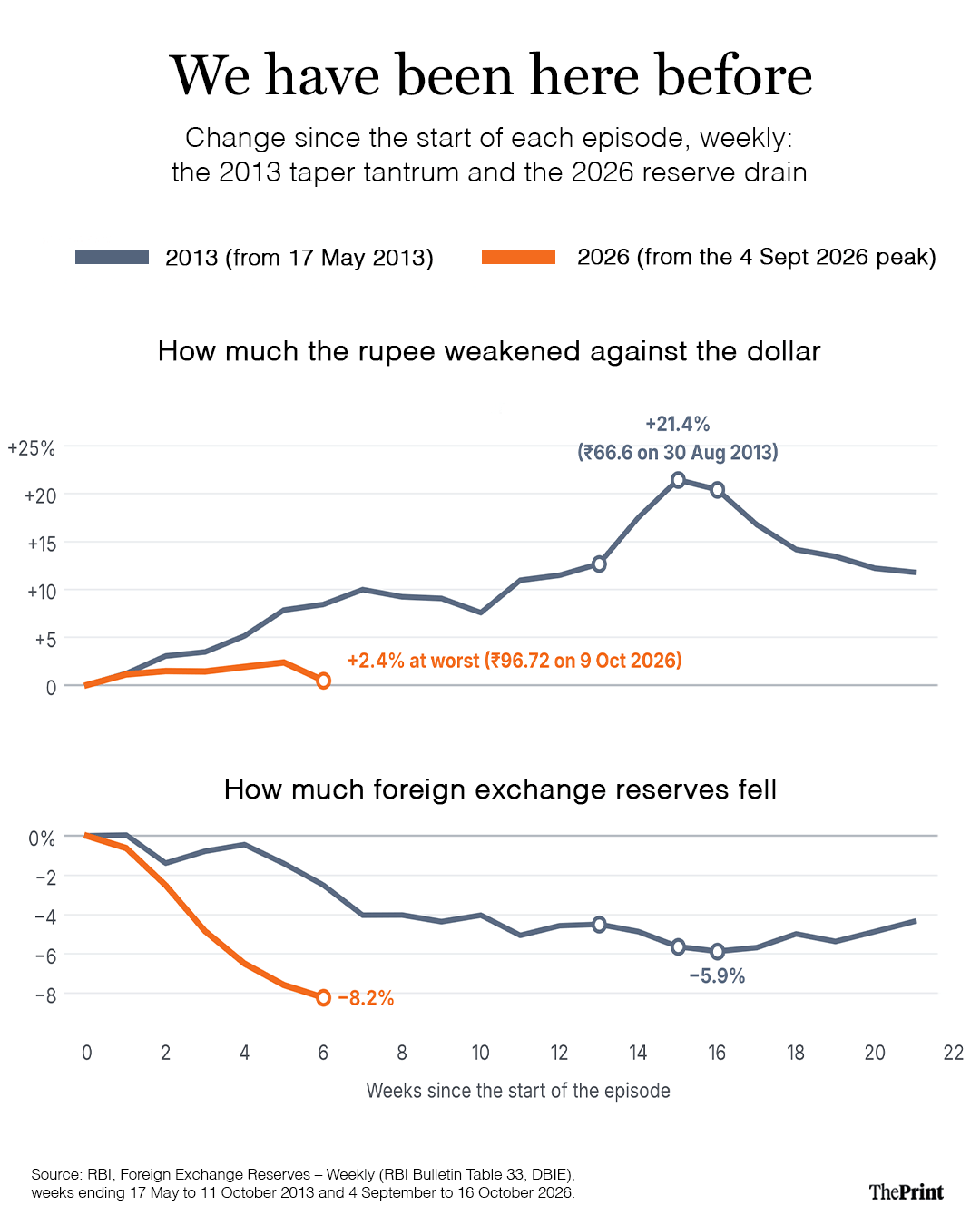
In contrast, the current scenario has seen the RBI expend a larger proportion of its reserves, approximately 8 per cent, while the rupee has depreciated by less than 2.5 per cent at its weakest point. This strategic choice is feasible for a nation with reserves about 2.5 times higher than in 2013, though it is not sustainable indefinitely. The current objective is to ensure the effectiveness of these measures and subsequently withdraw them. Markets are more amenable to temporary restrictions on rapid capital flows when there is a clear exit strategy.
Therefore, announcing a review date or linking the regulations to specific indicators, such as oil prices or reserve levels, would reassure investors that these measures are temporary. Additionally, the government should actively engage with long-term investors, as Indian companies invested $17.7 billion abroad in the first five months of the current fiscal year, offsetting the benefits of foreign investment inflows. Ultimately, the most robust defence is domestic: increased investment by Indian households and institutions in local markets would mitigate the impact of foreign capital withdrawal on the rupee.
The situation remains precarious. Should oil prices rise further or foreign capital outflows resume, the RBI will face renewed challenges. Unlike in 2013, when India could only watch the rupee decline and respond reactively, in 2026 the country has been able to intervene, at least temporarily. The sustainability of this intervention depends on factors beyond the RBI’s control, such as oil prices, US Federal Reserve policy, and how quickly the current restrictions can be lifted.
Bidisha Bhattacharya is ThePrint Consulting Editor (Economics) and an Associate Fellow, Chintan Research Foundation. She tweets @Bidishabh. Views are personal.
(Edited by Prashant Dixit)