



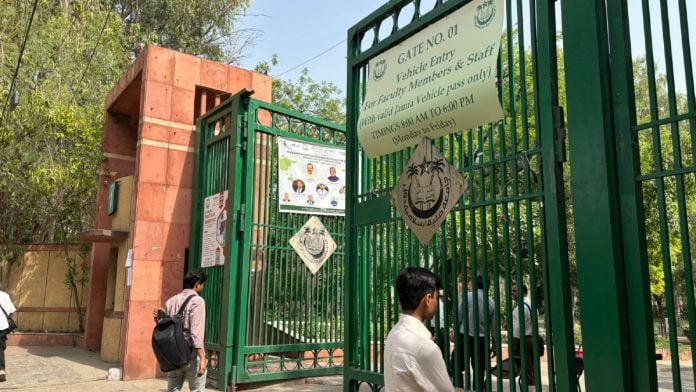
New Delhi: Following weeks of protests and a hunger strike by students, Jamia Millia Islamia (JMI) agreed Monday to hold students’ union elections after a 20-year gap. However, the administration has conditioned the polls on the approval of a new union constitution: it has said the election will be held within 15 days of the constitution getting approved, with no deadline set for its approval.
The agreement marks a potential turning point in a dispute that began when Jamia dissolved its elected union in 2006, citing campus violence and disruption to academic activities. Successive administrations also cited pending court proceedings as a reason for not holding elections.
Over the last two decades, the university relied on departmental subject associations rather than a central elected body.
The earlier union had elected office-bearers, including a president, vice-president, secretary and joint secretary, alongside faculty representatives. The composition and election process may change under the new constitution being drafted by the university.
Also Read: Hindu College teachers’ stir enters 2nd month. Why they’re demanding ‘temporary DU takeover’
Why did Jamia dissolve its students’ union in 2006?
Jamia’s last students’ union elections were held in 2005. The university dissolved the elected body on 31 March 2006, citing campus violence and disruption to academic activities following a confrontation between student union leaders and university officials over student admissions and an alleged assault involving the then proctor.
A May 2012 reply in the Rajya Sabha recorded the university’s explanation that the union had been disbanded following violent incidents, the last involving an attack on the vice-chancellor.
Najeeb Jung, who served as Jamia’s vice-chancellor from 2009 to 2013, became a key figure in the debate over restoring elections.
In July 2012, Jung ruled out holding students’ union elections that academic session. In a report published by The Indian Express’s Newsline on 19 July 2012, he proposed strengthening subject associations in individual faculties, with greater student representation. He said that the associations would organise lectures, seminars and other activities.
However, the university-wide union was not restored.
Demand over the years
In 2017, amid repeated demands from students, Jamia proposed a student council in which only class representatives could vote for office-bearers.
However, students opposed the plan, saying the proposed council lacked independence and real powers. The university eventually put the proposed elections on hold.
A petition seeking the restoration of Jamia’s students’ union elections was filed in the Delhi High Court in 2012 by Hamidur Rahman, then a student at the university.
On 20 December 2022, the court disposed of the petition after Jamia’s counsel submitted that the union had been dissolved and that the question of holding elections did not arise. The court passed no further orders. It neither directed the university to resume elections nor barred it from holding them in the future.
Also Read: Higher education capacity expands nationwide but big gaps in UP, Bihar, Jharkhand, finds study
What led to the current protest?
Five students began an indefinite hunger strike on 12 October, demanding the restoration of the students’ union and a clear election schedule.
Students argued that departmental subject associations could not replace a university-wide elected body that can collectively raise concerns about campus facilities, hostels, fees and student welfare.
The agitation escalated after the university took disciplinary action against three students: rusticating law student Ebin Basil for a year and suspending two others. The administration subsequently formed a committee to engage with protesters and examine their demands.
On 21 October, the university announced a separate committee to draft the students’ union constitution, taking into account the circumstances of the union’s dissolution, court orders, the recommendations of the Lyngdoh Committee (tasked in 2006 to set guidelines for student elections on campuses across India), and university rules.
The administration Monday agreed to hold elections within 15 days of approval of the constitution. It also agreed to revoke the suspension orders and show-cause notices issued to students, and to investigate complaints against security personnel for allegedly mishandling the protesters.
However, the administration did not specify a deadline for approving the constitution. Students also objected to conditions requiring them to publicly apologise for allegedly defamatory statements and remove related social media posts. The terms of Monday’s agreement remain a point of contention.
How AMU’s decision gave momentum to Jamia’s protest
Jamia’s latest agitation for the restoration of its students’ union gained momentum after the Aligarh Muslim University (AMU) announced elections on 9 October 2026.
At AMU, protests began on 21 September after students demanded the restoration of union elections, which had not been held since 2018. Over the past eight years, AMU’s elections were repeatedly postponed amid campus unrest and alleged violations of election rules.
Last month, however, postgraduate student Yasir Fahad started an indefinite hunger strike demanding the resumption of elections. After 19 days of the hunger strike, the university announced elections for 5 November 2026 and replaced the proctor. The students then called off their agitation.
Three days later, Jamia students began an indefinite hunger strike, demanding the restoration of their own elected union and a clear election schedule.
(Edited by Sunanda Ranjan)