



Central banks are often evaluated by the commitments they fail to uphold, rather than those they fulfil. Three weeks ago, I wrote a column on the Reserve Bank of India’s reversal of its Non-Resident Indian, or NRI, deposit scheme, retracting its decision nine days after dismissing the possibility of an early closure. This article is about what happened when the RBI kept every word of that promise, let the scheme run its full, wildly successful course, and ended up with a bigger problem than the one it started with.
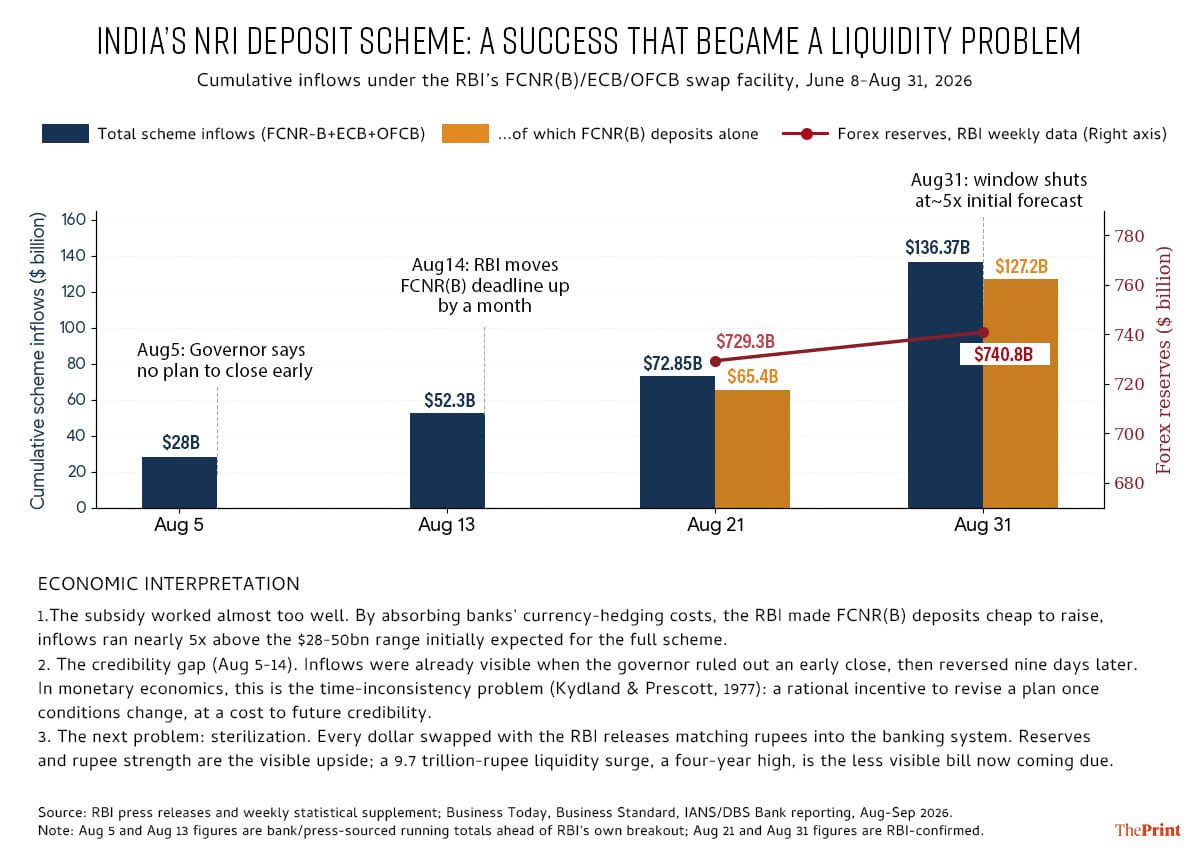
Here’s where things stand right now: On 5 August, Governor Sanjay Malhotra asserted that there were no intentions to prematurely terminate the RBI’s special NRI deposit window. At that time, inflows under the scheme were approximately $28 billion.
By 21 August, RBI data indicated that Foreign Currency Non-Resident (Bank) [FCNR(B)] deposits, central to the scheme, had reached $65.4 billion, with total inflows, including overseas borrowings, amounting to $72.85 billion. Upon the window’s closure on 31 August, the final RBI report recorded $136.37 billion, with $127.2 billion attributed solely to FCNR(B) deposits. This figure is nearly five times the $28-50 billion range projected by analysts at the scheme’s inception in June. In the meantime, foreign exchange reserves increased from $729.33 billion on August 21 to a new peak of $740.80 billion a week later.
Communication problem to plumbing problem
In my previous column, I argued that the RBI nine-day policy reversal resulted in what economics calls a “credibility discount.” This refers to the additional risk premium that markets require when a central bank’s statements and actions become misaligned. This assertion remains valid. However, the scheme’s overwhelming success has now presented the RBI with a different challenge altogether, unrelated to its verbal commitments but rather concerning its necessary actions.
When NRIs deposit dollars and banks exchange them with the RBI, the rupees the RBI provides in return do not disappear; instead, they augment the banking system’s liquidity. This process, when applied to $127 billion in Foreign Currency Non-Resident (Bank) [FCNR(B)] deposits, has resulted in India’s banking system holding a record surplus of Rs 9.7 trillion, the highest in four years, leading to a decline in overnight interest rates. Bank executives met with the RBI this month to discuss strategies for absorbing liquidity.
This situation exemplifies the classic “sterilisation problem”, a concept recognised in central banking practice prior to its formal modelling in foreign exchange intervention literature. Having acquired dollars to stabilise the rupee, the RBI must now withdraw the resulting rupees to prevent the liquidity surplus from contributing to inflation or affecting asset prices. This scenario is, in essence, the inverse of the issue discussed in my previous column. Previously, the RBI’s challenge was sequencing a decision; now it involves managing the quantitative outcomes of a decision that exceeded all predictive models.
Also read: The CNG hike nobody questioned is hiding India’s most expensive untold secret
The trilemma hiding inside the swap window
The theoretical framework known as the open economy trilemma, articulated by economists Robert Mundell and Marcus Fleming in the 1960s, explains why the RBI cannot remain inactive. According to this theory, a nation cannot simultaneously sustain a fixed or managed exchange rate, allow free movement of capital, and exercise independent control over domestic interest rates; it must choose two of these three options. India, lacking full capital account convertibility, enforces capital controls across much of its economy. However, it has progressively liberalised specific channels, such as NRI deposits, external commercial borrowings, and portfolio investment. Within these channels, the trilemma is fully applicable. FCNR(B) deposits are a prime example of a channel India has chosen to keep open.
The FCNR(B) scheme was implemented as a capital flow intervention to support the exchange rate aspect of this trilemma, specifically by attracting dollars to bolster the rupee. However, this intervention, executed on a large scale, exerts pressure on the third aspect, namely the RBI’s capacity to maintain domestic liquidity and, consequently, short-term interest rates at desired levels. Sterilisation operations, foreign exchange swaps, bond sales, or an increase in the Cash Reserve Ratio (CRR) are mechanisms that enable a central bank to balance currency defence with control over domestic monetary conditions.
These measures are not without cost. During this month’s meeting, bankers expressed a preference for swaps over a CRR hike, as an increased CRR directly impacts their margins. The RBI appears to concur, given its approximately $45 billion in forward dollar positions maturing within the year, which a rolling sell/buy swap programme could accommodate. A Rs 7 lakh crore, 30-day Variable Rate Reverse Repo (VRRR) auction on 7 September will address some of the short-term excess liquidity.
This does not imply that the scheme was a failure. Reserves have strengthened, the rupee has appreciated to the mid-94 range against the dollar, and India’s external buffers are more robust than they have been in years. However, it indicates that the RBI’s task is only partially complete.
The best approach is not a singular dramatic measure but a calibrated sequence of actions. Rolling sell/buy swaps against the $45 billion of forward positions already maturing this year should accomplish most of the necessary adjustments, as they involve liabilities the RBI would have had to manage regardless. The VRRR auctions can address the short-term liquidity surplus without indicating a permanent shift in policy stance.
The RBI should avoid resorting to the CRR, not solely because bankers oppose it, but because a CRR hike is perceived as a tightening signal, unlike swaps and VRRRs. After August, the RBI can least afford to convey a signal that has not been thoroughly considered. Having spent nine days instilling doubt in the markets regarding its announcements, its most valuable asset now is consistent and predictable liquidity management. Central banks seldom receive accolades for such foundational work. However, following this August, the RBI’s most prudent strategy is to ensure that this is the only type of surprise it has left to offer.
Bidisha Bhattacharya is ThePrint Consulting Editor (Economics) and an Associate Fellow, Chintan Research Foundation. She tweets @Bidishabh. Views are personal.
(Edited by Aamaan Alam Khan)