



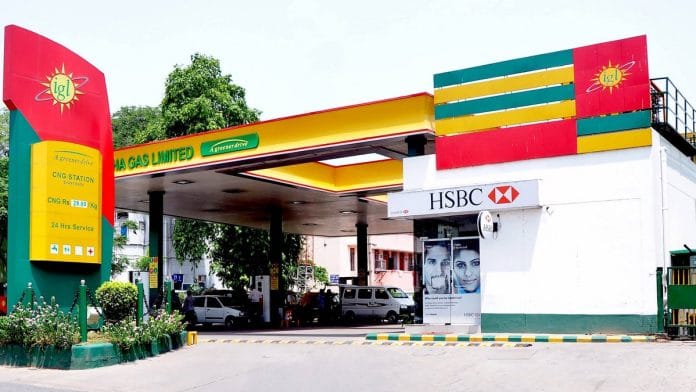
On the morning of 29 August, Indraprastha Gas Limited increased the price of CNG in Delhi by Rs 3.89 per kilogram. This marks the fifth increase this year. While this adjustment may appear to be just another incremental rise in fuel costs and commuting expenses, it calls for a deeper examination.
The CNG hike is part of a broader government strategy that has unfolded over the past seven months in the wake of the fuel crisis. Primary government data shows how prices were raised selectively, giving insight into governmental priorities and decision-making processes.
The shock that started it
The narrative originates in West Asia rather than Delhi. The Indian Basket crude oil price, which serves as the benchmark for India’s actual expenditure on imported crude, remained stable between $63 and $69 per barrel during January and February 2026. However, within a single month, it surged by 64 per cent to $113, coinciding with the disruption of the Strait of Hormuz due to renewed regional conflict. The price reached a peak of nearly $114 in April, decreased through June and July as tensions subsided, and began to rise again by August, coinciding with the fifth increase in Delhi’s CNG bill.
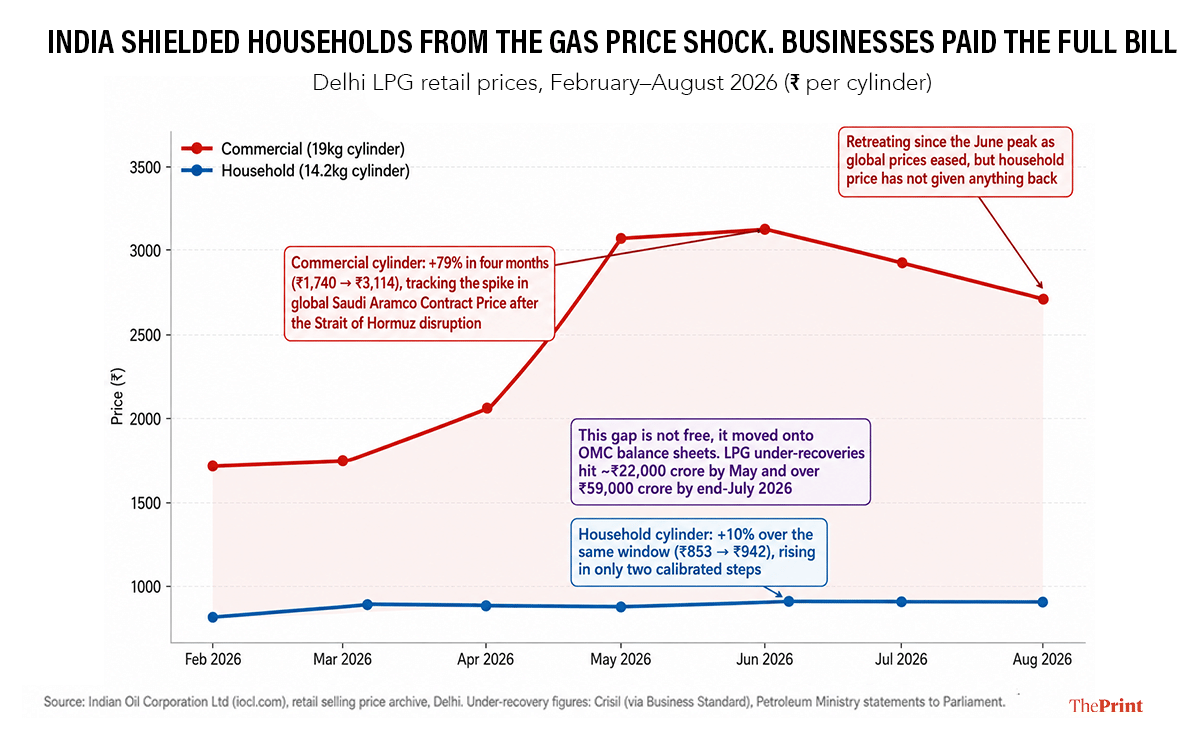
A war abroad, an oil shock and a subsequent domestic price increase is a familiar narrative. Such events, in isolation, might not necessarily require extensive analysis. What matters, however, is India’s response to this shock — the transmission of its effects was neither uniform nor transparent in its magnitude.
A textbook case of price discrimination, run on gas cylinders
In economics, the practice of charging different prices to different buyers or groups of buyers for the same product is known as price discrimination. This concept was formalised by economist AC Pigou in the 1920s to describe such segmented pricing strategies.
During the crisis, India implemented a form of price discrimination without explicitly labelling it as such.
In Delhi, the price of household LPG cylinders increased by only 10 per cent over the entire period, from Rs 853 to Rs 942, in two calibrated increments. In contrast, the price of commercial cylinders, which are essential for restaurants, hotels, and small businesses, increased by 79 per cent during the same timeframe, from Rs 1,740 to Rs 3,114, before decreasing slightly as global prices stabilised.
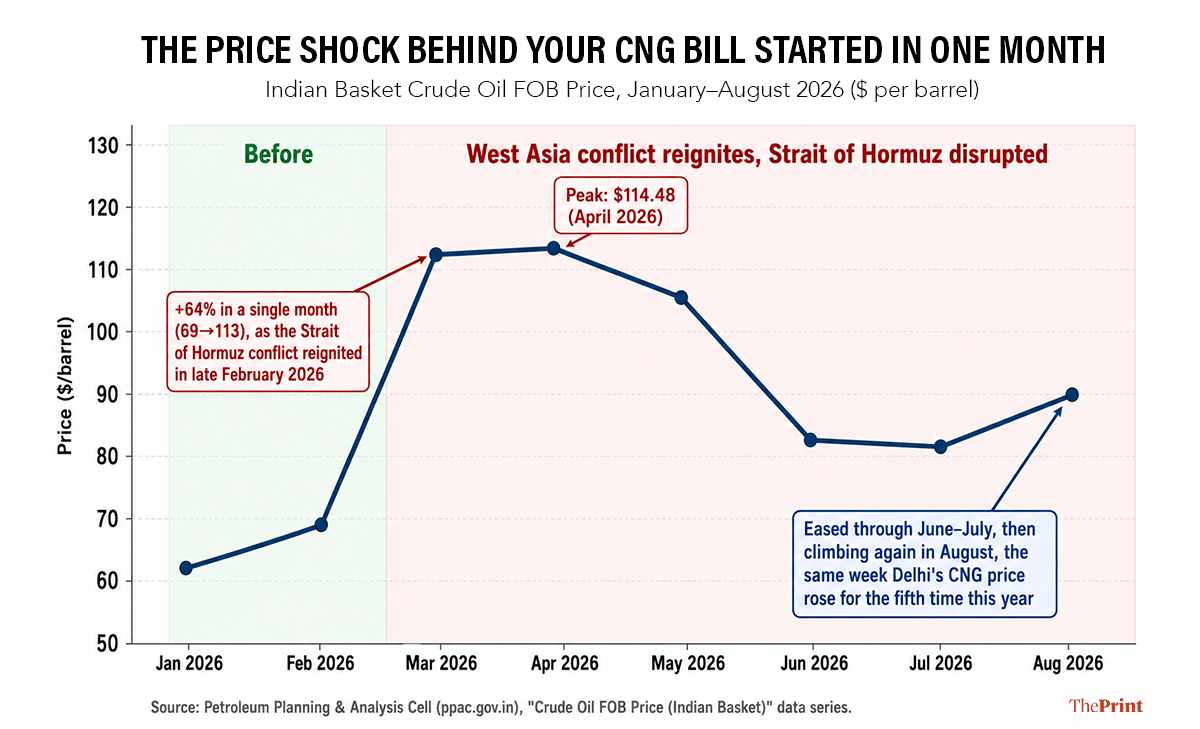
According to Pigou, price discrimination requires a seller possessing both pricing power and the capability to differentiate between buyers. India’s oil marketing companies exhibit these characteristics, and the disparity they established between household and commercial pricing persisted beyond its inception, subsequently impacting their balance sheets.
The LPG under-recoveries, defined as the discrepancy between the actual cost of fuel and its selling price, were estimated by Crisil to have reached approximately Rs 22,000 crore by May and exceeded Rs 59,000 crore by the end of July. The government’s confirmed figure, presented to Parliament, indicated that total under-recoveries across all sensitive fuels amounted to Rs 2.19 lakh crore for the quarter.
This scenario illustrates a secondary, less conspicuous concept known as fiscal illusion. This phenomenon involves a genuine cost that does not manifest as government expenditure during the period it is incurred, as it is borne by a state company rather than being recorded in the Budget. Consequently, the household consumer perceives stability, while the exchequer remains unaffected temporarily. The financial obligation exists but remains obscured from the public, who ultimately bear the cost, until it necessitates recapitalisation, a price adjustment, or an unanticipated subsidy.
Prices that move like a calendar, not a market
Petrol and diesel introduce another dimension to the story: the mechanism by which prices were adjusted.
In a textbook competitive market, prices are expected to adjust continuously in response to cost fluctuations. However, the petrol price in Delhi remained fixed at Rs 94.77 for four months. It then increased on four occasions over a ten-day period in May, reaching Rs 102.12, and has remained unchanged for three months despite fluctuations in global oil prices. Diesel followed the same pattern within the same ten-day period, increasing by 8.6 per cent to Rs 95.20.
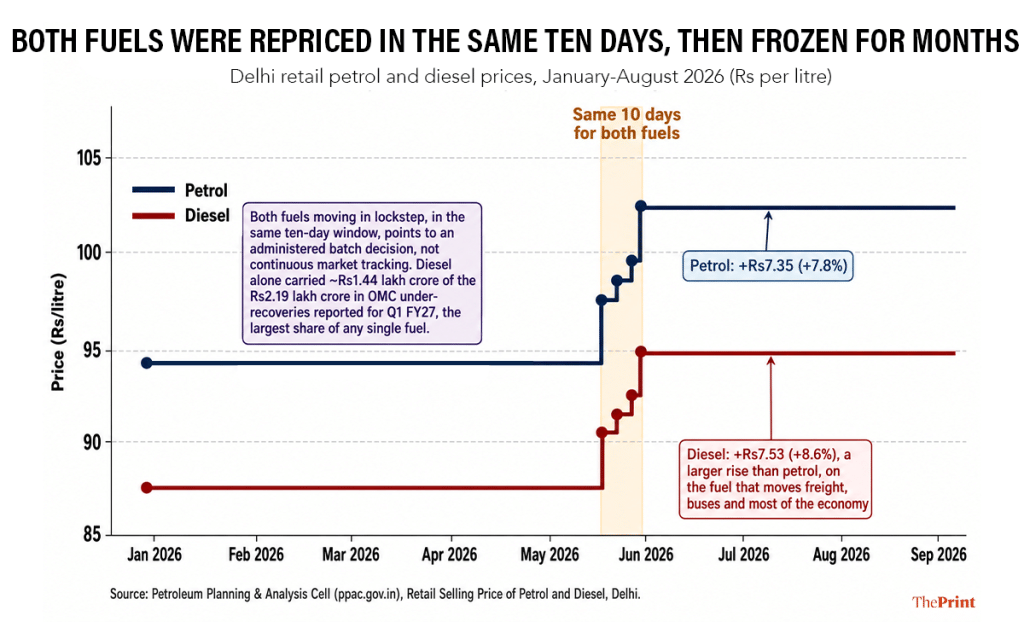
Two fuels, sold by the same state retailer, were repriced in lockstep during one narrow window and then held flat regardless of what the underlying commodity did afterward. This is not a market price finding its level. It is an administered price, set periodically by decision rather than continuously by markets, much like regulated utility prices — except without the same public rate-setting process utilities are typically subject to.
Diesel alone is understood to have carried the largest share of that quarter’s under-recovery burden of any single fuel. This is unsurprising for the fuel that moves freight and buses, and feeds into the cost of transporting nearly everything else in the country.
The real issue is transparency
Now, none of this makes the underlying decision indefensible. It is reasonable for a government to shield households from a global cost shock, especially when a war disrupts a fifth of the world’s oil and gas supply. Most governments facing similar shocks adopt comparable measures.
A century ago, economist Frank Knight distinguished between risk, which can be priced and insured against, and uncertainty, whose scale and duration are unknown. A war of uncertain length exemplifies uncertainty in Knight’s terms, and a government’s effort to cushion its citizens against it is not unreasonable.
What is avoidable, however, is the lack of transparency. A subsidy that appears in a budget line undergoes scrutiny, parliamentary debate, and eventual reform if it becomes unjustifiable. In contrast, a subsidy that appears as a quietly increasing under-recovery on a state company’s books lacks such scrutiny until the figure becomes too significant to ignore. At that point, the necessary correction is often more severe than it would have been had the true cost been apparent from the outset.
Also Read: RBI’s nine-day U-turn is a masterclass in how not to talk to markets
What honesty would actually look like
The resolution does not require reversing the decision to prioritise household protection. The cost of that decision simply needs to be made visible while it is still being incurred, rather than months later through a parliamentary statement or a ratings agency estimate.
The Petroleum Planning and Analysis Cell (PPAC) already publishes retail prices daily, as shown in Figures 1 and 3. A similar approach could apply to Oil Marketing Companies’ (OMCs) under-recovery figures on a consistent monthly basis, rather than through sporadic disclosures contingent on ministerial discretion.
Any prolonged price freeze, such as the current stabilisation of petrol and diesel prices since May, could also be accompanied by the publication of the shadow price it would reflect if aligned with the international benchmark. This would make the extent of the discrepancy visible in real time rather than reconstructed retrospectively from archived data. In addition, diesel, given its disproportionate impact on fiscal costs, requires its own distinct reporting line rather than being subsumed into a combined petrol-diesel-LPG figure.
A government that shields its citizens from a conflict it did not initiate has made a defensible decision. However, a government that allows its citizens to comprehend the actual magnitude of what they are being shielded from has made a more robust decision.
Currently, the only method to ascertain the true cost of this crisis is to independently reconstruct the data, fuel by fuel, from PPAC’s archives, as was necessary for the three figures in this analysis. A figure that requires manual reconstruction seems to be one that the public was never intended to perceive clearly from the outset.
Bidisha Bhattacharya is ThePrint Consulting Editor (Economics) and an Associate Fellow, Chintan Research Foundation. She tweets @Bidishabh. Views are personal.
(Edited by Asavari Singh)