







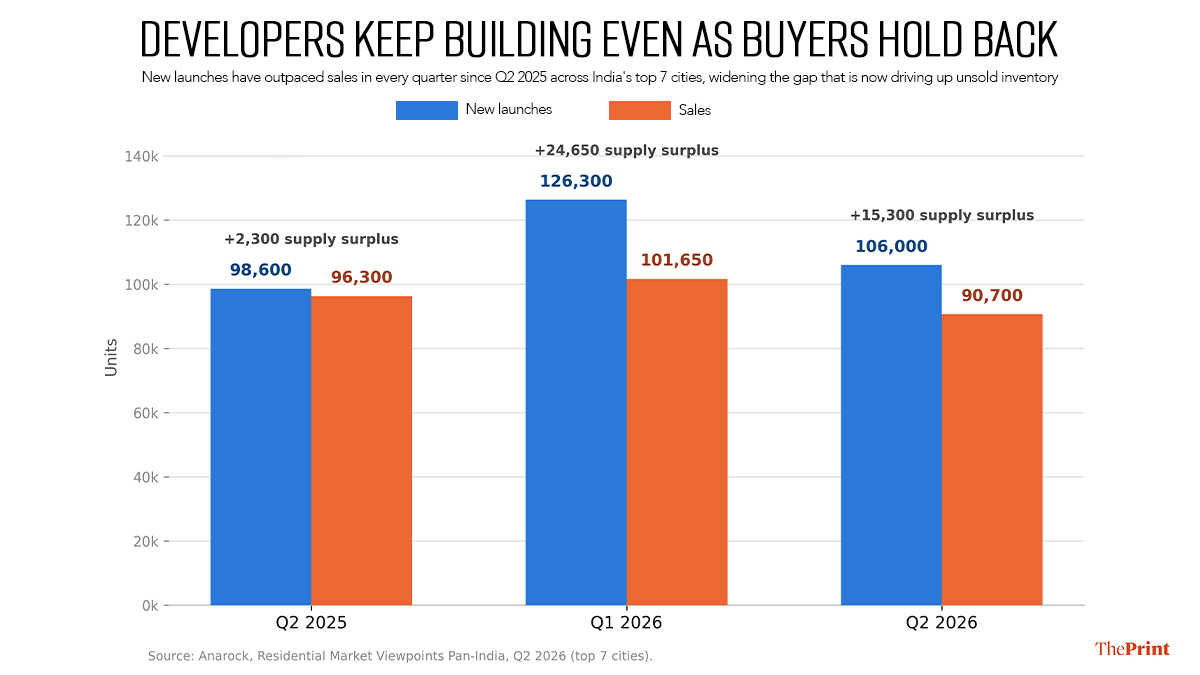
New Delhi: Housing sales across major Indian cities experienced a 6 per cent year-on-year decline in the second quarter of 2026. According to Anarock’s tracker for the top seven cities, sales amounted to approximately 90,700 units, a decrease from 96,300 units in the previous year. Similarly, Proptiger’s Real Insight report, which includes data from eight cities, including Ahmedabad, reported a comparable decline, with sales at 91,729 units compared to 97,674 units in the second quarter of 2025.
Despite these figures suggesting a slowdown, additional data from the same period presents a contrasting narrative. New housing launches increased by 7 per cent, according to Anarock, and by 6 per cent, according to Proptiger. Furthermore, average residential prices rose 7 per cent annually across India, according to Anarock, while Proptiger reported a sales-weighted average price exceeding Rs 10,000 per square foot for the second consecutive quarter.
Additionally, listed developers have projected presales of Rs 1.72 lakh crore for FY27, approximately 10 per cent higher than the current year.
This indicates that sellers were actively increasing construction, raising prices, and anticipating higher sales, even as buyer activity declined. This scenario does not align with a demand collapse but rather suggests a different economic phenomenon, which can be elucidated by two established economic theories, one of which is Nobel Prize-winning.
Search frictions, not demand destruction
The initial concept is the search and matching theory, formulated by Peter Diamond, Dale Mortensen, and Christopher Pissarides, whose work was awarded the 2010 Nobel Memorial Prize in Economic Sciences. Their fundamental insight, originally applied to labour markets, posits that a decline in transactions does not necessarily indicate a decrease in the underlying willingness to trade. Instead, it may signify a deceleration in the matching process between buyers and sellers, as uncertainty on one or both sides increases the cost of committing to a transaction. This phenomenon is precisely what both trackers identify as the cause.
Buyers, confronted with two new sources of uncertainty, namely, the West Asia conflict affecting Gulf-Non-Resident Indian (NRI) capital flows and AI-related workforce concerns in the Information Technology and Information Technology-enabled Services (IT-ITeS) sector, required more time to finalise deals this quarter. Concurrently, developers continued construction based on land parcels acquired for 2024 and 2025. This situation represents a matching friction rather than a demand collapse, a distinction with significant policy implications: frictions tend to resolve once uncertainty diminishes, whereas demand collapses necessitate structural intervention.
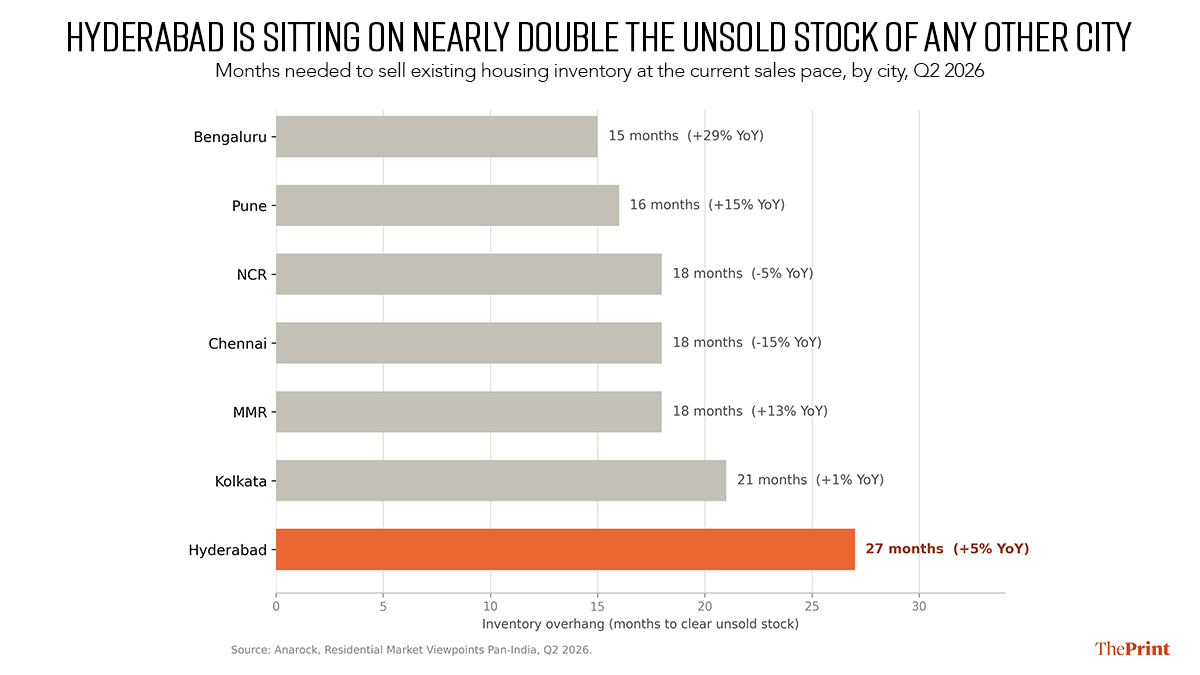
The friction is directly reflected in the inventory data. Anarock’s available stock increased by 10 per cent year-on-year to approximately 616,000 units, elevating the inventory overhang, months of unsold stock at the current sales velocity, to about 19 months, up from 18 months in the previous quarter. Although this remains well below the 25-plus months observed in early 2022, the trend is noteworthy, particularly in Hyderabad, where the overhang has extended to 27 months despite the city experiencing some of the nation’s most robust launch growth.
Also Read: ‘Dream of owning home can’t become nightmare’—SC declares right to housing part of right to life
National picture hides city-level split
While national market friction does not imply uniformity across all cities, aggregate figures can be misleading. According to Proptiger’s city-level analysis for the second quarter of 2026, Bengaluru, Delhi-NCR, and Mumbai MMR launched more homes than they sold, with surpluses of 2641, 775, and 770 units, respectively, aligning with the national oversupply trend. Conversely, Ahmedabad and Chennai exhibited a different pattern, with sales surpassing new supply by 3246 units in Ahmedabad and 2869 units in Chennai. These markets are not characterised by oversupply awaiting buyer demand; rather, developers are under-launching relative to demand.
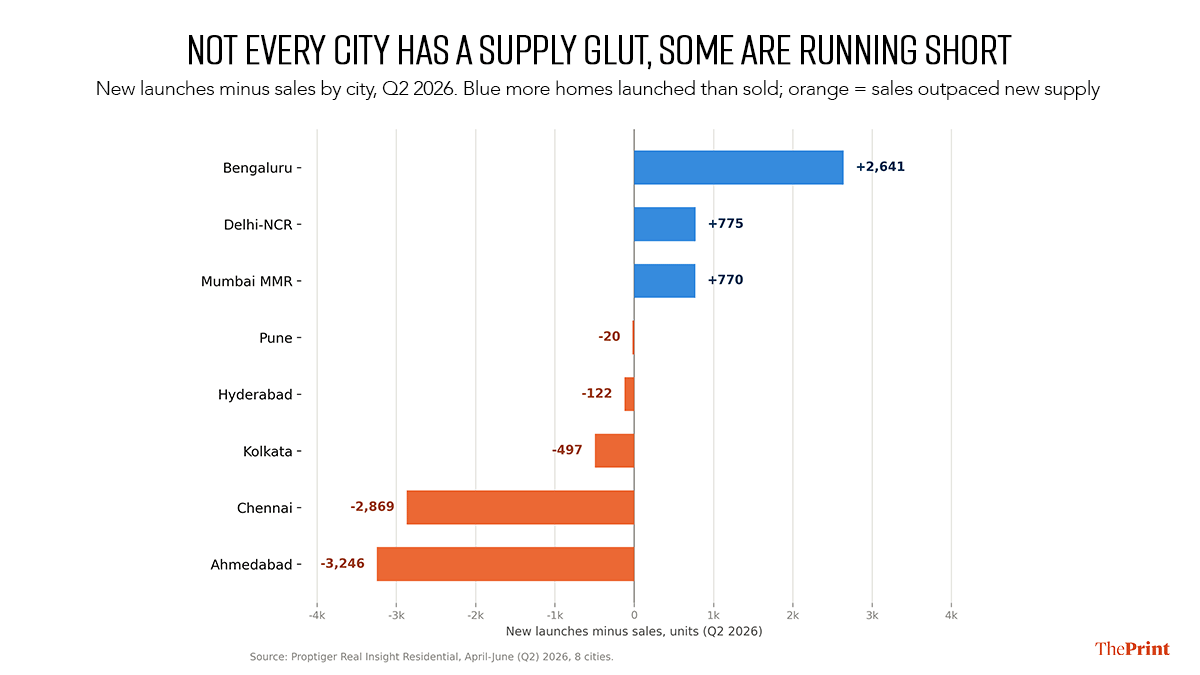
This distinction is crucial for interpreting market friction. A singular national narrative would suggest a uniform slowdown across all cities. However, city-level data reveals that friction is concentrated in a few large metros linked to tech employment, specifically those identified by Anarock and Proptiger as vulnerable to AI-related hiring concerns. In contrast, smaller, more affordable markets are rapidly absorbing available supply.
Premiumisation as a market segmentation story
The second concept pertains to market segmentation, a principle integral to industrial organisation economics since Joan Robinson’s 1933 exploration of imperfect competition. This concept posits that a single product category can fragment into distinct sub-markets catering to buyers with varying price sensitivities. In the context of India’s housing market, there has been a pronounced upward segmentation. According to Anarock’s data on budget-tier housing, homes priced above Rs 2.5 crore now constitute 22 per cent of new launches.
Conversely, the affordable segment, defined as homes priced under Rs 40 lakh, has contracted to merely 6 per cent of the supply, marking the lowest share since the segmentation series commenced in early 2022.
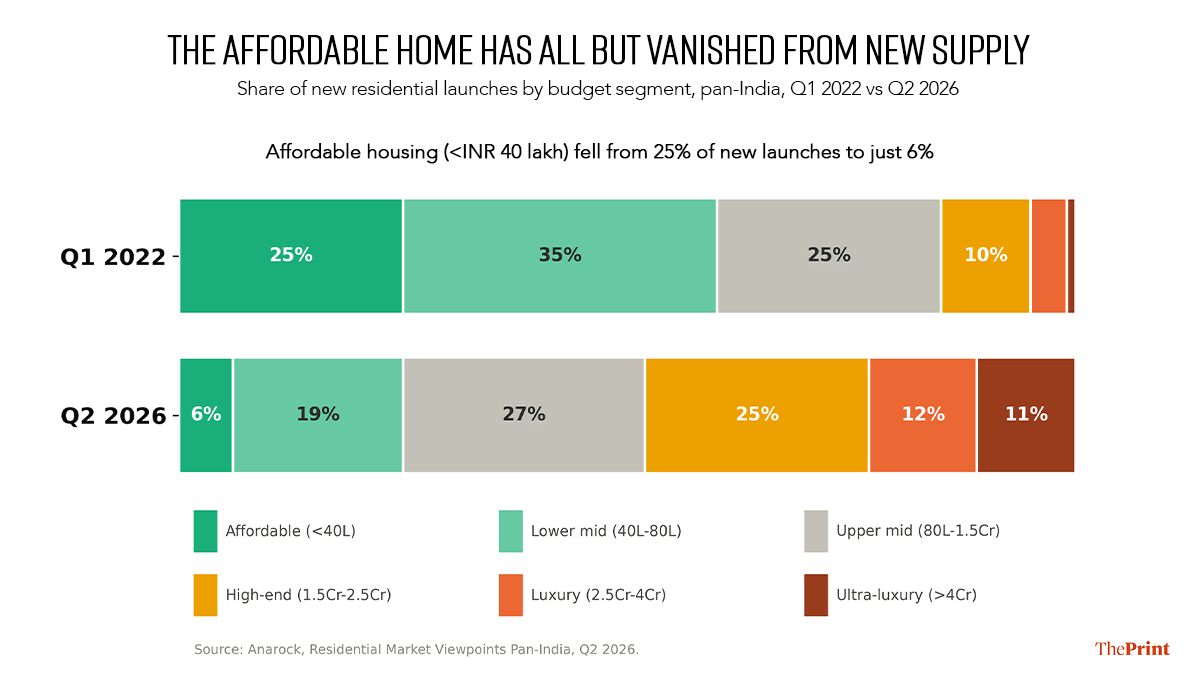
The phenomenon observed is not merely an increase in prices; rather, it involves developers reallocating supply towards buyers who exhibit lower sensitivity to price changes, while diverting it from those who are more price-sensitive. According to standard price theory, a decrease in volume would typically lead to a reduction in prices. The fact that this has not occurred suggests that the market is functioning less as a unified national housing market and more as several segmented markets operating independently.
In this scenario, the luxury segment continues to absorb demand with minimal disruption, whereas the mass-market segment experiences concentrated friction. Additionally, there is a noteworthy aspect concerning cost pass-through, or the lack thereof.
The rationalisation of the Goods and Services Tax (GST) on cement (from 28 per cent to 18 per cent) and on marble and granite (from 12 per cent to 5 per cent) has provided developers with significant relief in input costs. According to standard incidence theory, as articulated by Adam Smith in The Wealth of Nations, the benefits of a cost reduction are typically distributed between producers and consumers based on their relative price sensitivities. However, reports indicate an absence of pass-through to buyers, which aligns with the observation that developers encounter highly inelastic demand in the premium segment, where the cost savings are retained as margin rather than being reflected in competitive pricing.
The road to H2 2026
In the Indian housing market, the Mumbai Metropolitan Region (MMR) and Bengaluru continue to account for approximately half of all national sales and launches. Meanwhile, Kolkata’s sequential sales recovery of over 20 per cent in both reports appears to be a release of pent-up demand following an election-disrupted quarter, rather than a shift in market fundamentals. This does not indicate a downturn.
The economic analysis of the second quarter of 2026 reveals that India’s housing market did not weaken; rather, it underwent a re-segmentation both geographically and by price tier. Geopolitical and employment uncertainties introduced search frictions, slowing the pace of transactions in certain exposed metropolitan areas. Concurrently, the supply base shifted towards a smaller, less price-sensitive segment of the market on a national scale. This is not indicative of a crisis but rather a sign of market maturation.
A maturing market does not require intervention; it requires accurate interpretation. When headline figures suggest a slowdown in housing, it is crucial to consider the actions of sellers during the period when buyers were hesitant, and to identify the cities contributing to these figures. In this quarter, the activities included construction, price adjustments, and strategic planning for the upcoming year, with these actions varying across different regions. This is not indicative of a downturn but rather a market that is aware of its trajectory.
The author, an Associate Fellow at the Chintan Research Foundation, is Consulting Editor (Economics) at ThePrint.
(Edited by Nardeep Singh Dahiya)
Also Read: Affordable housing crisis affecting Asia’s growth. ‘Political rewards from fixing it may be massive’