





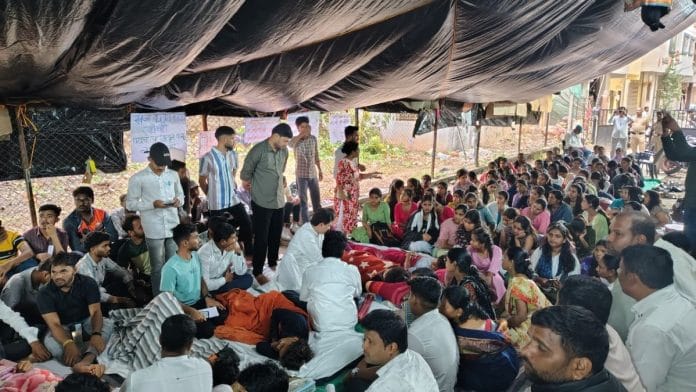

Mumbai: Sixteen days into the protest, the deadlock continues between Maharashtra government and students from the tribal community on hunger strike in Pune’s Manjari area.
On Thursday, Maharashtra Tribal Development Minister Ashok Uike while speaking to reporters in Mumbai urged protesting students to withdraw their stir and not fall into the “trap” of Opposition parties. The previous day, Uike had after a five-hour meeting with protesters said talks ended on a “positive note” and their demands would be fulfilled. He also said the government had sought two days to discuss the demands.
But protesters maintained that their hunger strike will continue until they get assurances from the government in writing.
Students from the tribal community have been protesting in Pune’s Manjari area for 15 days now. Their demands include in-house meals and improved conditions of state-run hostels for tribals and residential (ashram) schools, besides immediate appointments to vacant posts and compensation for kin of students who died in these state-run facilities. Another demand is adjusting allowances for consumer price index (CPI) and inflation.
On Tuesday, the Maharashtra government had accepted a key demand and put on hold the Government Resolution (GR) on revised rules for facilities and amenities at tribal hostels. The GR, issued on 5 August, proposed setting 26 as the upper age limit for enrolment. There was no such upper age limit earlier. In view of the protests, the government revised this upper age limit to 30 on 14 August before ultimately scrapping the GR on 25 August.
This was the second time in three weeks that the rules were modified or withdrawn.
As ThePrint reported earlier, this intervention followed Lok Sabha Leader of the Opposition Rahul Gandhi’s letter to Maharashtra CM Devendra Fadnavis, urging him to take note of the demands raised by protesting students. “Adivasi students from across Maharashtra have been on hunger strike for more than ten days. In Pune, they told me about rules that strip them of their dignity and shut off their path to education. Hostels are unsafe and often lack food, sanitation and medical care. Students have suffered injuries and deaths, including from snake bites. Facilities for women are worse still,” wrote Gandhi, who addressed the Congress party’s ‘Chhatron Ki Gunj’ programme in Pune on 22 August.
A PhD scholar part of the protest in Pune’s Manjari area, Somnath Nirmal, told ThePrint over the phone Thursday, “The government has put a hold on the GR but we want them to issue a new GR with the changes that they have promised us.”
The upper age limit criteria, he said, is discriminatory since one cannot compare students from the Adivasi community to other students. Students from the community sometimes drop out early due to migration, financial constraints or other reasons or take gaps and decide to resume studies at a later point in their lives, he explained.
“Besides, lack of exposure to various courses is also one of the reasons they pursue higher education later in life. They decide to do double graduation or PhD and hence the age limit at hostel becomes discriminatory,” said Nirmal.
Also Read: ‘World’s largest indigenous school’ in Odisha is a jail. ‘We’re all monkeys,’ says tribal student
What triggered protest
For the past two weeks, a group of six students from the tribal community have been on a hunger strike at the hostel for tribal students in Pune’s Manjari area. This was followed by protests in Thane, Palghar, Nandurbar, Nashik and Amravati to Nagpur, among other parts of the state.
The immediate trigger was the GR issued by the Tribal Development Department on 5 August in which it introduced the upper age limit for ashram schools and state-run hostels. Those opposed to it argued that such a rule would leave many aspirants, especially those pursuing higher studies, without any accommodation.
They also highlighted the current state and in many cases lack of hostel facilities, besides rules particularly one under which female students have to undergo ‘pregnancy tests’ once they return from a long leave. This point was also raised by Rahul Gandhi in his letter.
Aiming to highlight their demands, sixstudents between the ages of 20 and 26 sat on an indefinite hunger strike at the hostel for tribal students in Pune’s Manjari on 13 August.
Maharashtra has 500 government-run and 513 government-aided ashram schools for students from the Scheduled Tribes (ST) community pursuing primary or higher education.
These 500 state-run ashram schools currently house about 60,000 students, an official from the Tribal Development Department told ThePrint, requesting anonymity. The facility, the official said, is available to those who reside in villages about 10-12 km away and find it difficult to commute to school each day.
Even at existing hostels and residential (ashram) schools, the situation is precarious.
Government data shows that 584 students enrolled in ashram schools died between 2024 and 2026, translating to an average mortality rate of nearly one student per day across the 730-day period. Causes of death ranged from snakebites and sickle cell disease to serious illnesses, accidents, and death by suicide. Just this month, on 18 August, six girls were bitten by a snake at an ashram school in eastern Maharashtra’s Gadchiroli district. Three of them died. A week later, a seven-year-old boy died in Palghar due to high fever at an ashram school while 26 others were hospitalised with symptoms of cold, cough and fever.
Why students are still protesting
According to Bhaskar Mhase, vice president of the Maharashtra unit of Students’ Federation of India (SFI), the protesters are also demanding more hostels and improved facilities at existing ones.
“At some places, there are no female hostels so where will those female students live? So we demand that the number of hostels should also increase and the facilities provided at the existing and new hostels should be improved,” Mhase told ThePrint over the phone Thursday. He explained that wherever facilities are inadequate, students have to commute daily to school from their villages, which in some cases can lead to drop outs.
According to Mhase, those seeking accommodation at state-run hostels or ashram schools are prone to ill-health for a number of reasons; no provision of hot water for bathing being one of them. Students have to go to a nearby river or well and take a cold bath, he said.
Students from the tribal community protesting in Pune’s Manjari area are also demanding that the Maharashtra government scrap the policy under which food is prepared at a central kitchen and dispatched to state-run hostels or ashram schools.
There is one central kitchen for multiple ashram schools in a 70-100 km radius, said Nirmal, adding that the food gets spoiled by the time it reaches its destination. Sometimes the food comes in late and students sleep without eating. “This is not right and so we demand that the meals should be prepared at the location where the school is and provided to the students immediately,” he said.
Protesters are also demanding that they be given allowances adjusted for inflation and that the authorities act against 12,500 government employees occupying positions reserved for tribals on the basis of ‘fake caste certificates’.
Deployment of an ambulance, anti-snake venom and a medical officer at each ashram school is also a demand, besides Rs 1 crore as compensation for each of the families of those who died at these state-run facilities.
Protesters are also demanding that the government make arrangements to impart semi-English and CBSE education at these ashram schools from the next academic year onwards. As Mhase put it: “The Adivasi community students are slowly coming into the education stream but if the system does not help them out, how will they succeed?”
(Edited by Amrtansh Arora)