





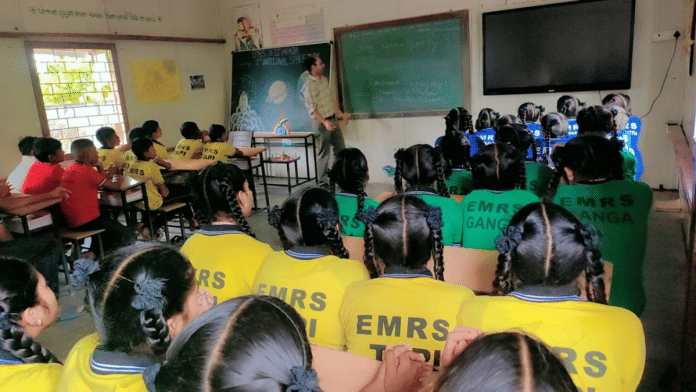


New Delhi: The Standing Committee on Social Justice and Empowerment has recommended that the Ministry of Tribal Affairs consider setting up an independent agency to construct Eklavya Model Residential Schools (EMRS), noting that the measures cited to expedite construction largely repeated those proposed in previous years.
The EMRS scheme, revamped in 2018-19 and overseen by the National Education Society for Tribal Students (NESTS), provides residential schooling from Class VI to XII to tribal children in areas with a high Scheduled Tribe population. It is the single largest head in the Ministry’s budget, accounting for Rs 7,150.01 crore, or 46.67 per cent of the total allocation for 2026-27.
In its report overseen by BJP MP P.C. Mohan, the committee said the steps described by the ministry “are repetitive and these measures have been largely taken by the Ministry of Tribal Affairs earlier also but the same problems persist.” It recommended the ministry “find some alternate solution like setting up of an independent agency which may be competent enough to handle the issues that are delaying the work.”
The report—tabled in both House of Parliement—recorded that 428 of 728 sanctioned EMRS buildings were completed as on 30 April, while work was under way at 249 locations and 51 at the pre-construction stage.
The ministry attributed delays to land availability, forest clearances and the pandemic. The Budget Estimate of Rs 7,088.60 crore for 2025-26 was cut to Rs 4,900 crore at the revised stage, of which NESTS used Rs 4,896.40 crore. The committee said the delay would raise construction costs and “unnecessarily increase the budget” of NESTS.
On EMRS premises, the ministry reported that 381 schools were functioning from their own buildings, 108 from government buildings, and 10 from rented premises. The committee was “unsatisfied with the fact that 118 schools are still functioning from Government and rented buildings,” which, it said, may lack technology and AI labs, smart classrooms and sporting arenas envisaged under the scheme.
The panel also examined the Tribal Freedom Fighters’ Museums, a programme to memorialise tribal figures in the freedom struggle.
Four of 11 sanctioned museums had been inaugurated in Jharkhand, Madhya Pradesh and Chhattisgarh; the Shaheed Veer Narayan Singh Memorial at Nava Raipur was inaugurated by the Prime Minister in November 2025. The Manipur project remained at the DPR preparation and land identification stage.
On the National Overseas Scholarship, which funds meritorious ST students at the top 1,000 ranked universities abroad, the ministry said it proposed raising the family income ceiling from Rs 6 lakh to Rs 8 lakh a year, along with a rise in annual slots from 20 to 50 and in the maintenance allowance from $15,400 to $ 19,250, subject to a Cabinet approval.
As for the Dharti Aaba Janjatiya Gram Utkarsh Abhiyan, a convergence programme launched in October 2024 and involving 17 ministries, the panel noted the Budget Estimate of Rs 2,000 crore for 2025-26 was cut to Rs 500 crore, with Rs 250.02 crore used till 19 January, 2026, and that the Ministries of Rural Development, Jal Shakti, and New and Renewable Energy were yet to start work.
This, it said, “directly points to the deep mismanagement in the execution of the scheme.”
The ministry was allocated Rs 15,421.97 crore for 2026-27 against a demand of Rs 17,223.47 crore.
It suggested the ministry use at least half its funds by September 2026 to avoid a revised-stage cut. Of 11 recommendations, seven were accepted, two were not being pursued, and two required reiteration.
(Edited by Tony Rai)
Also Read: Scheduled Tribes finance body got just 2% of Rs 750 crore it sought from Centre, defunct in 6 states