



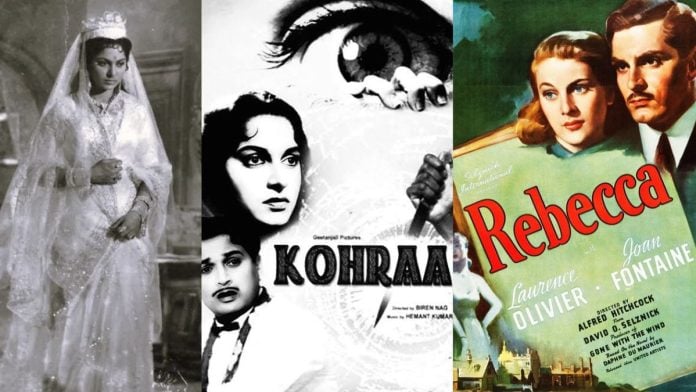
There is no doubt that Indian filmmakers have long looked to Hollywood for inspiration. But adapting a foreign film is not simply a matter of transplanting its plot. Sometimes, in trying to recreate another filmmaker’s cinematic language, they end up leaving audiences puzzled. That is what happened in 1964, when Biren Nag adapted Alfred Hitchcock’s Rebecca nearly 20 years later and named it Kohraa.
Based on Daphne du Maurier’s novel of the same name, Rebecca (1940) follows a young woman who marries a wealthy aristocrat, only to find herself haunted by the memory of his first wife. In Kohraa, Waheeda Rehman plays Rajeshwari, who marries Amit, played by Biswajeet. As she settles into his palatial home, she senses an unsettling presence. It is through the household’s servant, Dai Maa, played by Lalita Pawar, that she learns Amit was married before and that his first wife died in the same mansion.
The story has all the ingredients of a classic gothic tale: a troubled marriage, a new bride, a mysterious servant, a haunted mansion and a sprinkling of aristocratic life. Hitchcock turned them into a timeless gothic thriller. Nag, however, struggles to achieve the same effect. Although Kohraa retains the original’s eerie atmosphere, its dreamlike sequences often confuse rather than intrigue. In trying to evoke the film’s titular kohraa, fog, Nag sometimes allows the mystery to overwhelm the story.
Indian cinema’s history of borrowing from foreign films goes back decades. Homi Wadia’s Hunterwali (1935), for instance, is said to have drawn heavily on the American serial The Perils of Pauline (1914), while Mehboob Khan’s Aurat (1940) has been compared to The Good Earth. Over time, such borrowings became more direct, with Hindi filmmakers adapting foreign plots and cinematic set pieces for domestic audiences.
Examples include Gumnaam (1965), based on Agatha Christie’s And Then There Were None; Raat Aur Din (1967), inspired by The Three Faces of Eve; Ram Aur Shyam (1967), based on The Corsican Brothers; and Jhuk Gaya Aasman (1968), inspired by Here Comes Mr. Jordan. These films did not merely borrow ideas, they often followed the original films closely, sometimes recreating entire sequences while changing certain plot points or the climax to make the stories work for Indian audiences.
Also read: Delhi Ramlila’s fourth effigy is a pink, moustached man with a cockroach crawling up his chest
A crucial difference
Kohraa follows a similar path, but Nag makes a crucial change to Rebecca: he absolves Amit of responsibility for his first wife’s death.
In Hitchcock’s film, Maxim reveals that he confronted Rebecca after she taunted him with the possibility of a pregnancy. During their confrontation, she fell and died. He subsequently concealed her death, making it appear that she had drowned at sea. The truth eventually emerges, and the obsessive housekeeper, Mrs Danvers, sets the mansion on fire before dying in the blaze, while Maxim and his second wife escape.
Kohraa takes a different route. Here, Amit is innocent, and Dai Maa despises Poonam, Amit’s first wife, for her infidelity and believes she must protect him from his unhappy marriage. By shifting the guilt away from the husband, Nag retains the broad framework of Rebecca while changing the motivations behind the murder and giving the story a different moral angle for Indian audiences.
Then there are the songs, which often do more to convey Rajeshwari’s inner life than the film’s visual flourishes. Hemant Kumar’s “Yeh Nayan Dare Dare” and “Band Rahon Ki Manzil” capture her loneliness and confusion as she adjusts to married life in a luxurious yet desolate mansion. Lata Mangeshkar’s “O Beqarar Dil” and “Jhoom Jhoom Dhalti Raat”, meanwhile, evoke the desires and uncertainties of a newly married woman.
The music gives emotional shape to Rajeshwari’s experience in ways that the fog, shadows and dreamlike sequences sometimes fail to achieve. In a film preoccupied with mystery, the songs offer a more intimate understanding of the woman at its centre.
Kohraa was Nag’s second directorial venture, following Bees Saal Baad (1962). His command of light and shadow, central to the film’s visual atmosphere, drew on his earlier experience as an art director at Guru Dutt Productions. He had worked on films including C.I.D. (1956), Chaudhvin Ka Chand (1960) and Sahib Bibi Aur Ghulam (1962). The visuals lend Kohraa much of its gothic appeal, even when its storytelling struggles to match the suspense of its inspiration.
(Edited by Janaki Pande)