



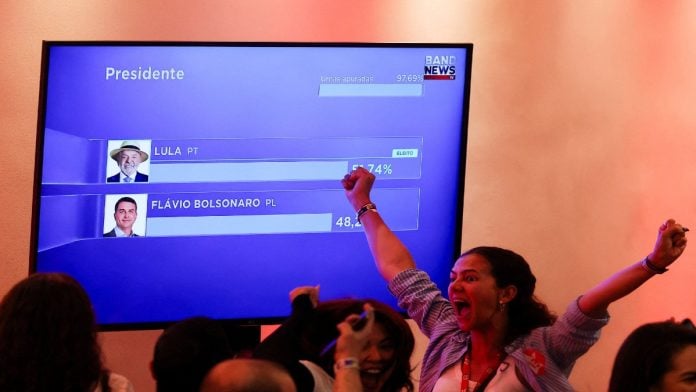
New Delhi: For Luiz Inácio Lula da Silva, the incumbent president of Brazil, political comebacks are usual business. After a month of multiple political obituaries, the 80-year-old staged another stunning comeback Monday, defying projections to defeat Flávio Bolsonaro, the 45-year-old senator and son of former president Jair Bolsonaro, to secure an unprecedented fourth presidential term. No other candidate in Brazilian presidential elections has ever won a runoff after losing the first round.
With his victory, Brazil has staved off the conservative wave in Latin America that has seen Colombia, Peru, Argentina and Chile bring in right-wing governments—all with the backing of US President Donald Trump. In his winning speech, taking an apparent dig at Trump, Lula declared, “This country does not accept being anybody’s backyard.”
Prime Minister Narendra Modi was among the leaders who congratulated Lula as his victory became evident, referring to him as “my dear friend”. “Look forward to working closely with him to further deepen and expand the multifaceted India-Brazil Strategic Partnership,” he wrote on X. “Together, we will continue to strengthen our cooperation across diverse sectors, advance the shared priorities of the Global South and work towards a more inclusive, equitable and sustainable world.”
Lula received 51.78 per cent of the vote against Bolsonaro’s 48.22 per cent in Sunday’s runoff, the second round of voting after an inconclusive first. Bolsonaro had emerged ahead in the first round, held on 4 October, with 47.03 per cent of valid votes against Lula’s 45.16 per cent. Neither candidate won over 50 per cent of the vote, forcing a runoff that cast doubt on Lula’s political future. While he lost the first round by around 2.2 million votes, by the end of the runoff, he had won by roughly 4.3 million.
Bolsonaro has refused to concede defeat—much like his father in 2022—and is seeking to annul the runoff. He has criticised a decision by the Supreme Court to extend voting by two hours across the country. “Lula’s campaign had requested the extension, citing difficulties transporting voters to polling stations in several states. Bolsonaro’s campaign had also sought extra voting time, but only in municipalities across five states, citing heavy rain, flooding and power outages,” DW reported.
Also Read: Lula in dead heat with Flávio Bolsonaro as Brazil prepares to elect next president: What’s at stake
A political career built on comebacks
Lula worked in a factory before becoming a union leader in São Paulo in the late 1970s. He helped establish the Workers’ Party in 1980 and became one of the most recognisable figures of Brazil’s democratic transition over that decade.
His first three presidential campaigns, in 1989, 1994 and 1998, ended in defeat. In 2002, he finally won the presidency and secured re-election in 2006. He left office in 2010 after completing the two consecutive terms permitted by the constitution.
He was then imprisoned over corruption charges but Brazil’s Supreme Federal Court ruled that the federal court in Curitiba lacked jurisdiction to hear the relevant cases, invalidating its decisions and restoring his eligibility to contest elections.
In 2022, he defeated Jair Bolsonaro, then the incumbent president. The latter was subsequently convicted over a plot to overturn the result of the election and sentenced to 27 years in prison.
Lula’s fourth term is possible because Brazil restricts consecutive presidential terms rather than imposing a lifetime limit of two. A president may serve two consecutive terms and seek the same office again after an interruption.
Lula’s latest victory comes just before his 81st birthday Tuesday. His inauguration is scheduled for 5 January 2027.
At 80, Lula has presented his victory as something larger than personal political survival. “I always think God has been very generous to me,” he said in his victory statement. “And why was I chosen by God?” he asked, before declaring his belief that God’s finger had always been on his head.
The religious language was also politically significant. For the first time in Brazil’s history, evangelical Christians account for more than a quarter of the population, according to census figures released in June 2025. Data from the 2022 census, published by the Brazilian Institute of Geography and Statistics, counted 47.4 million evangelicals, or 26.9 per cent of Brazilians aged 10 and older, up from 21.6 per cent in 2010.
The figures include Pentecostals and other Protestant groups, an increasingly important constituency in Brazilian politics, particularly for the conservative right.
Also Read: Brazil’s Bolsonaro, Lula spar in first debate as personal attacks fly
Economy and foreign policy
Lula’s return to office will be accompanied by expectations that extend well beyond electoral symbolism. Brazil faces persistent questions about public debt, fiscal credibility, investment and economic growth. The Atlantic Council’s pre-election analysis placed public debt above 80 per cent of gross domestic product and estimated annual fiscal deficits at almost 9 per cent of GDP.
A Lula government is likely to favour a more gradual fiscal adjustment, preserving room for public investment and social programmes while attempting to maintain a credible framework for managing debt, the analysis noted. Its challenge will be to persuade financial markets that the approach is sufficiently ambitious to stabilise the debt trajectory, it added.
Lula must also contend with a Congress in which right-wing and centre-right parties have strengthened their position. Trade agreements and other commitments requiring legislative approval will depend on negotiations with lawmakers whose political preferences may differ sharply from those of the president.
The result is a familiar tension in Brazilian politics: a president elected on a promise of change, but required to govern through compromise.
The most consequential implications of Lula’s victory may emerge beyond Brazil’s borders. Brazil’s relationship with the United States will remain important regardless of Lula’s political preferences. The same is true of China, which has become Brazil’s largest trading partner. During the campaign, Lula criticised the implications of greater American involvement in Brazil’s critical minerals sector. Bolsonaro, meanwhile, defended closer intelligence-sharing and security cooperation with Washington. Lula has emphasised strategic autonomy, diversified partnerships and multilateral diplomacy.
During Lula’s first two terms, Brazil sought to transform its economic weight and diplomatic reach into a greater role in global governance. Lula and his foreign minister, Celso Amorim, shifted the emphasis of Brazilian foreign policy away from an overwhelmingly North-South orientation towards South-South cooperation.
Internationally, Brazil expanded its engagement with African countries and helped establish BRICS alongside Russia, India, China and South Africa.
Brazil also worked with India and South Africa through the IBSA (India, Brazil, South Africa) dialogue forum, which seeks to promote cooperation among the three democracies and develop a shared agenda for addressing poverty and other development challenges. His government also repeatedly called for reform of the United Nations Security Council, seeking a permanent seat for Brazil. Its ambitions aligned with those of Germany, Japan and India, bringing the four countries together in the G4 initiative.
Brazil is a major producer of agricultural commodities, energy, minerals and manufactured goods. Its exports to China provide a substantial economic foundation that neither a new government nor a change in diplomatic tone can easily replace.
Also Read: India’s Modi speaks to Brazil’s Lula on strategic partnership
Why it matters for India
For India, Lula’s victory offers an opportunity that extends beyond the return of a familiar political ally.
Brazil and India have long shared an interest in reforming global governance, expanding the influence of emerging economies and preserving room for independent foreign policy. Yet their relationship has never approached the intensity of either country’s ties with its largest trading partners.
That could change under Lula’s renewed presidency, particularly if Brasilia and New Delhi make greater use of their overlapping interests in BRICS, IBSA and the G20.
Like Brazil, India too seeks to balance close relations with the United States and other regional partners, including through the Quad, while maintaining its longstanding relationship with Russia. Brazil, meanwhile, has historically sought to mitigate American influence in South America while expanding its international partnerships.
Neither country wants to be forced into a choice between Washington and Beijing, or between the Western alliance and Russia.
There is also a strong economic case for a deeper relationship. India is seeking to diversify its international partnerships while managing its geopolitical rivalry with China. Brazil, for its part, is aware of the risks created by its heavy dependence on commodity exports to China and its need for greater foreign investment.
During the campaign, Lula emphasised his desire to travel abroad to encourage investment in Brazil. India could be an important destination for that effort.
Stronger commercial ties would also offer benefits beyond the immediate value of trade. They could help both countries reduce vulnerabilities arising from excessive dependence on a small number of partners, while providing a firmer economic foundation for their diplomatic cooperation.
(Edited by Sunanda Ranjan)
Also Read: How Brazil’s election winner could reshape its institutions as vacancies mount