



New Delhi: “Raghukul reet sada chali aayi, pran jaaye par vachan na jaaye.”
Every Indian familiar with the Ramayana recognises this well-known line from Tulsidas’s Ramcharitmanas, expressing King Dasharatha’s commitment to a defining principle of the Raghu dynasty: life may be sacrificed, but a promise must never be broken. For centuries, this unwavering reliability has been regarded as a cornerstone of righteous governance—a ruler who honours his word allows citizens to place their trust in his decisions and plan their lives accordingly.
Yet Dasharatha’s story also reveals the dangers of an unyielding commitment when circumstances change. This conflict between keeping promises and exercising judgement offers an understanding of the work of the two economists awarded the Nobel Prize for their contributions to understanding economic expectations and stabilisation. Their research helps explain why credible commitments are important for central banks, but also why credibility need not mean following a predetermined course of action regardless of what happens.
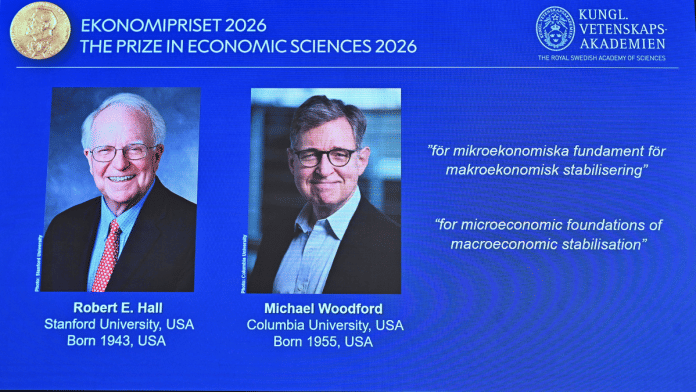
Robert E. Hall of Stanford University and Michael Woodford of Columbia University were recognised for their contributions to understanding the “microeconomic foundations of macroeconomic stabilisation”. At the heart of their work is a deceptively simple idea: an economy is not a machine that responds predictably to policy interventions. It comprises millions of households and businesses that continually form expectations about the future. This means that those who can influence expectations about the future can, in turn, influence present actions.
Their work developed against the backdrop of the economic turbulence of the 1970s, when oil shocks brought high inflation and unemployment simultaneously, challenging conventional approaches to economic stabilisation. Rather than treating the economy as a system that policymakers could steer through immediate interventions alone, their research helped explain how individual decisions and expectations shape macroeconomic outcomes.
Also Read: Anne Carson is a literary Houdini. Her diabolical brilliance got her the Nobel
Living in tomorrow
In 1978, Hall found an important insight in household behaviour. Building on Milton Friedman’s idea that families allocate spending based on anticipated lifetime earnings,
Hall envisioned individuals who incorporate all known future information into their current decisions.
Consider a young engineer in Patna who receives a job offer from a Bengaluru firm. Upon receiving the offer, she may begin planning for a motorbike or a flat rather than waiting for her first salary.
Hall’s research showed that, if families made decisions this way, current spending already reflects foreseeable future events and changes in consumption depend on new information that was not previously anticipated. Since genuinely new information is inherently unpredictable, consumption changes can, in this model, follow a pattern of random fluctuations, known in economics as a random walk.
This insight had important implications for economic policies: what people expect can matter as much as the immediate effects of a policy intervention. An announcement about future policy can therefore influence behaviour well before the government or central bank acts.
Woodford developed a broader theory of central banking centred on this forward-looking behaviour. Initially trained as a lawyer at Yale before transitioning to economics, he published his influential work ‘Interest and Prices’ in 2003. He examined how expectations about future monetary policy influence current economic decisions, including how businesses set prices.
Consider a dhaba owner who rarely updates his menu board. Knowing that he may not be able to revise prices immediately, he set prices today with anticipated future costs in mind.
Taken together, Hall’s work on household consumption and Woodford’s work on businesses showed that the economy is influenced more by public expectations about what policymakers will do over the next two to three years than current policy settings.
Woodford’s work consequently concluded that monetary policy primarily involves managing expectations, with a central bank’s communication serving as its most potent tool.
Following the 2008 financial crisis, when policy rates in several economies approached zero, central banks adopted his “forward guidance” strategy to commit to maintain low rates for an extended period. This commitment alone helped reduce borrowing costs and stabilise the economic recovery.
Dasharatha’s dilemma
The Ramayana offers a cautionary message for central bankers. When Kaikeyi invoked the boons Dasharatha had granted her, demanding Rama’s exile, Dasharatha honoured his promise despite its devastating consequences. This part of the story shows that a promise made under one set of circumstances and fulfilled uncritically in another can become a liability rather than a virtue.
The lesson for central banks is that a commitment to an objective need not require inflexibility about the means of achieving it.
Central banks faced this challenge after the pandemic. The US Federal Reserve, having committed to keeping interest rates near zero for an extended period, faced constraints as inflation surged in 2021, delaying rate increases until March 2022.
This predicament had been foreseen by economists.
In a 2012 paper, Jeffrey Campbell and his colleagues at the Federal Reserve Bank of Chicago discussed what they called “Odyssean” and “Delphic” guidance. Odyssean guidance involves a binding commitment analogous to the Greek hero securing himself to his ship’s mast to resist the Sirens’ song. Delphic guidance, by contrast, refers to a sincere projection of the central bank’s responses to evolving conditions. Woodford was among the paper’s discussants.
The discourse has since resurfaced, with the Federal Reserve, under its new chair, reducing its reliance on inflexible guidance. Woodford argues that credibility comes not from following a predetermined path, but from consistently and reliably responding to unfolding events.
The wiser vow on Mint Road
In 2016, India codified this philosophy into law by amending the RBI Act to establish a 4 percent inflation target with a tolerance band of two percentage points on either side. The framework also established a six-member Monetary Policy Committee (MPC), with its decisions, voting records and minutes made public.
This framework marked its tenth anniversary this month, and the RBI’s decision on 7 October demonstrated its maturity. The repo rate increased by 25 basis points to 5.50 per cent, marking the first hike since February 2023.
However, the most significant aspect was the adoption of a new stance termed “calibrated tightening.” This approach signals commitment and discipline rather than rigid adherence to a predetermined path. It signals to families and shopkeepers that the RBI will prevent an oil shock from shaping their expectations while allowing flexibility as data evolves. This reflects a blend of Delphic wisdom and steadfast resolve.
If Woodford were to meet Tulsidas, they might agree in a more nuanced interpretation of an enduring principle—an authority’s strength lies in the promise it is trusted to uphold, yet the most prudent course of action is not following a fixed path regardless of the circumstances.
The principle of “Pran jaaye par vachan na jaaye” holds, provided the vachan is judiciously chosen.
(Edited by Chingkheinganbi Mayengbam)