




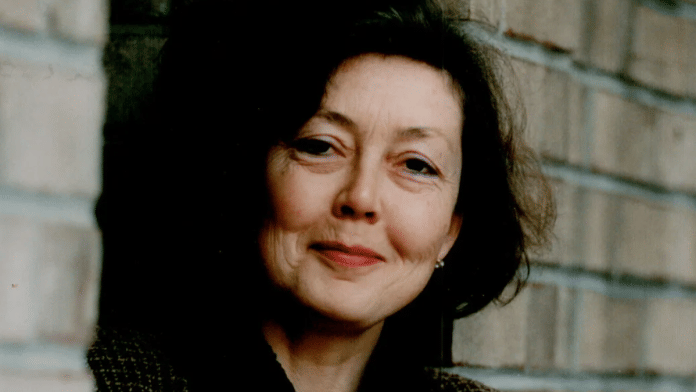

Anne Carson is unbearable. She has always wanted to be, in her own words. She makes reading an uneasy business. She toys with words, giving them her own shape, as her work slips between poetry, essay, classical scholarship and fiction, often without pausing to announce the transition. There is no particular box you can classify her oeuvre into. A monumental task that even the Nobel committee that awarded her the highest honour for Literature couldn’t accomplish. Opting instead to simply call her writing “inventive”.
Inventive sums it up yet falls short. She leaves you feeling, but confused. You may be moved, amused or vaguely disturbed. You may be all three at once. The difficulty is not incidental to the experience. It is the experience.
Carson knows this. She once commented on the enigma her writing is.
“I do think that something of the effect I have on people is to put everything on an edge where they’re both infatuated with a kind of charmingness happening in the person or in the writing, and also flatly terrified by a revelation or acceptance of revelation that’s almost happening, never quite totally happening,” she said in 2004 interview to The Paris Review.
That quality helps explain why Carson’s writing has inspired equal parts devotion and bewilderment. Literature lovers rejoiced at her win. Even as Carson remains difficult to categorise, she is hardly obscure. Most of us agree it was a long time coming.
Others were divided. A friend of mine, while discussing her win, described how someone he knew after reading a section of Autobiography of Red (1998), said: “This won the Nobel Prize? I dunno about this, man”.
For my friend, however, the gay Herakles monster book is “for him”.
The contradiction of love
One of Carson’s peculiar gifts is that she makes the classics feel less like an inheritance to be preserved than a set of possibilities to be disturbed. Homer is among her favourite writers, and she has more than once described herself as a classicist. But her relationship with tradition is not one of dutiful reverence. She takes what she loves seriously enough to disobey it.
Carson belongs to all, not just the classicists. Long before a Nobel Prize, which cemented her in history and will in due course introduce her to a wider audience, her lines had found their way into the internet’s cosy literary cultures. From Tumblr and dark-academia pages to Instagram poetry accounts, Carson reigned supreme. On the internet, readers encountered in her work a language for feelings they could not quite articulate themselves.
I discovered Carson relatively late. I was in my classics phase, wading into the world of Greek literature (pretending to be above the fray and appear ‘cool’ among the literature snobs ), when a friend recommended Autobiography of Red. I picked it up almost out of boredom and was immediately hooked— is it a novel in verse? Is it a poem? No one could tell. The ancient story of Geryon, the red-winged monster killed by Herakles, is at once a contemporary story of a young man, love and heartbreak. The language of desire is no longer ancient or incomprehensible. It is recognisable and relatable. Ask any reader, and they will tell you– nothing beats her rendition of Grief Lessons: Four Plays by Euripides (2006).
Also Read: Anne Carson’s Nobel win is big news, but 19 female winners isn’t enough
A literary Houdini
Translation is one of the many bows in her quiver. Carson’s translations of Sappho, the ancient Greek poet who wrote about love, are seminal not because of the language but because of her feminist refusal to fill the gaps of the original papyrus with words. She let the silences breathe, unlike her predecessors.
In Carson’s hands, the past is neither a museum nor a moral authority. It is something to make and remake, with your own version. In Plainwater: Essays and Poetry (1998), Carson is mock-interviewing a seventh-century Greek poet. In Men in the Off Hours, she imagines Virginia Woolf and Thucydides discussing war.
Perhaps this is why her writing has travelled so well. Carson’s classicism is demanding, but her work does not require the reader to arrive with a complete knowledge of the past and present. But simply a willingness to be surprised. The references matter, but not as much as the experience of encountering them in the new and the unknown.
Sam Anderson perfectly summed it up in his 2013 New York Times profile, Carson produces “poetry that can seduce even people who don’t like poetry”.
“Carson gives the impression — on the page, at readings — of someone from another world, either extraterrestrial or ancient, for whom our modern earthly categories are too artificial and simplistic to contain anything like the real truth she is determined to communicate”, he wrote.
Her work is restless; time moves in circles or sometimes in a vacuum. The living and the dead interact; lovers move from antiquity to modernity; a word is written with a different meaning. And there is never a form, a poem is an essay, a book an object, because grief cannot be contained by ordinary narrative. A myth becomes contemporary because desire has never belonged exclusively to the past.
In all of this, Carson can be maddening. Her work is diabolically distorted. There are moments when one wonders whether the obscurity is illuminating anything at all. Feeling precedes understanding.
The reader is left doing what Carson herself seems to do: testing the limits of a form to discover what it might contain.
There is something distinctly contemporary about this refusal to fit into a box. In a Tetris-like world, with neat edges and clear labels, exits the bipolarity of Carson’s literature. She offers a different proposition from all existing understandings.
In the poem ‘Wildly Constant’, Carson imagines a library of melted books, their sentences streaming across the floor, their punctuation settling at the bottom like residue. The result, she suggests, would be confusing, “unforgivable and a great adventure”. It is an apt description of her own literary universe.
Unbearable: eccentric, elusive, occasionally exasperating, and unmistakably her own. In making language strange, Carson makes room for experiences that the ordinary often flattens. She does not always tell us what we feel. She gives us a way to feel it before we know its name. And that, for a writer, may be a more lasting achievement than being understood.
“We participate in the creation of the world by decreating ourselves,” she wrote in her in her book Decreation: Poetry, Essays, Opera (2005). And that is exactly what makes her so irresistible.
Views are personal.
(Edited by Insha Jalil Waziri)