




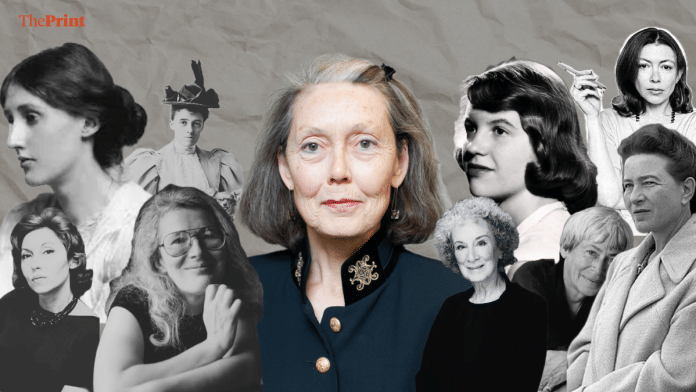

Anne Carson is only the 19th woman to win the Nobel Prize in Literature since the prize was first awarded in 1901. The statistic for men in the same category is a whopping 104. So while her win is a cause for celebration, it is also a damning indictment of women in yet another “male-dominated” field. More than a century of literary honours, and women still account for barely one-sixth of the winners.
The Booker Prize, too, has historically rewarded more men than women, though that gap has narrowed in recent years. There are many defences: prizes are subjective, and no writer is owed a trophy. Literary merit cannot be measured by counting winners. All true. But when it happens across institutions and generations, it becomes a disconcerting pattern. And we must ask the question: why are men only deemed worthy as winners?
The list of women who never won the Nobel is extraordinary: Virginia Woolf, Maya Angelou, Edith Wharton, Sylvia Plath, Clarice Lispector, Ursula K Le Guin, Angela Carter, Simone de Beauvoir, Anne Sexton, and Joan Didion. Even the great Margaret Atwood, a perennial favourite in the annual guessing game, does not have one. These writers do not need a Nobel to establish their place in literature. The prize, however, helps decide who gets read, taught, translated, and more importantly, remembered.
But this fight for recognition began long before prize committees entered the picture.
The female quotient
It began with the absence of women’s names. In the annals of history, women are either inconspicuously absent or hiding under pseudonyms. Their struggles to be a part of society become more apparent than ever in the 19th century.
Mary Ann Evans had to become George Eliot. The Brontë sisters published as Currer, Ellis and Acton Bell. George Sand was born Amandine Aurore Dupin. Katharine Bradley and Edith Cooper wrote as Michael Field.
Imagine having to conceal your identity to give your talent a fair hearing. The pseudonym became both passport and protection, a way around the prejudice that a woman’s writing was likely to be sentimental or slight before anyone had even read a word of it.
Marriage made this business of disappearing even more literal. Take Colette, for example, now recognised as one of France’s great writers. Her first husband, Henry Gauthier-Villars, published the Claudine novels (1900–1904) under his own name and eventually sold the rights without her consent. She supplied the substance; he collected the spoils.
And then there was the Mother of Science Fiction, Mary Shelley. An 18-year-old wrote Frankenstein and published it anonymously in 1818. Percy Bysshe Shelley edited the manuscript and wrote its preface, but modern stylometric research supports Mary as its author.
But the famous husband has often hovered over the story, as though a young woman’s imagination always required a male chaperone. She changed literature, and yet her bigger identity remained a Romantic great’s love.
Also Read: Canadian author Anne Carson wins Literature Nobel Prize for ‘reinventing’ classical works
Making space in a man’s world
Women entered a literary world in which the rules, the gatekeepers and the idea of greatness itself were largely shaped by men. Publishers chose what to print; critics decided what deserved attention; universities determined what belonged on the syllabus. Their choices were not made in a vacuum; their strategies and sly workarounds were best suited to the injustice.
A man could write about war, sex, ambition or loneliness and he would be hailed as speaking to the human condition. A woman writing about marriage or motherhood was more likely to be filed under “women’s writing”, as though half the human experience were a niche interest.
A man’s novel about marriage could be universal, but a woman’s would be domestic. A man’s account of desire could be philosophical and worldly; a woman’s would be confessional smut.
Of course, not every male Nobel laureate was undeserving, nor was every woman who missed out necessarily better than the writer who won. But it needs to be acknowledged that literary decisions did not escape the overriding prejudices. The scale is tipped in favour of the first sex, even as the rest continues to put all their might into it.
Women have had to be exceptional just to be considered. Men, on the other hand, far too often have just had to exist to be deemed “great”. In literature or otherwise. Equality has always been excess for the world, not a necessity.
Things have changed now. Women hardly use male pseudonyms now (barring JK Rowling/Robert Galbraith) and literary prizes have become more attentive to writers once reduced to the footnotes of history. But the virus has not been eradicated yet. The progress cannot and must not be confused with repair. The fact that 19 women have won the Nobel today does not undo the history of women who struggled to get their names on their books, control their earnings or secure a place in the canon. Nineteen wins out of 123 are not significant reparations; it’s just a quarter of the human experience.
Celebrate Carson. But let’s not forget the women who wrote brilliant books while the room was still deciding whether they belonged there. Some greats are still alive, others are in the making. History must be kinder and more just to the Zadie Smiths, Chimamanda Ngozi Adichies, Can Xues, and the Arundhati Roys of the world. Give them the limelight they deserve.
Views are personal.
(Edited by Insha Jalil Waziri)