



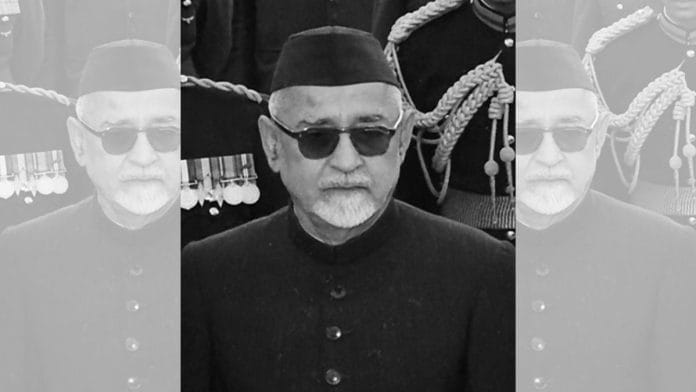

It is said that habit dulls the edge of sensitivity. If this were so, I should by now be going through inauguration ceremonies and seminars, all symposia, conferences and contests without even noticing them. But I am, on the contrary, becoming more and more allergic to them. Once in a while there is an inexplicable change and I feel even happy at being asked to repeat the performance. This was the case when my dear friend G. Ramachandran asked me to inaugurate the International Inter-Religious Symposium on Peace. And so here I am and inevitably must say a few words.
Let us be clear in our minds that, in spite of all advances in science and technology, religions still exercise a powerful influence on the minds of millions of human beings. The majority of the people of the world belong to one religion or another. Great issues continue to be settled, consciously or unconsciously, against the background of religious convictions. It will be unwise for anyone to ignore religious influences in finding solutions for world problems, big or small.
Let us also be clear that all religions teach the reality of God and obedience to the will of God translating itself into goodwill and peace among men. All religions have their systems of ethics. Religions and ethics have marched hand in hand throughout history. This perhaps is the reason why religions continue to be of great significance in lifting man above the animal kingdom. Religions have considerably helped to humanise human relations and to create and sustain the higher values of human conduct. If hatred, violence and evil have still persisted in the world, it is a matter for conjecture of what the situation might have been without religious influences. We are often apt to forget the might-have-beens.
Let us not, however, forget that religious passions have sometimes become accessory to conflicts and wars. During their long history, religions became confined within circles of their own and there came competitions and conflicts among them. Perhaps these competitions and conflicts have themselves led to a deeper introspection of the human soul with the ultimate result that truth, love and non-violence received a fuller confirmation. One of the heartening trends in our time is the increasing inter-religious co-operation and harmony which we now witness in different parts of the world. The winds of liberalisation blowing within the Roman Catholic Church and the consequent rapprochement between it and the rest of the Christian world is undoubtedly one of these significant trends. Buddhism and Hinduism have also come closer to each other in recent times. We have also witnessed uplifting influences sweeping through Islam. All these have inevitably led to the reassertion of higher spiritual, ethical and cultural values. They will help us to move, however slowly, towards a more united human community in good time.
The supreme challenge of the century in which we live, arising both from advances in science and religions, is to move towards the one-world community. Just as we have now great multi-national federations like the USA, the USSR and India, we must not hesitate to think in terms of a World Federation, of World Law, a World Court and a World Police Force preserving the autonomy of nations and at the same time preventing wars and violent conflicts among them. This will, of course, mean disarmament, which may be slow and progressive but nevertheless nations must disarm. These religions of the world, which all teach and emphasise the supremacy of God and the law of goodwill and peace among men, will have to play a fuller and more conscious part than till now in taking man to such a future. Religions can and, therefore, must influence the mind of man positively to achieve the great goal of the one-world community.
But in order that religions can effectively play this historic role, they will have to look beyond such dogmas, rituals and practices which obstruct the flow of life from different religious circles towards a new sense of harmony and collaboration. This will mean nothing less than the self-purification from within of every religious community. Who can deny that all religious communities require today to undergo such self-purification?
Once this is achieved it will be found that the path to harmony and co-operation among religions lies open without any obstruction.
Mahatma Gandhi, in our own lifetime, equated spirituality to truth and ethics to non-violence. To him the core of every religion was truth and non-violence, with love linking the two. From this flowed his teaching of unreserved reverence for all the great religions in the world. Reverence is more than tolerance. Gandhiji asked for much more than tolerance among the great religious systems. He pleaded for deep mutual understanding and the humility to learn from each other.
We must also take care not to put science and religion against each other, however contradictory they might appear on the surface. On the contrary, we must put them together for the good of man. Science without religion becomes rudderless in terms of human destiny and religion without science tends to superstition and reaction. The gap between religion and science, if not closed, will be fatal to the growth and progress of human society.
World peace today depends largely upon the marriage of religion and science. Religion should be enabled to point to the direction and science should be enabled to find the means by which human society can move towards a united, prosperous, happy and peaceful world community.
The purpose of this Symposium, as is evident, will be for all the representatives of different religions gathered together here to recover the profound heritage of truth, love and non-violence in every religion and then to resolve firmly that this heritage shall not be allowed to remain dormant. It must be recovered because it can be recovered. It has now to be reapplied to the solution of the great problem of making world peace.
We have now long realised that peace and justice are indivisible. Peace without justice will be short-lived and justice without peace will be a contradiction. Religious leadership must reckon with this inter-dependence of peace and justice. Who can understand the indivisibility of the two more than true votaries of the great religions which keep the love of God and the love of man in their hearts? If religious leaders will stand for peace and justice unequivocally, then we take a big step towards world peace. We want peace between individuals and groups within nations and peace among the nations. These are all vitally interdependent. If the spirit of the Sermon on the Mount, Buddha’s philosophy of compassion, the Hindu concept of Ahimsa, and the passion of Islam for obedience to the will of God can combine, then we shall see generated the most potent influence for world peace.
Let each one of us return from this International Inter-Religious Symposium to each one’s religious constituency with the determination that the message of this Symposium will be the watchword of all of our work hereafter. Then something significant can happen to strengthen the forces of peace in the world. The world is on the brink of great peril; perhaps the suicide of the race in a nuclear war. We must push back this peril with all the strength in us and we can best do so as men and women of deep religious and ethical convictions which have the sanction of centuries and which have never been proved to be without deep significance in building up a just and peaceful human society.
This is part of ThePrint’s Great Speeches series. It features speeches and debates that shaped modern India.
Very wise essay by the good doctor. however, its obvious that he was unaware of Zionism and its dirty machinations throughout the world that promote violence and aggression, using science and tech, to destabilize world and promote vice.