



New Delhi: In India, it is not uncommon for a family to order paneer tikka and receive a dish where non-dairy ingredients have replaced milk without their knowledge. Consumers often miss this substitution, and restaurants rely on that lack of awareness.
Recently, the Food Safety and Standards Authority of India proposed a draft amendment prohibiting the sale, labelling, or marketing of products as paneer if they are made from non-milk constituents.
Maharashtra had already implemented a ban on such analogues in July. While this issue may seem related to food safety, it is fundamentally an economic concern, with imitation paneer as a prominent manifestation.
India is currently experiencing a subtle inflation in protein food prices, prompting the market to adapt in three distinct ways: Presenting substitutes as paneer, replacing whey with pea protein, and reducing product sizes.
An examination of the economic dynamics reveals that the cost of 100 grams of protein is nearly seven times higher in paneer compared to dal. Meanwhile, 500 grams of paneer costs double of the same weight in chicken, and more than double compared to fish (rohu). It also costs more than 500 grams of prawns.
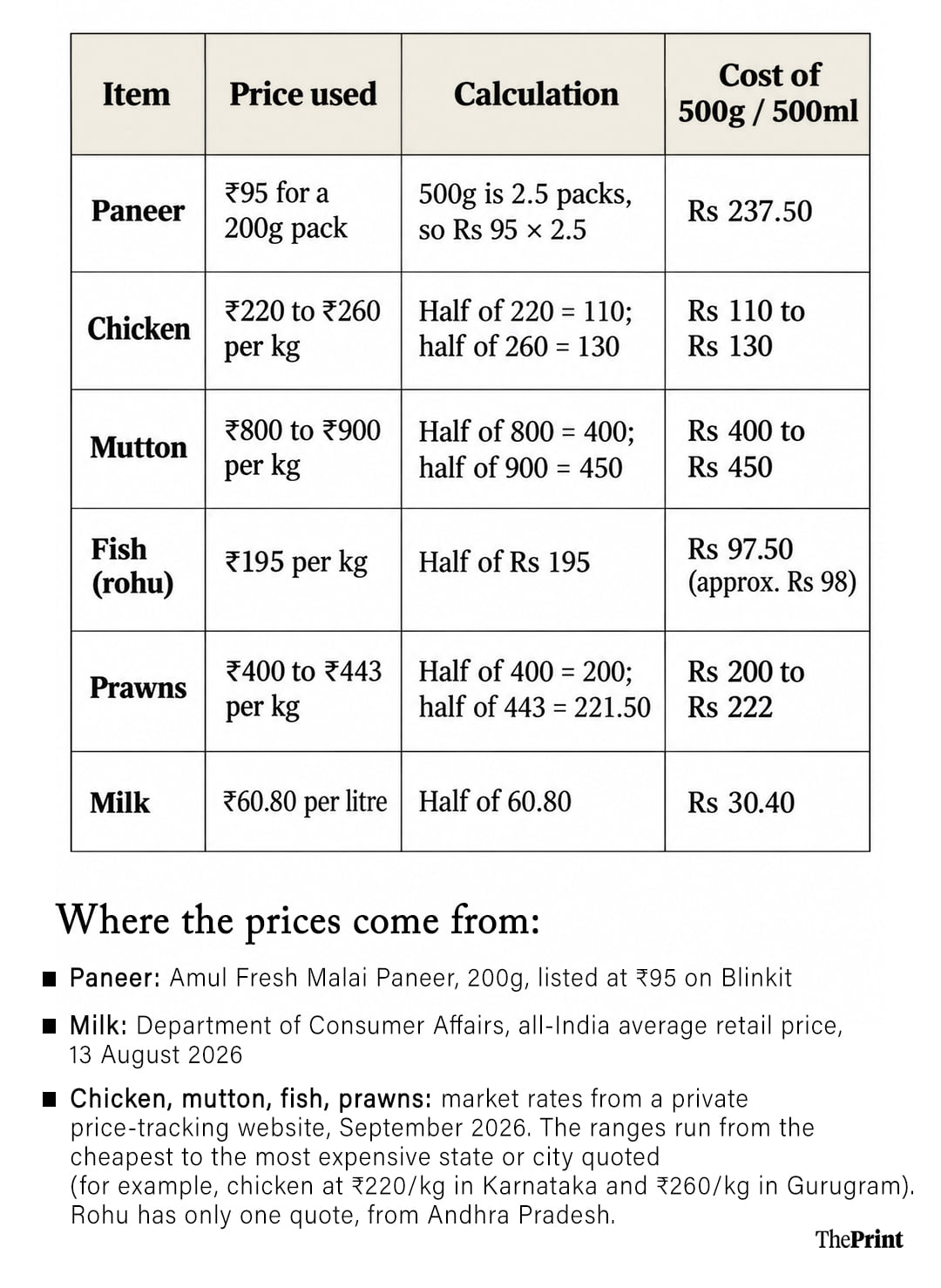
Five hundred grams of paneer cost around Rs 237, while 500 grams of chicken cost Rs 110 to Rs 130. Meanwhile, half a kg of rohu fish costs Rs 98 approximately. Significantly, paneer is even costlier than seafood—500 grams of prawns cost Rs 200-222.
A richer plate costs more
In 1941, American agricultural economist Merrill K. Bennett noted that as individuals become wealthier, their consumption shifts from starchy staples to more protein-rich foods. Bennett’s Law is a lesser-known counterpart to Ernst Engel’s 1857 observation that the proportion of a household’s budget allocated to food decreases as income increases.
These principles are reflected in contemporary Indian dietary patterns. When the Ministry of Statistics and Programme Implementation (MoSPI) updated the consumer price index based on the Household Consumption Expenditure Survey 2023-24, there was a significant reduction in the weight assigned to cereals. This shift does not indicate a decrease in food consumption among Indians; rather, it signifies an improvement in dietary quality, which incurs higher costs.
This concern is not unprecedented. In October 2010, then Reserve Bank of India Deputy Governor Subir Gokarn delivered a speech titled ‘The Price of Protein’, in which he argued that as Indians became more affluent, demand for protein would outstrip supply, leading to persistent price increases as a structural driver of food inflation.
Sixteen years later, data confirm his prediction regarding the trend; however, the protein market is not monolithic. It comprises three distinct segments, each with its own dynamics.
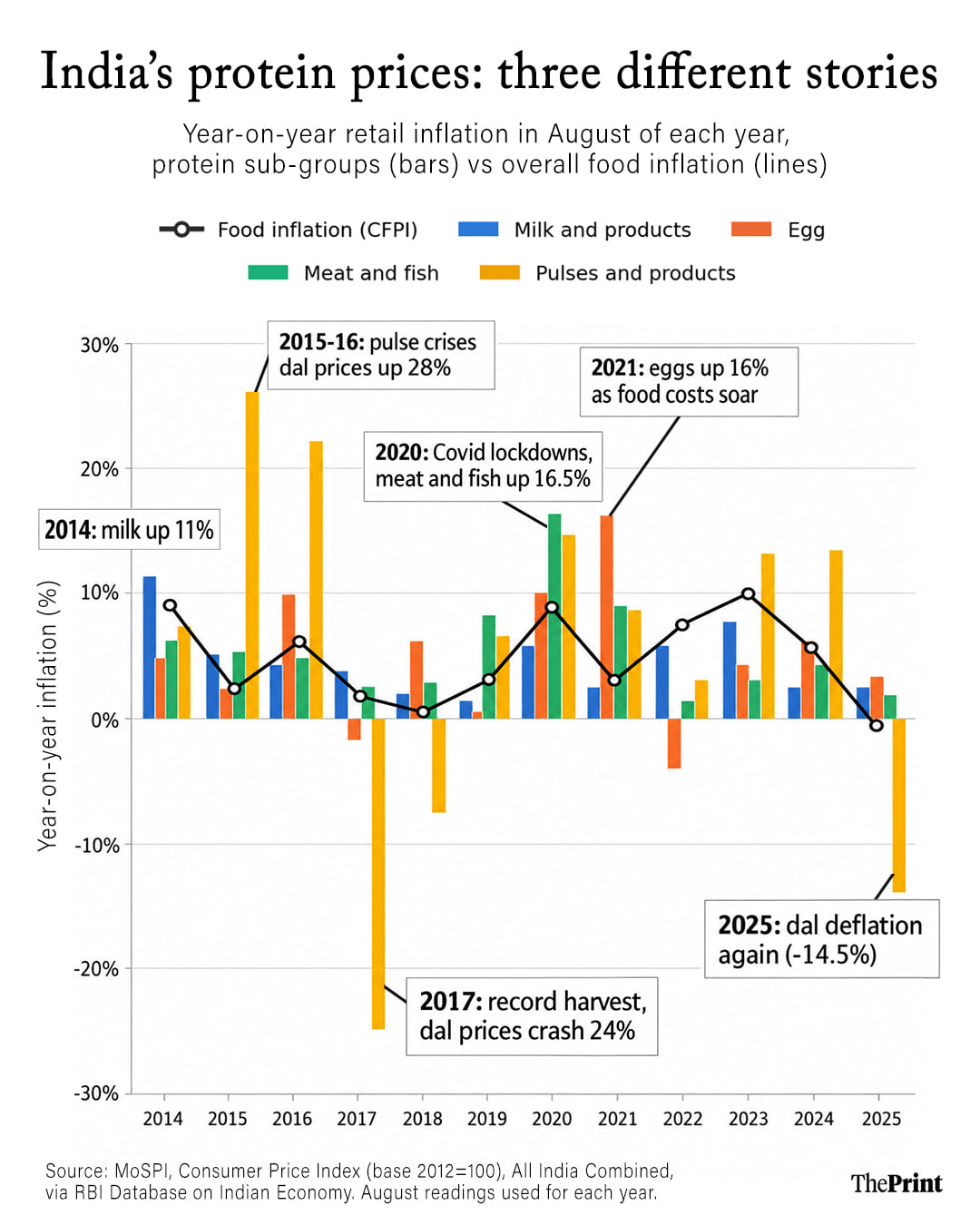
Pulses exhibit cyclical price movements. In August 2015, dal prices increased by 26 percent, followed by a 24 percent decline in 2017 after farmers produced a record harvest. Prices rose by 13 to 14 percent in 2023 and 2024, then decreased by 14.5 percent in 2025. This pattern aligns with the Cobweb Theorem, introduced by Nicholas Kaldor in 1934 and formalised by Mordecai Ezekiel in 1938, which posits that farmers plant-based on the previous season’s prices, leading to alternating periods of surplus and shortage. The positive aspect revealed in the data is the strong responsiveness of Indian farmers.
Milk prices have exhibited a consistent upward trajectory, increasing by 2 to 8 percent annually since 2015, thereby exemplifying Bennett’s Law, which associates rising demand with increasing incomes.
In contrast, the prices of eggs and meat are susceptible to shocks. For instance, during the COVID-19 lockdowns in 2020, meat and fish prices rose by 16.5 percent, while egg prices increased by 16 percent in 2021 due to higher feed costs.
The pandemic induced two significant shocks in quick succession. In February 2020, rumours circulated on WhatsApp that chicken was a vector for the coronavirus, halving broiler prices within weeks.
By the latter half of the year, the narrative shifted: Medical professionals began recommending eggs to COVID-19 patients, and the notion of ‘protein for immunity’ gained widespread acceptance. Coupled with lockdown disruptions and a tripling of poultry feed costs by mid-2021, inflation in meat and fish prices reached 16.5 percent in August 2020, with egg prices following at 16 percent a year later.
Economists refer to the spread of such beliefs as an information cascade, a concept articulated by Sushil Bikhchandani, David Hirshleifer, and Ivo Welch in 1992, in which individuals adopt others’ beliefs rather than relying on their own information. Consequently, protein prices are influenced as much by narratives as by supply dynamics.
The chart’s black line represents overall food inflation, which remains within a narrow range, while the protein price bars fluctuate between -24 percent and +26 percent. Over the past decade, the headline inflation figure has averaged out the most volatile components of the Indian diet.
In 2026, three economic rhythms have aligned in a unique way. In January, the price of arhar was 24.9 percent lower than the previous year, significantly reducing the cost of protein for households. However, by August, arhar prices rose by 5.6 percent, and urad by 7.4 percent. Additionally, the prices of chicken, fish, prawn and eggs rose by 14.1 percent, 8.2 percent, and 11 percent, respectively. The inflation rate for paneer nearly tripled since March, reaching 4.1 percent. Consequently, the financial relief previously experienced has dissipated.
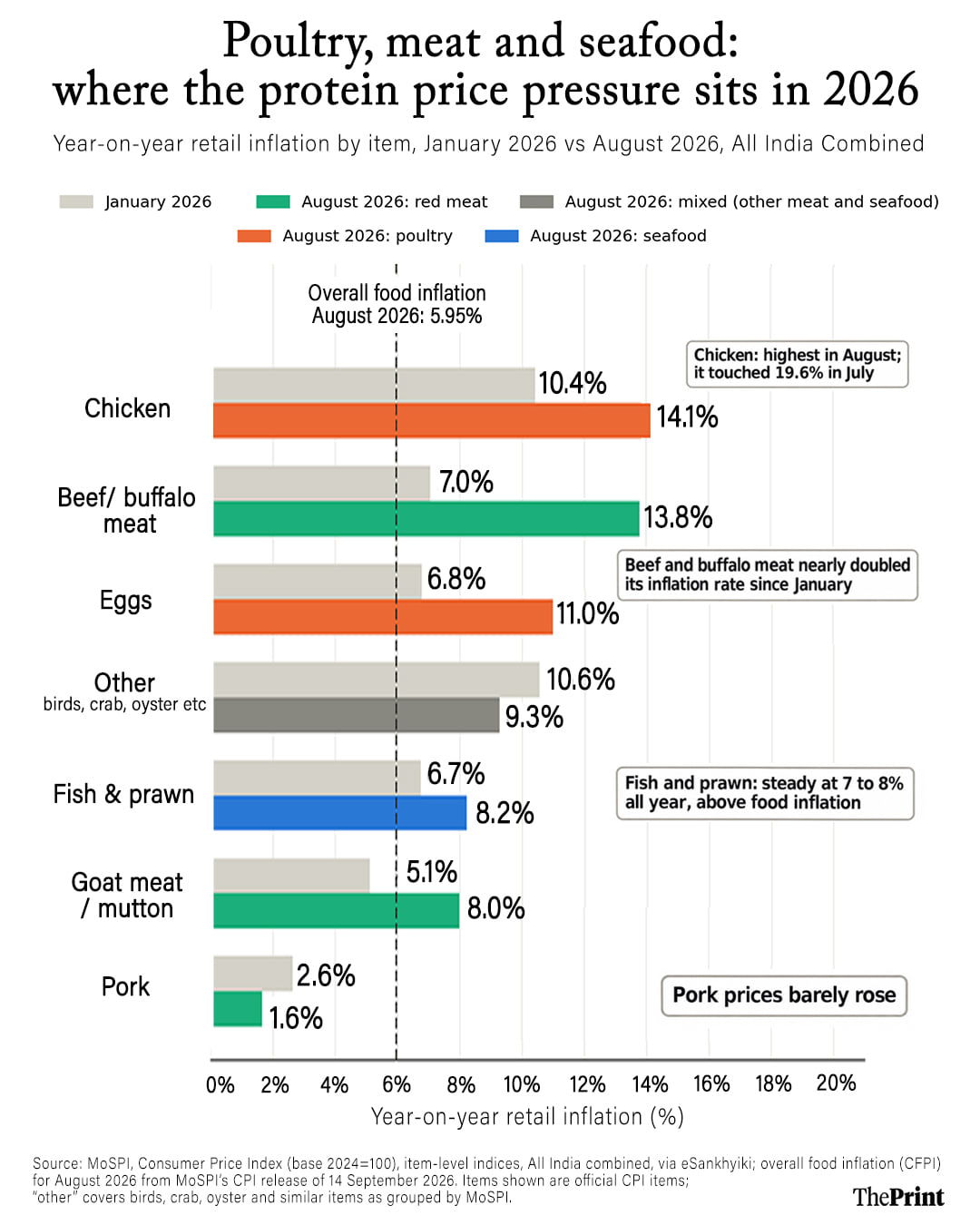
An item-by-item look at animal protein shows price pressures are pervasive. Among the seven categories of meat, poultry, and seafood in the new price index, only pork shows a slower rate of increase than the overall food category. In contrast, the inflation rate for beef and buffalo meat has nearly doubled since January.
The year 2026 is distinct because the three pricing patterns have converged. In January, arhar dal was 24.9 percent cheaper than the previous year, providing relief to household protein budgets. By August, arhar prices increased by 5.6 percent and urad by 7.4 percent. Chicken prices rose by 14.1 percent, and egg prices by 11 percent, while paneer inflation nearly tripled since March to 4.1 percent. The previous price cushion has dissipated.
The protein ladder
The focus should be on cost in rupees, not inflation rates. Specifically, what is the actual expense incurred by an Indian household for 100 grams of protein?
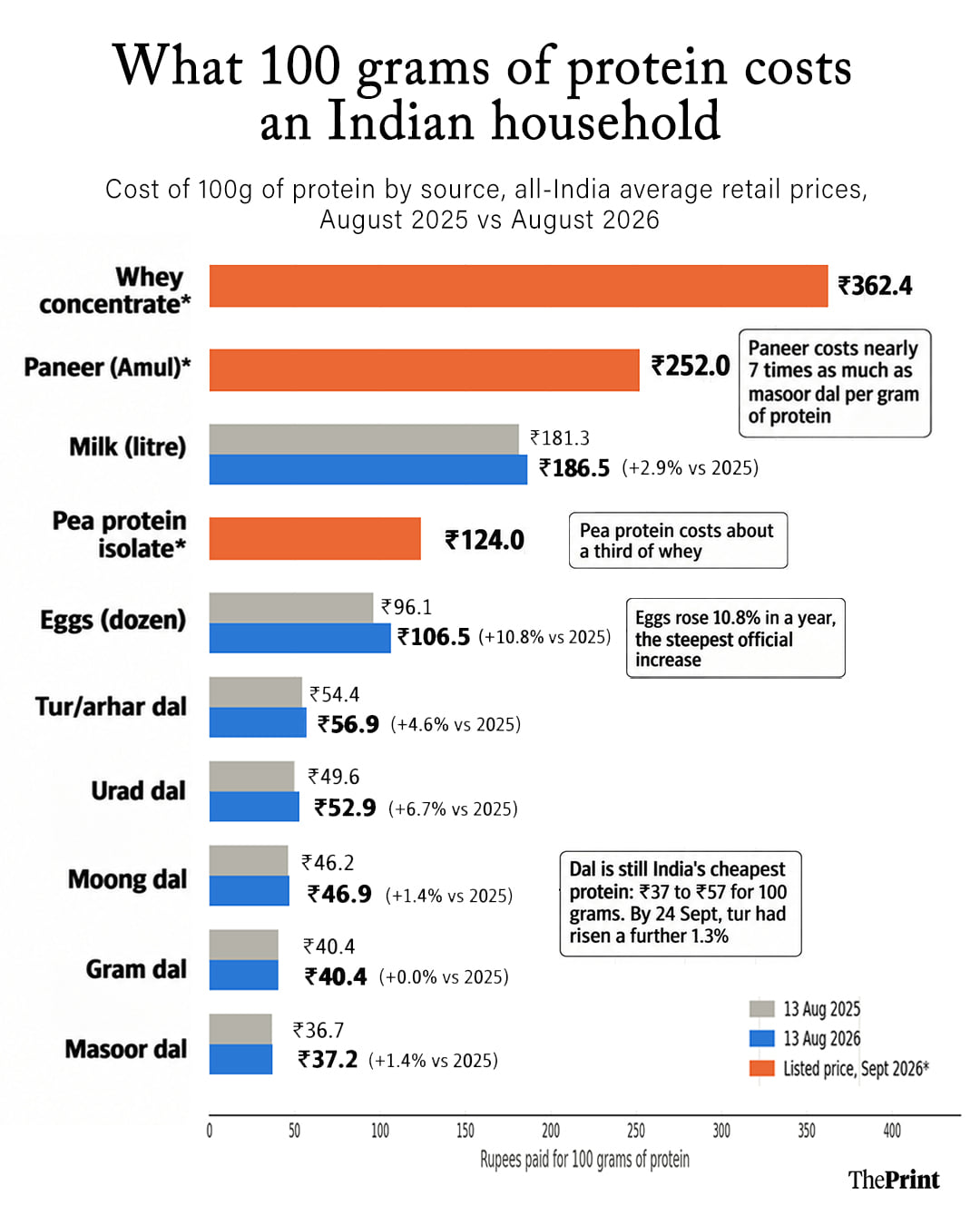
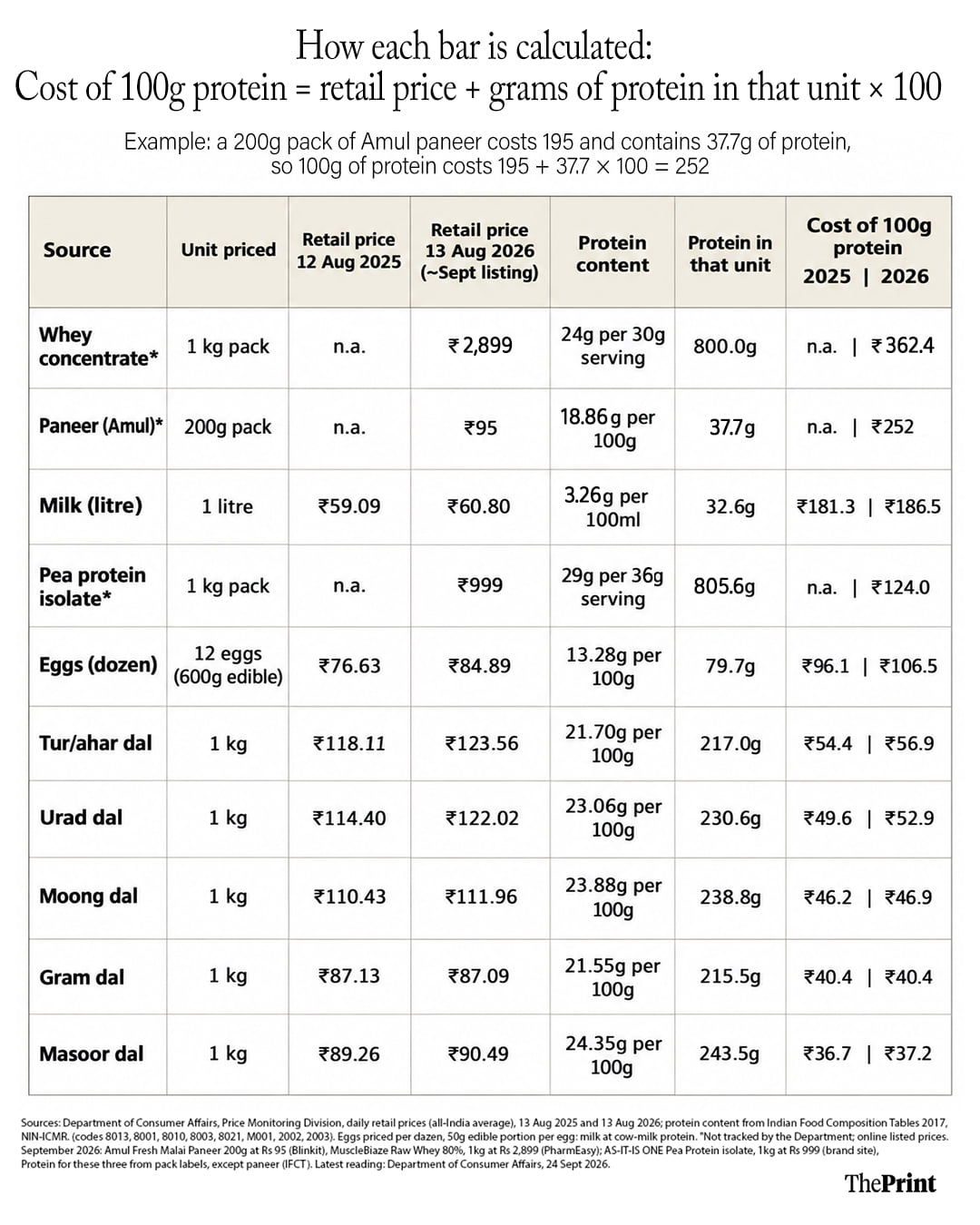
Using retail prices from the Department of Consumer Affairs, online listings for paneer and supplements, and protein values from the National Institute of Nutrition’s food composition tables, the cost analysis reveals a clear hierarchy.
Masoor dal is priced at Rs 37 for 100 grams of protein, while eggs, milk, and paneer are priced at Rs 107, Rs 187, and Rs 252, respectively. Whey concentrate, a preferred protein source among gym enthusiasts, is priced at Rs 362. The same nutrient can cost tenfold depending on where you buy it.
In 1966, Kelvin Lancaster posited that consumers purchase the attributes within goods rather than the goods themselves. Consumers do not seek whey for its own sake; they desire protein, amino acids, and convenience. When one product bundle becomes costly, consumers shift to alternatives, a trend evident in the supplement market. Pea protein isolate, which costs Rs 124 for 100 grams of protein, is approximately one-third the price of whey, prompting brands to reformulate their products accordingly.
The rising cost of whey can be explained by Alfred Marshall’s 1890 ‘Principles of Economics,’ which discusses joint supply goods: Products that cannot be produced independently.
Whey, a by-product of cheese, has its supply contingent on global cheese production rather than the number of gym-goers in India. As the world’s largest milk producer, India focuses its dairy industry on liquid milk, curd, and paneer rather than cheese.
Consequently, industry estimates suggest that India imports 80 to 90 percent of its supplement-grade whey, paid for in dollars, with the rupee nearing 97 in July.
Paneer represents the pinnacle of the protein hierarchy for vegetarian households. For families abstaining from eggs or meat, dairy serves as the primary protein source beyond dal, with paneer costing nearly seven times more per gram of protein than masoor dal.
Such a significant price disparity invites fraudulent practices. In 1970, George Akerlof demonstrated that when buyers cannot assess quality, inferior imitations displace genuine products, as sellers of authentic goods cannot charge for unseen quality. Consumers cannot distinguish between analogue and authentic paneer in a curry, creating a ‘market for lemons’ scenario. It raises the question of whether cheaper analogues are suppressing the average paneer price recorded by the Consumer Price Index (CPI).
The Food Safety and Standards Authority of India’s (FSSAI’s) draft regulation offers a textbook solution. Akerlof’s resolution to the lemons problem was providing information, and composition-based naming gives buyers precisely that: If a product is not made from milk, it cannot be labelled as paneer.
From price shock to opportunity
Protein food inflation in India should not be seen as a failure. Rather, it reflects the nation’s rapid advancement in protein consumption, outpacing the current capacity of its supply chains. The next step now is to expand these supply chains rather than hamper progress.
India has previously demonstrated its ability to address such challenges. Following the pulse crisis of 2015-16, the country achieved a record harvest exceeding 23 million tonnes in 2016-17, which led to a significant reduction in dal prices, illustrating the responsiveness of Indian agriculture to price signals.
The dairy sector could follow a similar trajectory. The cooperative network that made India the world’s largest milk producer has the potential to expand into cheese and whey processing, turning Marshall’s joint-supply problem into an opportunity for import substitution. Accurate labelling will facilitate this transition, allowing genuine paneer to compete based on its true composition.
Consumers, such as families ordering paneer tikka, have the right to transparency regarding their food. Similarly, the nation requires a protein strategy that matches its growing demand. Just as India has mastered cultivating its own dal, it can also develop the capability to produce its own whey.
(Edited by Viny Mishra)
Also read: FSSAI proposal for dairy analogues: No ‘paneer’ label for products made from non-milk ingredients
There are only two kinds of nutrition:
1. Mal-nutrition
2. Animal-nutrition
People should give up paneer and dal and start consuming chicken, eggs, mutton and fish.