



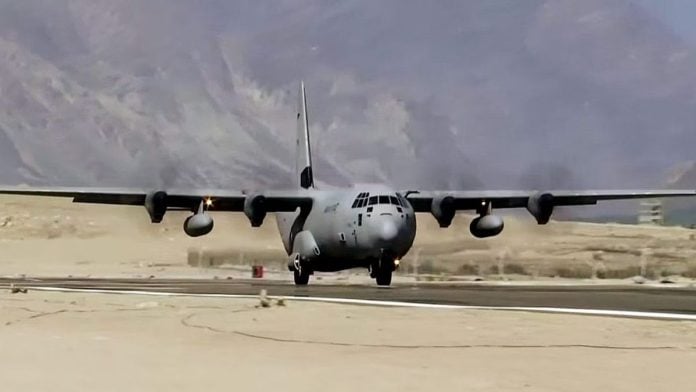
New Delhi: Drawing from India’s experience of its fleet of the C-130J-30 Super Hercules, Lockheed Martin has sharpened its pitch saying the aircraft offers far greater usable capacity and operational flexibility than its nearest competitor—Brazil’s Embraer C-390 Millennium for the mega Medium Transport Aircraft (MTA) programme.
The American aerospace major is competing with Embraer for what is the largest military transport aircraft contract, seeking to replace the ageing AN 32s and the IL-76 operated by the IAF.
While the numbers sought by the IAF formally in a Request for Proposal sent out to Indian players is for 60 aircraft, it is expected to go up subsequently.
European aviation major Airbus has dropped out of the contest, leaving the C-130J-30 and C-390 as principal contenders.
The Request for Proposal (RFP) for the programme was issued on 12 August, with bids due by 2 December.
Lockheed is offering the latest version of the C-130J-30, known as the C-130J-30 Block 8.1.2 to the IAF with 12 aircraft to be built at its facility in Marietta, Georgia, while the remaining 48 would be manufactured in India in partnership with Tata Advanced Systems Limited (TASL). The RFP states a minimum of 40 percent indigenous content.
Speaking to ThePrint, Robert Toth, Vice President, Strategy & Business Development, Air Mobility and Maritime Missions at Lockheed Martin, underlined that what the IAF has and what the company is offering is the C-130J–30 and not just the C-130J that everyone believes it is.
“Many of the characteristics that get attributed to the C-130J are actually of the C-130H or the original version of the C-130J, which was a shorter version,” he said.
He said that when people say that C-130J has a capacity of 18-19 tonnes, they are wrong because the C-130J-30 that the IAF uses has a capacity of 22 tonnes.
The C-130J-30 is a stretched version of the Hercules, with the fuselage extended by about 14 feet to provide additional internal cargo space.
The difference is significant, with the IAF’s RFP stating that the aircraft should have a minimum capacity of 18 tonnes and a maximum of 30.
The Embraer aircraft has a capacity of 26 tonnes and falls in between.
‘It’s about volume, not weight’
One of Toth’s central arguments is that maximum payload weight alone does not determine the effectiveness of a tactical transport aircraft.
He argued that in most logistics missions, the aircraft runs out of available cargo volume before reaching their maximum payload weight.
“When you think about moving cargo, it is really a math problem, the amount of items you need to move over a specific period of time,” Toth, a former C-130J pilot with the US Air Force said.
He claimed that compared to the C-390, the C-130J-30 can carry 60 percent more passengers, 45 percent more fully combat-loaded paratroopers and 30 percent more litter positions for casualty evacuation.
He also claimed the C-130J-30 can accommodate eight standard cargo pallets compared to the seven on the C-390, a 15 percent difference.
These figures are Lockheed Martin’s own comparative claims and they did not give specific numbers.
However, the company’s website says it can carry 128 combat troops and 92 paratroopers.
Lockheed argues that the additional usable floor space of the C-130J-30 therefore matters more than a simple comparison of maximum payload figures.
The company also pointed to the aircraft’s ability to operate from short and austere runways and at high-altitude airfields.
Lockheed argues that its aircraft possess the best short-field takeoff/landing performance, highest pallet/passenger/litter capacity, lowest fuel use rate, greater range, lower carbon footprint, combat proven survivability, and best unprepared airfield capability/durability.
Toth also said that The C-130J-30 requires fewer sorties to complete combat troop deployments and humanitarian operations.
Its ability to transport more personnel and equipment with fewer sorties allows faster delivery of forces for contingency and humanitarian operations while also reducing overall operational costs, he said.
India’s experience with the Hercules
The IAF inducted its first C-130J-30 aircraft in 2010 and has since used the platform extensively for a range of operations.
Toth said the Indian fleet has accumulated around 58,000 flight hours while maintaining a availability ration of above 85 percent.
The aircraft have been used for operations ranging from disaster relief to the evacuation of Indian citizens from conflict zones.
One of the most daunting tasks that the aircraft did was landing at Daulat Beg Oldi (DBO) in Ladakh at an altitude of about 16,600 feet.
The aircraft has also been used for operations in Afghanistan and Sudan, as well as humanitarian assistance missions, including ongoing operations in Nepal.
Lockheed is placing considerable emphasis on this operational experience as it makes its case for the MTA.
The company says the global C-130J fleet has accumulated more than three million flight hours across roughly 28 operators, creating what it describes as a large pool of operational experience and feedback for continuous upgrades to the aircraft.
New aircraft more advanced than IAF’s existing C-130Js
The aircraft proposed for the MTA programme would not be identical to the C-130Js currently operated by India. The existing Indian aircraft are Block 6 configuration, while Lockheed says it intends to offer the latest Block 8.1.2 configuration for the MTA.
The newer configuration incorporates upgrades to communications, navigation, avionics and software, among other improvements, he said without getting into details.
Lockheed also says it has the capability to upgrade India’s existing 12 aircraft to the same configuration.
That upgrade, however, would be a separate contract and is not part of the current MTA proposal, he said.
Toth argued that if the upgrade is undertaken, it would allow the IAF eventually to operate a common fleet of 72 C-130J-30s, the existing 12 plus the 60 MTA aircraft, that will come with common training, maintenance and logistics infrastructure.
Four engines versus two
Another key part of Lockheed’s pitch is the C-130J’s four-engine turboprop configuration. The company argues that the configuration provides greater engine redundancy during operations in difficult environments, particularly at high-altitude and high-temperature airfields.
Its executives contrasted this with the C-390, which uses two turbofan jet engines.
The Lockheed argument is that an aircraft losing one engine can still continue its mission or complete a take-off or landing in circumstances where a twin-engine aircraft would have less redundancy.
This is being presented by Lockheed as an operational advantage, particularly given India’s geography, which ranges from sea-level environments to some of the world’s highest military airfields, he said.
Lockheed highlights Tata partnership
The company is also seeking to make its existing industrial presence in India a central part of its case. Under the MTA proposal, 48 of the 60 aircraft would be produced in India with TASL.
Lockheed says its relationship with Tata goes back more than a decade and that the two companies have already established manufacturing capabilities in India through their joint ventures.
One of these facilities in Hyderabad has produced 265 C-130J empennages, Toth underlined.
He pointed to its work on S-92 helicopter cabins and F-16 fighter wings as evidence that the industrial ecosystem required for a major aircraft production programme already exists.
Lockheed says more than 500 Indian suppliers, including around 140 MSMEs, form part of its global supply chain.
Its argument is that this existing network would allow it to scale up production for the MTA programme faster than a manufacturer starting to establish an Indian ecosystem only after winning the contract.
Lockheed is also setting up a C-130J maintenance, repair and overhaul facility in Bengaluru.
The company says the facility is on schedule to be completed by the end of 2026, with the first Indian aircraft expected to enter the facility around the first or second quarter of 2027.
(Edited by Viny Mishra)
Also read: Embraer takes on Lockheed, says its KC-390 is 30% cheaper, better suited for IAF than C-130J
The argument given by Lockheed Martin seems logical. Furthermore, it will be to India’s advantage to make closer bonding with a USA based company with much better technology than with Brazil, provided there is technology sharing. If Lockheed Martin guys are not friendlier, hesitate in sharing technology then India must go for Embraer!