



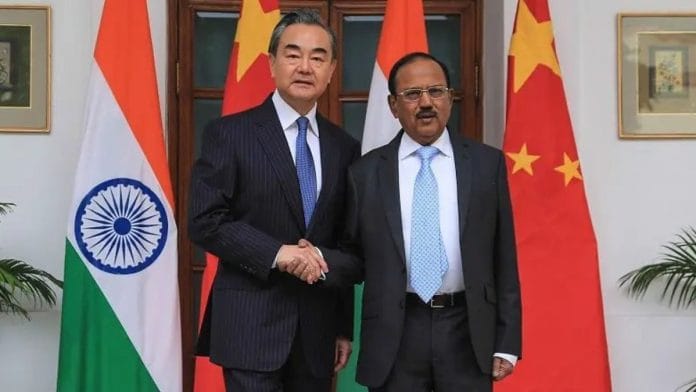
New Delhi: Amid renewed border tensions along Arunachal Pradesh and ahead of the upcoming SCO and BRICS summits, which both Prime Minister Narendra Modi and Chinese President Xi Jinping are to attend, National Security Adviser (NSA) Ajit Doval, also India’s Special Representative (SR) on the India-China Boundary Question, has reached Beijing.
Doval and Chinese Foreign Minister Wang Yi, who is China’s Special Representative, will hold the 25th round of the Special Representatives’ talks on the India-China Boundary Question Tuesday. The NSA will also call on China’s Vice President Han Zheng during his visit, the Ministry of External Affairs (MEA) said in a statement.
Ajit Doval’s visit assumes significance amid heightened tensions along the India-China border in Arunachal Pradesh, with Chinese troops trying to assert their claims in border areas. It also comes ahead of the Shanghai Cooperation Organisation (SCO) Leaders’ Summit in Bishkek, Kyrgyzstan, next week, which both Modi and Xi are expected to attend.
Though not formally announced yet, Xi is also expected to travel to India for the BRICS Summit scheduled for 12-13 September. If it does take place, it will be Xi’s first trip to India in seven years.
India and China have been engaged in a military stand-off in eastern Ladakh since 2020. While disengagement followed multiple rounds of military and diplomatic talks, the broader boundary question remains unresolved. Each major phase of disengagement since the 2020 stand-off has followed meetings between Doval and Wang.
Asked about talks between Ajit Doval and Wang Yi, Chinese foreign ministry spokesperson Lin Jian said Monday that the talks are an important platform for communication between the two sides on issues of mutual concern. At the 24th round of talks last August, the two sides exchanged candid and in-depth views on the China-India boundary question, and reached a number of consensuses, he said.
At the upcoming talks, Lin said both sides will, in the spirit of the consensus reached by the leaders of the two countries, continue in-depth communication on the boundary question. The two sides will also exchange views on bilateral relations as well as international and regional issues, Lin added.
Also Read: Not just a borderline difference: China’s readout on Ajit Doval-Wang Yi meet differs from India’s
Tensions along Arunachal border
While eastern Ladakh is calm, the situation is very different along the India-China border in India’s Northeast. On 11 August, ThePrint reported on a face-off in late July when patrol parties of both countries came face to face in remote Taksing village of Arunachal Pradesh. The Chinese are said to have returned in early August and set up a few makeshift tents.
When ThePrint sought a response on the Arunachal Pradesh incident during a regular press briefing, the MEA said the state of affairs along the India-China border is of utmost importance to New Delhi and will have a bearing on the broader bilateral relationship.
Arunachal Pradesh CM Pema Khandu had in February inaugurated the Tsari Taksing Gajang Shedup Dargeyling Monastery at Taksing. Taksing would be developed as a tourism circuit in view of its historical and religious significance in Buddhism, he had said at the time.
Khandu further explained that Taksing is associated with the ancient Tsari (Rong Kora) pilgrimage, which attracted pilgrims from Tibet and other regions until the mid-20th century. Efforts are underway, he added, to revive the pilgrimage in a regulated manner in consultation with the Army and the central government.
(Edited by Amrtansh Arora)
Also Read: Chinese imports are fuelling India’s export growth, from smartphones to pharma