





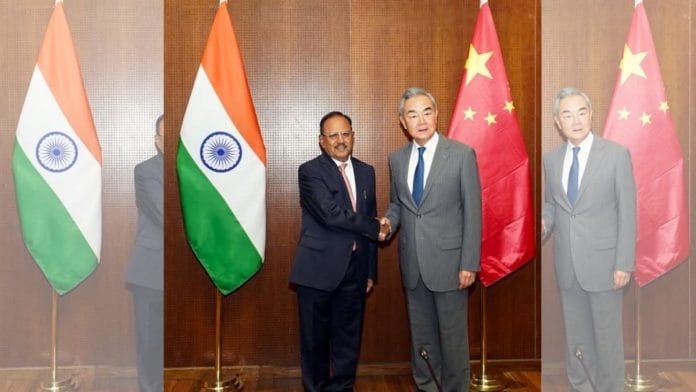

New Delhi: India and China have issued differing readouts of the meeting between National Security Adviser Ajit Doval and Chinese Foreign Minister Wang Yi, highlighting the differences in views of the status of ties between the two neighbours.
India Tuesday said that Doval “underlined that stable, predictable and constructive bilateral relations” will assist in enhancing trust and a better understanding between New Delhi and Beijing, during his bilateral meeting with Wang on the margins of the BRICS National Security Advisers’ (NSA) meeting Monday.
“NSA also emphasized the importance of sensitivity being consistently displayed to each other’s issues of core concern. The Spokesperson added that this would be in keeping with our overall approach of mutual sensitivity, mutual interests and mutual respect,” Randhir Jaiswal, the official spokesperson added in a Ministry of External Affairs statement.
China highlighted that Wang told Doval that both sides should “respect each other’s core interests, properly deal with sensitive issues and put the China-India border issue in an appropriate position to avoid affecting the overall situation of bilateral relations”.
Different readouts
Beijing’s view of the meeting between the two officials indicated its repeated position of separating the border issue from the overall relationship.
Until the agreement to disengage across friction points on the Line of Actual Control (LAC) in October 2024, India maintained the need for “peace and tranquility” at the border areas for the stabilisation of ties.
The Chinese readout said: “Doval said that the leaders of India and China pointed out the direction for the development of bilateral relations through the meeting between Kazan and Tianjin. They agreed that India and China are not competitors but partners, and believe that stable India-China relations are in the common interests of both sides.”
“India is willing to continue to view relations with China from a strategic perspective, work with China to implement the consensus of the leaders of the two countries, view and accelerate the development of bilateral relations with a forward-looking attitude, properly handle differences, and strive for a win-win situation,” added the readout.
The readout makes no mention of Doval’s call for “sensitivity” being displayed to each side’s core concerns, while asserting that the Indian NSA agreed to the notion that the two countries are not “competitors but partners”.
Differences in readouts between India and China after meetings of officials are not new. Countries often release readouts based on the key points they wish to highlight. However, China has often highlighted understandings that are not seen within the Indian readouts.
Sources indicated that the meeting between the two officials was “cordial” and lasted around 30 minutes.
The bilateral meeting between Doval and Wang wasn’t specifically on the boundary question. The brass tacks of the boundary question are discussed in the Special Representative format, which is yet to be held this year.
Mutual sensitivity, mutual respect and mutual interests
For Beijing, it is important to highlight points such as the fact that India is one of the “earliest countries to recognise New China”.
The Chinese readout also mentions that New Delhi’s position on Taiwan “has not changed”, while agreeing to “jointly defend multilateralism”.
None of these discussions find a mention in New Delhi’s readout of the meeting. India, however, emphasised its position of the need to maintain the three Ms – mutual sensitivity, mutual respect and mutual interests.
For the two countries, stabilisation of ties remains important. The relationship cratered following the clashes in Galwan in the summer months of 2020. For the next four years, they maintained a heavy military presence across the LAC.
The 2024 agreement to disengage at the friction points allowed the political discussions between India and China to restart.
Prime Minister Narendra Modi has met Chinese President Xi Jinping twice since then – in the Russian city of Kazan in 2024 and the Chinese city of Tianjin in August 2025. Both meetings were on the margins of larger summits.
Wang also met with Prime Minister Modi Tuesday. Modi met with the various NSAs and senior officials of the BRICS grouping, as India is currently the chair of the organisation.
During his meeting with Modi, Wang told the Indian prime minister that Beijing is ready to “properly address sensitive issues”, and build deeper trust in ties.
Modi conveyed his greetings to President Xi, promoting “pragmatic cooperation” between the two countries, according to the Chinese readout.
(Edited by Sugita Katyal)