





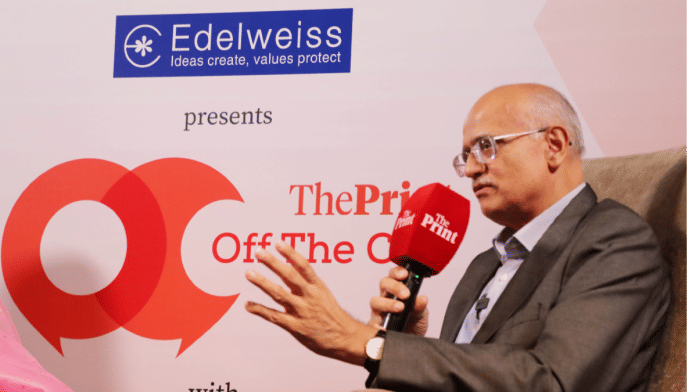


New Delhi: China sees India as an “ideological threat” because of its democratic system. These remarks by former Foreign Secretary Vijay Gokhale’s comments, made at the ThePrint Off the Cuff in Mumbai last month, have rattled the Chinese strategic community.
The comments led to pushback not just on social media platforms, but in conversations within China, with critics either vindicating Beijing’s own political choices or minimising India’s own global positioning.
“It is not difficult to understand why Chinese scholars have ideologically run down Indian democracy over the past many decades. And today, when by most measures of comprehensive national power, China has stolen a march, there is an even greater sense of vindication,” Jaideep Mazumdar, former Secretary (East) in the Ministry of External Affairs, explains to ThePrint.
He adds: “But India’s strength is that we have been able to achieve what we have in the midst of all our incredible diversity and without compromising on the rights and opportunities for every section of our population. And that is a model whose ideological success, the Chinese fear.”
The emphasis in the conversation emanating from China following Gokhale’s remarks has been to prove as to why the Chinese model is either more efficient or why India does not matter to Beijing’s larger strategic view of the world.
One commentator juxtaposed India’s keen interest to build “one kilometre of road on the border” or its trade deficits with China with Beijing’s larger worries about keeping the “Eurasian plate stable”. Another online commentator hit out at the “zero-sum view” in certain circles in India, which portrays China as a threat and finds assumptions to back this view.
“When a country aims its frustration [India] at the partner offering help [China] and spares the one applying pressure [the US], the driver isn’t interest, it’s psychology,” Zhou Chen, a South Asia analyst at Fudan University commented on the social media platform X.
In response to Gokhale’s comments, Zhou Chen specifically said, “the ideological threat claim misreads how Beijing actually thinks. An ideology becomes threatening only when it visibly works. China’s calculus on India is about growth rates, supply chains, and Washington alignment—not ballot boxes.”
Sriparna Pathak, Professor of China Studies and Founding Director of the Centre for Northeast Asian Studies and the O.P. Jindal Global University, explains to ThePrint that the comments and conversations within Chinese circles on India stem from a position of “insecurity”.
“This angst is not something new. It has been there with them. In the recent past, they came out with a white paper calling China ‘a democracy that works’—a clear jibe against India. Time and again they keep bringing up this fact, it shows their own anxieties vis-a-vis not being a democracy,” adds Pathak.
India’s growth and its polity find little support within the Chinese strategic community. Pathak highlights that despite a number of decades of economic growth, today the Chinese economy is slowing, while India is the “fastest growing major economy in the world” despite the chaotic nature of its polity. For China, the question remains, “what really did they gain from this?”
The consistent pushback against India is not just limited to its democracy. More recently, the Chinese Embassy in New Delhi flaunted the successful conduct of the Gaokao examination process in the country amidst the backlash triggered in India by the NEET paper leak last month.
In a statement, the Embassy highlighted that the Gaokao–an examination equal to the JEE/NEET combined–was conducted smoothly, with 13 million students appearing for it.
Pointing to this statement, Pathak says that there “must be a need to showcase that their autocratic model is better than Indian democracy…Otherwise why would they have said this?”
Also read: China sees Indian democracy as threat, ‘armed coexistence’ will define bilateral ties—Vijay Gokhale
A view of India with condescension
The debate surrounding India within the Chinese strategic and social media communities does have a sense of condescension, points out Ashok K. Kantha, the former Indian Ambassador to China.
“This is ingrained in Chinese thinking that they are way ahead of us. In track-II conversations, they reject the idea of multipolar Asia, arguing that there is only one resident major power in Asia, that is, China. Their ostensible position is that India does not pose a threat to China, but internally, they regard India as an adjunct threat. The nature of rivalry is a little more complex,” explains Kantha.
He adds: “They look at India more through the prism of their rivalry with the US, questioning its agency. Despite recent recalibration in Sino-US relations, China has not changed its assessment that the US-led West is trying to contain and suppress China. They look at India as complicit in the US project. They believe that we are in a way trying to encircle and counter China.”
The two civilisational powers are yet to find a “compatible” model of managing their reemergence of national rejuvenation, says the former ambassador, adding that this has a larger impact to the relationship between the two countries.
Three decades of the modus vivendi—or balancing of ties—broke down following the clashes at Galwan in the summer months of 2020. The two countries had found an effective way to manage the boundary question, but the issue came to the forefront following the summer clashes six years ago.
India and China have sought to redefine the modus vivendi, however, there has been no clear agreement on it yet.
“The online jingoism that we see in both countries, is certainly not good for our bilateral relations. We need to tamper it down for any progress toward a modus vivendi. There are important issues outstanding that require dispassionate resolution. I can say with certitude that as a matter of state policy, we do not wish to see an antagonistic relationship with China. But it is not clear that that is reciprocated,” says Mazumdar.
The two sides agreed to disengage at the friction points across the Line of Actual Control in October 2024. Since then Prime Minister Narendra Modi has met Chinese President Xi Jinping twice, first on the margins of the BRICS summit in 2024 in the Russian city of Kazan, and then in Tianjin on the sidelines of the SCO Heads of States summit last year.
Nevertheless, the two sides have yet to find an agreement to deescalate across the LAC. People-centric contacts like the resumption of the Kailash Mansarovar Yatra and direct air travel between India and China do not add up to a “reset” in ties, as structural problems in the relationship remain unaddressed, explains Kantha.
“There is a simultaneous reemergence of the two countries, two civilisational states. These two projects of national rejuvenation are not in sync with each another…The Chinese are not willing to concede a coequal status to India. The way they look at their China dream is restoration of the country’s rightful role as the preeminent power by the middle of the century. This narrative involves going back to a historical norm which was disturbed by the ‘century of national humiliation’. This China-led hierarchical arrangement will involve India fitting in as a lesser power,” adds the former India ambassador to China. “India doesn’t seek preeminence but will not accept a subsidiary role either.”
(Edited by Amrtansh Arora)
Also read: China never considered India an equal, and it still doesn’t—ex-foreign secretary Vijay Gokhale
I don’t think India causes China any feeling of insecurity. Nor do they feel defensive about the nature of their political system. It is possible for India and China to engage professionally across trade, investment, other shared objectives like climate change. The boundary dispute has been there for a long time, there is no realistic prospect of its being solved any time soon.