





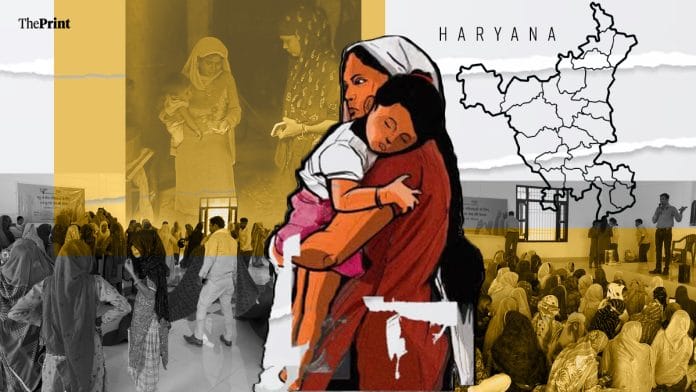

Gurugram: Haryana has been living with the consequences of its skewed sex ratio for over two decades now.
Thousands of men in Haryana’s villages, unable to find local brides, have married women from far-off states, Assam, Bihar, West Bengal, Odisha, Jharkhand—women still referred to in local parlance as “molki” or “procured” brides.
Their arrival into Haryanvi households has been documented and debated for years. What has gone largely unexamined, until now, is the identity they pass onto their children. A new peer-reviewed study argues that the marginalisation faced by these mothers is quietly being passed down to their sons and daughters, many of whom are born and raised in Haryana but still seeking acceptance.
The study, for University of Wroclaw, Poland, and published in the Scopus-indexed journal Asian Ethnicity is titled “Left behind or left out? Migrant brides’ worries for their children’s futures in cross-regional marriages in rural Haryana”.
It is authored by Manisha Kaushik, a PhD from the International Institute for Population Sciences (IIPS), Mumbai, and Ankit (goes by first name), who received his PhD in May this year from the Doctoral College of Sociology at the University of Wroclaw, Poland.
Fieldwork for the study was carried out in August 2024.
The two researchers conducted semi-structured interviews with 24 cross-region brides, in Jind and Mahendragarh—two districts chosen because local media reports had flagged them as emerging hubs for cross-region marriages.
Jind is dominated numerically by the Jat community, Mahendragarh by the Ahirs, with Dalits present in significant numbers in both.
Taunted as ‘Bihari’ and ‘Chinese’
The interviews threw up a pattern that repeated itself across both districts—children of migrant brides facing derogatory name-calling in school, in the lanes of their own villages, often mirroring slurs directed at their mothers.
Babita, originally from Bihar, told the researchers that her children were initially mocked as “children of the Bihari,” until she confronted those making the remarks.
Madhu, from Odisha, said local children taunted her sons and daughters as “Biharin ke,” meaning belonging to a Bihari mother.
Similarly, Anju, who came to Haryana from Assam, recounted that her son was even likened to “Chinese” during his childhood, a reflection of how physical appearance, and not just place of origin, becomes grounds for exclusion.
Sunita, another respondent from West Bengal, put it starkly: there is a saying in her village that families like hers have “bought” this humiliation upon their children.
“While I may be indifferent to what others say, I am compelled to voice this concern as our children bear the brunt of insults beyond the confines of our home,” she told the researchers.
A disconnect from mother’s side of the family
The study found that many of these children have never met their maternal relatives and, in several cases, do not even know their mother’s native village. Meena, a respondent from Odisha, said her daughter had asked about the significance of the maternal family during wedding rituals, a question Meena could not answer because she herself had lost touch with her birth family.
“Who will fulfil my brother’s responsibilities? Only the divine knows,” she said.
A 30-year-old widow from Assam told researchers that her children constantly ask to visit their maternal home. Her response, she said, is to tell them she no longer remembers the route and that the visit can happen once they are older and educated.
Inheritance disputes & the question of ‘whose child’
Beyond name-calling, the study documents more material consequences.
Meenu, a widow from Jharkhand raising two children, said her mother-in-law has refused to allocate any family land to her, even though her children, in her words, “should inherit land, akin to the offspring of local brides”.
The study notes that after the death of the father, children of cross-region unions frequently run into obstacles securing their share of inheritance, despite the father’s identity being what determines the family’s caste and land claims in the first place in Haryana’s patriarchal society.
Marriage prospects for the next generation are also affected.
The researchers also found that while daughters of migrant brides can sometimes find local matches because of paucity of girls due to Haryana’s skewed sex ratio, sons face considerably more difficulty because families are reluctant to send their daughters into households where the mother is seen as an “outsider”.
Some families get around this through ‘Atta-Satta’ arrangements, exchanging a daughter in marriage in return for a bride for their son, as Asha from Uttar Pradesh described doing to secure her son’s future.
Education as the escape route
Despite the discrimination, the study found a common thread running through nearly every interview—mothers investing everything they have into their children’s education, often at real financial cost, in the hope that it will eventually override the stigma of their birth.
Babli from West Bengal said she sends her children to private schools “solely because government-owned schools lack a conducive learning environment,” adding, “we may struggle, but our children will lead better lives”.
Neelam, originally from Bihar, said she tells her children that the taunts of “Bihari” will stop mattering once they grow up and work hard.
Meena from Odisha said her only wish was a stable job for her son.
The Haryana context: skewed sex ratio
The study situates these findings within Haryana’s long-standing demographic imbalance—a state that has, since Amartya Sen’s 1992 formulation of the “missing women” phenomenon, remained a byword for skewed sex ratios in India, driven by female foeticide, infanticide and the deep-rooted preference for sons.
Haryana is often cited as one of the strongest real-world examples of the long-term consequences of Amartya Sen’s thesis
With local brides in short supply, particularly for men from families with limited landholding or those considered less desirable in the marriage market, cross-region marriages emerged as a practical, if socially uneasy, alternative. The study finds that these marriages cross caste lines within villages and are usually arranged through informal go-betweens—relatives, shopkeepers, even truck drivers.
Over time, this has settled into a recognisable pattern the researchers call “chain marriage migration,” where one woman’s marriage into a village opens the door for others from her area to follow.
The researchers also point to a curious duality in how village institutions treat these marriages.
Khap Panchayats, the traditional caste councils that fiercely oppose local inter-caste unions and intra-gotra marriages, show comparatively less overt hostility towards cross-region marriages, largely because these unions are seen as serving the purpose of continuing the male lineage where no local bride is available.
But that tolerance, the study notes, does not extend to the children born out of these wedlocks, who continue to be viewed by the same social structures as somehow different or lesser.
Also Read: Abortion black market, touts, scan vans — how Haryana’s ‘Beti Bachao’ is losing momentum
Why this study, and why now
Speaking to The Print, Ankit said the idea for the research took root years before he began his PhD in 2021, during a stint working on contract under the Ministry of Rural Development in Tripura.
“When I used to tell local people that I am from Haryana, I would get to learn that several women from Tripura were married in Haryana. I was surprised because Tripura must be around 2,500 kilometres away. Later, I came to know about the concept of Molki Bahus in Haryana, and hence this topic interested me,” he said.
It was this curiosity that led him to reach out to Manisha Kaushik, who hails from Jind.
“I knew Manisha, who hails from Jind in Haryana, and so I collaborated with her for the research. While she focused on collecting data from Jind, I did so in Mahendragarh,” Ankit said.
Ankit has also made a documentary, ‘Bittoo’, around the experiences of an 18-year-old boy in a Mahendragarh village whose mother comes to Haryana from the Northeast. The documentary is available on the OTT app Stage.
In it, Bittoo talks about being persistently called “Bengali” by people in his village, and says he wants his education to one day force people to recognise him differently. At the time of filming, Bittoo was in Class 12 and doing well in school.
In the documentary, Bittoo says he has stopped stepping out of his home to play because of the taunts of other boys in the neighbourhood. “They mock me saying Bengalis eat insects and other creatures, their women do jaadu tona (black magic) I can’t listen to all this as this fills me with anger,” he says. He adds that school is the one place he feels at ease, because his teachers treat him well on account of his academic performance.
For Manisha Kaushik, the subject was even closer to home. “I have seen molki bahus in my native village Kasoon in Jind since my childhood and had known their poor plight,” she told The Print, adding that when Ankit approached her to collaborate on the study, “I immediately said yes.”
The road ahead
The study is careful to note its limitations—the sample of 24 women is drawn only from two districts, and the sensitive nature of the subject meant several women declined to disclose details such as their original caste, fearing stigma or pressure from in-laws to identify only with their marital family’s caste.
But the researchers argue that the findings are significant enough to demand policy attention: on inheritance rights for children of cross-regional unions, on caste and identity documentation, and on mental health and educational support systems for a generation of children growing up, quite literally, in between.
As the study’s authors put it, the children of migrant brides in Haryana carry a double burden—they watch their mothers face insult and exclusion, and then encounter the same prejudice themselves, their identity permanently tied to a mother’s place of origin they had no say in. Unless that changes, the researchers warn, Haryana risks raising an entire generation that wouldn’t know where it belongs.
(Edited by Amrtansh Arora)
Also Read: Haryana with lower sex ratio records more girl adoptions than Kerala—what central data reveals