





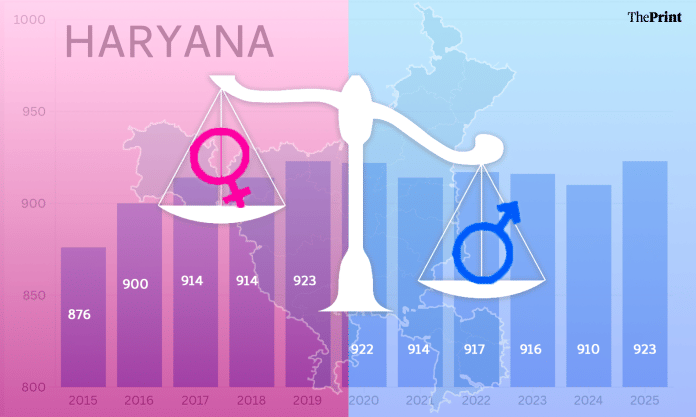

Gurugram: Eleven years after Prime Minister Narendra Modi launched the Beti Bachao Beti Padhao campaign from Panipat on 22 January 2015, Haryana has recorded one of its worst sex ratios at birth in recent years.
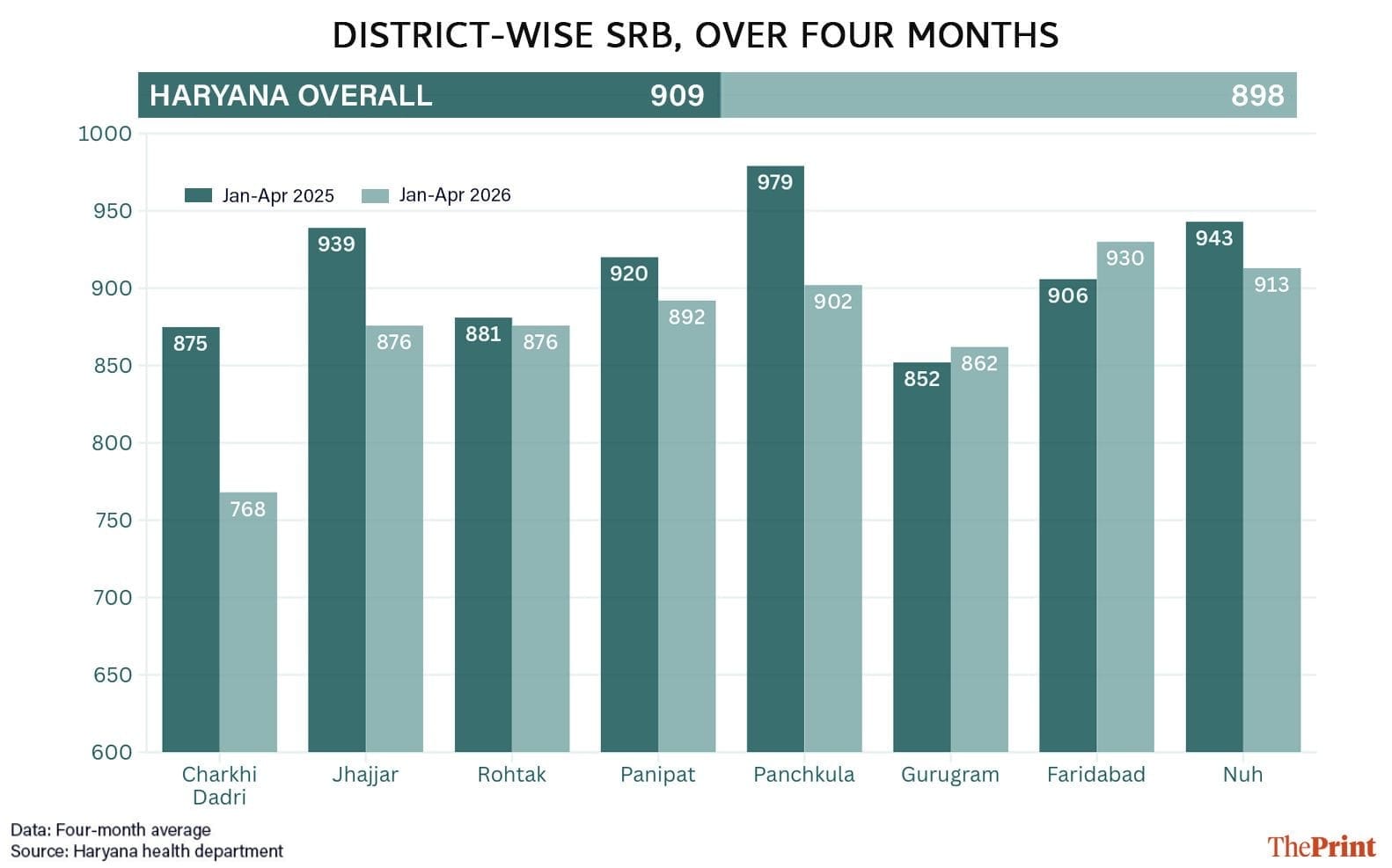
The sex ratio at birth (SRB) for the first four months of 2026 fell to 898 girls per 1,000 boys, down from 909 recorded in the first four months of 2025 and 923 recorded for all of last year. Of the 1,61,258 births registered between January and April, 84,953 were boys and 76,305 girls, data by the state health department showed.
The slide has alarmed the government enough to enlist religious leaders. Pandits, maulvis and granthis across the state are being directed to counsel newlyweds against sex selection—a measure that signals how administrative efforts have fallen short.
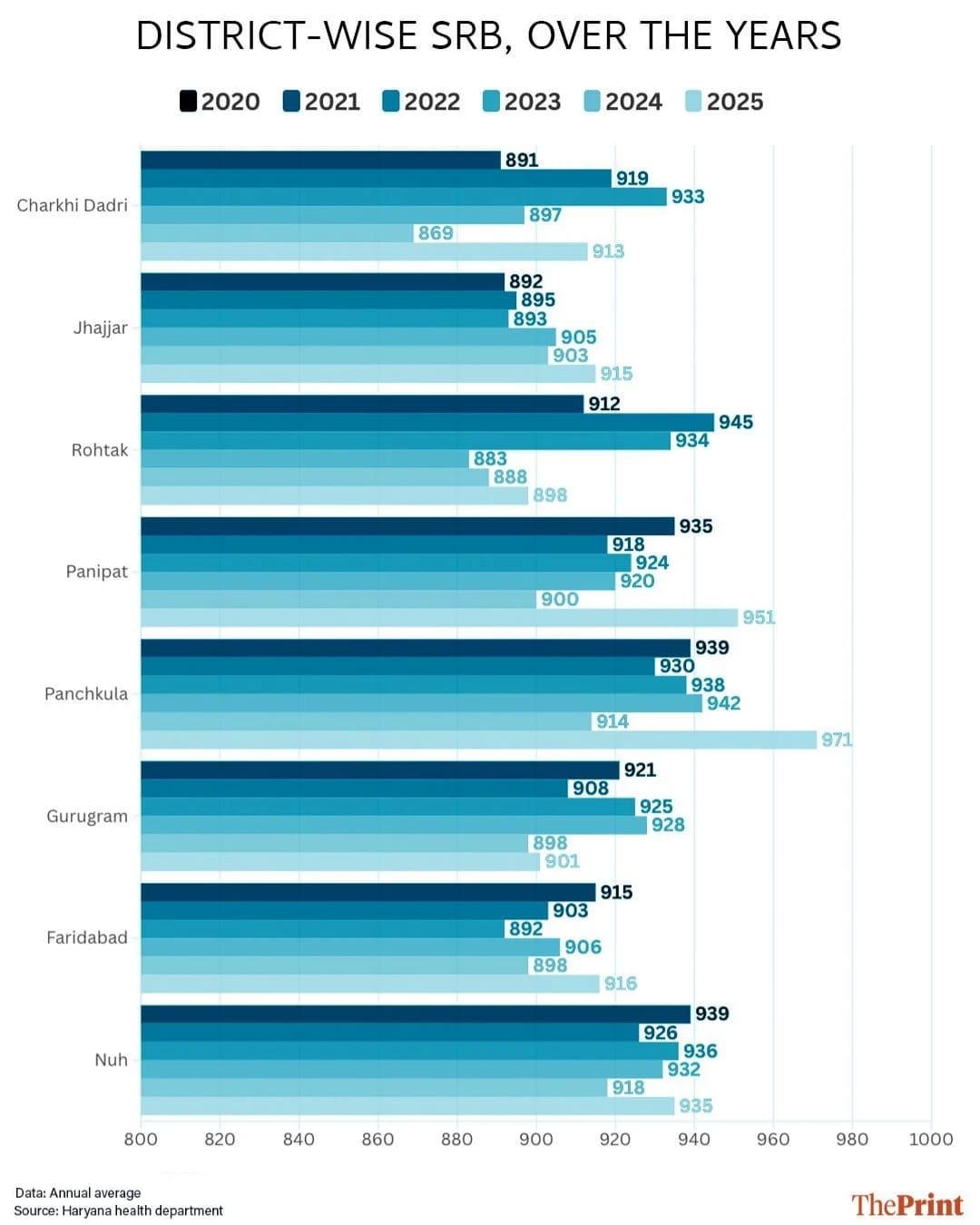
The Charkhi Dadri collapse is particularly severe. The district, carved out of Bhiwani in 2016, recorded an SRB of 891 in its first full year of data in 2020; it climbed to 913 in 2025, and dropped to 768 in the first four months of 2026.
But not every district has deteriorated. Rewari improved from 882 in 2025 to 906 this year (Jan-April). Nuh, often noted for relatively better SRB performance despite its economic disadvantages, slipped marginally from 918 to 913 and remains among the state’s better performers.
The 2026 breakdown
The district-level figures carry the starkest numbers.
Charkhi Dadri recorded an SRB of just 768 in the first four months of this year, down from 875 during the same period in 2025. Ambala stood at 843 compared to 906 in January-April 2025; Mahendragarh went from 899 to 847, and Fatehabad from 980 to 893 over this timeframe.
Jhajjar and Rohtak, among the better performers in the past, were both at 876, down from 939 and 881, respectively.
The difference with 2025’s full-year figures was sharp too. Panchkula was at 971 last year, Fatehabad 961, Panipat 951 and Karnal 944. Fatehabad’s fall—from 961 to 893—is among the most severe in the state. Panchkula, 2025’s best performer, now sits at 902. Sirsa fell from 937 to 883; and Hisar from 926 to 888.
The 2011 baseline
The urgency that produced the Beti Bachao Beti Padhao campaign was rooted in the 2011 Census, when Haryana’s SRB was among the lowest in India, at 879. Its child sex ratio, for children aged 0 to 6, was 834 girls per 1,000 boys, the worst among major states.
From that low, the annual SRB showed steady improvement: from 876 in 2015 to 900 in 2016, 914 in both 2017 and 2018, a peak of 923 in 2019, and a recovery to 923 in 2025 after a Covid-era dip. Four months of 2026 have placed that progress in doubt.
A link with IAS transfers?
Officials closely associated with the BBBP campaign since its inception point to the frequent transfer of senior IAS officers as one of the possible factors for the regression.
“When there is no consistent leadership, districts don’t take these targets seriously. They know that the officer who is monitoring them today will be gone in a few months,” said an official, speaking on the condition of anonymity.
The same official noted that a single month’s SRB figure carries limited statistical weight—births can be reported up to 21 days after the event—but a fall across four months is a different matter entirely.
Last year, when IAS officer Sudhir Rajpal served as additional chief secretary (health), a state task force was constituted to improve SRB. The committee, headed by Rajpal, met every week. But, when Rajpal moved to take charge as home secretary in January this year, the weekly meetings simply stopped.
Also Read: The Aggarwal crisis in India- They have everything but no one good to marry
Machinery activated
Additional Chief Secretary (Health) Sumita Misra earlier this week convened a meeting with civil surgeons across the state and issued a series of directives.
She directed all districts to step up raids and inspections targeting illegal sex determination and to strengthen ground-level surveillance. The Pre-conception and Pre-natal Diagnostic Techniques Act (PC&PNDT) Act and the Medical Termination of Pregnancy Act, she said, must be enforced without exception.
Misra also directed that district-level committee and district task force meetings be held under deputy commissioners within three working days, and continue regularly thereafter. Field staff accountability must be tightened, with every effort directed at improving SRB by the end of May 2026 compared to the same period last year.
On social mobilisation, she called for active involvement of religious leaders, community organisations and local institutions, and specifically directed that pandits, maulvis and granthis who conduct marriage ceremonies use those occasions to encourage newly-married couples to reject sex selection.
She also sought closer monitoring of pregnancy cases—particularly among couples who already have one or more daughters—to enable early intervention in suspicious abortions.
All enforcement activities and awareness campaigns, she instructed, must be publicised widely through media and social media. Officers were put on clear notice: negligence will invite strict disciplinary action.
Also Read: Sex ratio shocker in Bihar: A tale of two govt datasets
‘4 months too narrow a window’
Dr Rajeshwari, a Kurukshetra University professor who has supervised research on gender and demographic issues in Haryana, urged caution against over-interpreting data for four months.
“We must be careful not to read four months of data as a definitive verdict. A window as narrow as January to April is statistically fragile. Births are reported with a lag of up to 21 days, seasonal variations exist, and district-level figures can swing sharply within a short period,” she said.
She added that the full picture would emerge only with the complete year’s data. “Calling this a collapse at this stage would be premature and, frankly, unscientific,” she said.
But Dr Rajeshwari was clear that the underlying anxiety over Haryana’s SRB was legitimate and that the structural reasons for concern have never fully been dealt with.
On Nuh’s relatively better performance, Dr Rajeshwari observed: “Where fertility remains higher, girl children statistically have more room to survive the son preference filter. It is a grim arithmetic, but it is real.”
She explained that as people increasingly adopt the small-family norm, the pressure on each birth to produce a son intensifies. “A girl child becomes the first casualty of family planning in a society that has not yet reformed its preference structure,” she said.
Dr Rajeshwari cited National Family Health Survey (NHFS)-5 findings to demonstrate how entrenched that preference remains. “A majority of parents expressed a desire for the first child to be a son, and if they were to have only one child, they overwhelmingly wanted that child to be a boy. This has not changed in any meaningful way,” she said.
NFHS-5, an annual report by the Union Health Ministry, said that an overwhelming number of men and women (81 percent) said they wanted their first child to be a boy, and would also want a boy if they were to have just one child. The survey also found that the preference directly affects reproductive choices—women are statistically more likely to use contraceptives if they already have a son.
Dr Rajeshwari acknowledged improvements in girls’ enrolment in schools and colleges, but was firm that education alone does not dismantle household power structures.
“A daughter may go to school and even to college, but decisions about marriage, property, residence after marriage, and care of ageing parents still follow deeply entrenched patriarchal logic. The mindset changes far more slowly than the enrolment figures suggest,” she said.
On reliability of the data itself, she was measured but pointed. “Without a Census—and we are now fifteen years past 2011 Census, with no fresh data—we are working with administrative figures that carry their own limitations. Those very high numbers from certain districts in recent years always warranted scrutiny from demographers,” she said.
Her assessment was blunt: “The preference of sons in Haryana is not changing as fast as the campaign imagery projected. The campaign has achieved visibility; it has not achieved transformation.”
The structural problem, she argued, requires addressing why having a son remains economically and socially rational for families. “Inheritance patterns, old-age security expectations, the entire social architecture still tilts toward the son. Until those structural incentives shift, the sex ratio will remain vulnerable to precisely the kind of fluctuation we are seeing today,” she said.
Beti Bachao Beti Padhao
Jagmati Sangwan, national vice president of the All India Democratic Women’s Association (AIDWA), said the state government showed some seriousness when the BBBP campaign was first launched, but it soon pivoted to promotions, with a large share of campaign resources spent on advertising rather than implementation.
Sangwan said demographers don’t accept the higher SRB figures reported in some districts in recent years—figures as high as 971 in Panchkula in 2025—as credible, since such dramatic improvements over short periods are not statistically plausible.
“The only reliable data for the gender ratio is the one that comes after a Census operation, because this is collected door to door. However, no Census data has come after the 2011 Census,” she said.
Sangwan argued that improving the sex ratio requires improving the condition of women. Crimes against women remain insufficiently checked, and educated women are not being absorbed into the workforce, she alleged.
“If the government wants to improve the sex ratio, it has to work on the twin task of stricter implementation of PC&PNDT Act on one hand and towards the improvement of the condition of women on the other hand,” Sangwan added.
What CAG had flagged
The warning signs about implementation of Beti Bachao Beti Padhao were visible almost from the start. In its audit report tabled in the Haryana Assembly in 2017, covering the period from January 2015 to March 2016, the Comptroller and Auditor General (CAG) examined three districts: Mahendragarh (selected for its lowest child sex ratio), Panipat (highest) and Sonipat (maximum expenditure under the scheme).
The SRB target for Panipat—the very district from which the campaign had been launched—had not been achieved as of March 2016, the report said. Of the 20 districts in which the scheme was active in Haryana, the audit found that only one state-level meeting had taken place, and none at the district level.
The CAG also flagged suspected diversion of funds for purposes entirely outside the scheme’s mandate: money had been used to purchase laptop bags and mugs printed with the Beti Bachao Beti Padhao slogans.
And instead of the stipulated Rs 15 lakh to be awarded to schools in the three audited districts, only Rs 1 lakh was disbursed over that period, the report noted.
Asked about the criticism, Additional Chief Secretary (Health) Sumita Misra told ThePrint the state government has intensified its efforts to improve sex ratio. “Civil surgeons across the state have been told to ensure effective implementation of the PC and PNDC Act and the Medical Termination of Pregnancy, Act to prevent female foeticide and improve the sex ratio,” she said in a text message.
(Edited by Prerna Madan)