









Every year, somewhere in India, a child in institutional care turns 15 and becomes too old for the adoption system. Not because no family wanted them, but because the institution housing them was never registered with the adoption authority, or no licensed agency operated in their district, or the paperwork moved too slowly through an understaffed Child Welfare Committee.
The information needed to fix this exists. The Central Adoption Resource Authority (CARA), the government body that regulates all legal adoption in India, publishes a detailed statistical table every year, recording the number of children adopted in each state, broken down by type (in or out-of-country adoption) and gender. Their records go back to 2013–14. It’s a 12-year account of which children found families and which did not, state by state, year by year. That data has, to our knowledge, informed fewer than a handful of policy papers and never once shaped a state government adoption strategy or a Union Budget allocation. This analysis reads it systematically for the first time, to find where the gaps are, understand why they persist, and identify what it would take to close them.
A record year and what made it
In 2024–2025, India recorded 4,155 in-country adoptions: the highest figure in 12 years. This was a 24 per cent increase over the pre-COVID baseline of 3,351 in 2019–20, and it did not happen passively. Two specific interventions drove the result.
CARA’s Identification Cell, whose mandate is to move children from institutional care into the legal adoption pool, brought 8,598 newly identified children into the system in this period. At the same time, 245 new CARA-registered adoption agencies were established across the country, expanding the institutional infrastructure that connects waiting families with available children. The open question is whether they will be sustained.
The waiting list
According to parliamentary records, approximately 30,000 families were registered and on the CARA waiting list as of 2022. At any given time, roughly 2,100 to 2,500 children were on the adoption list. For every child, there were 10 families. The bottleneck is not demand. An estimated 4,000 childcare institutions across the country remain unregistered with CARA, which means the children in their care do not exist in the legal adoption system at all. These are not hard cases to resolve; they are administrative absences. The geographic data shows what those absences look like in practice, state by state.
The Postcode Problem: A Child’s Chance of Adoption Depends on Where They’re Born
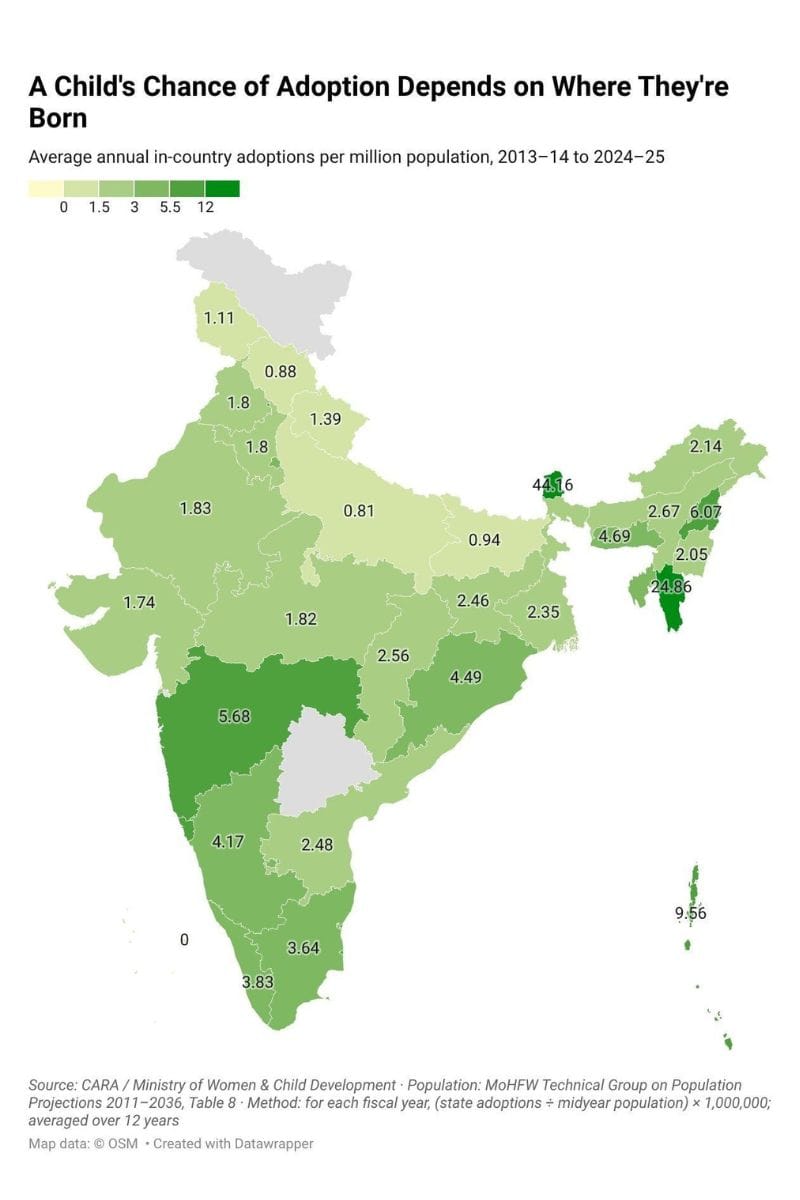
The disparity is stark. Uttar Pradesh, Madhya Pradesh, Rajasthan, and Bihar together have 539 million people, around 38 per cent of India’s population. Their combined average annual adoption rate is 1.4 adoptions per million. The national average in 2024–2025 was 2.95 per million. If these four states alone reached that national average, India would gain approximately 835 additional adoptions per year.
Figure 2: The Northeast has built what central India has not
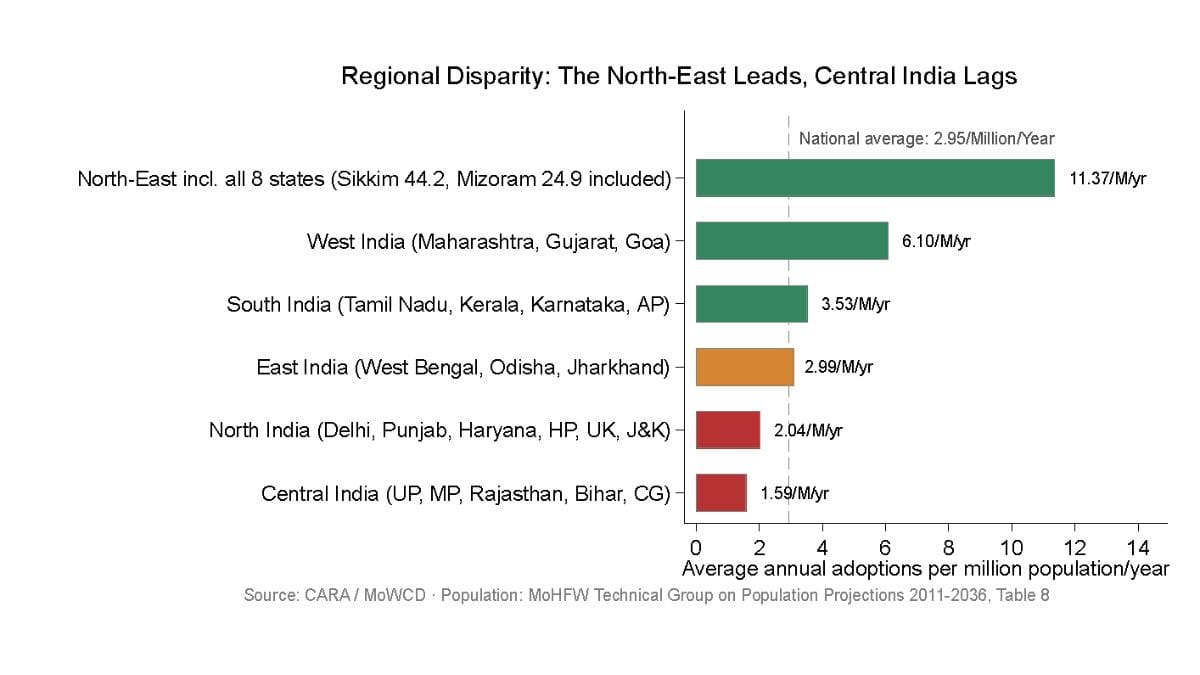
The regional comparison is the most instructive in the dataset. Sikkim, with a population of under 7,00,000, averages 44.2 adoptions per million per year: the highest rate in the country. Mizoram averages 24.9. But even after setting both aside, the remaining six northeastern states (Nagaland, Meghalaya, Assam, Manipur, Tripura, Arunachal Pradesh) average 3.66 adoptions per million per year. Central India averages 1.59. This 2.3-fold gap holds even when controlling for the outliers.
Taken together, Figures 1 and 2 make the same argument: adoption rates in India are not determined by family demand or by the number of children in need. They are determined by institutional infrastructure in the states. Sikkim and Mizoram must be doing something right, and the lessons one learns from these states can be replicated across other states.
The gender paradox
The most counterintuitive finding in the dataset concerns gender. Nationally, 58.1 per cent of in-country adoptions over the 12 years were girls: a share that has not fallen below 54 per cent in any year with complete data. When plotted against each state’s Child Sex Ratio (girls born per 1,000 boys aged 0–6 years) an inverse pattern emerges.
Figure 3: States that choose boys at birth, adopt more girls
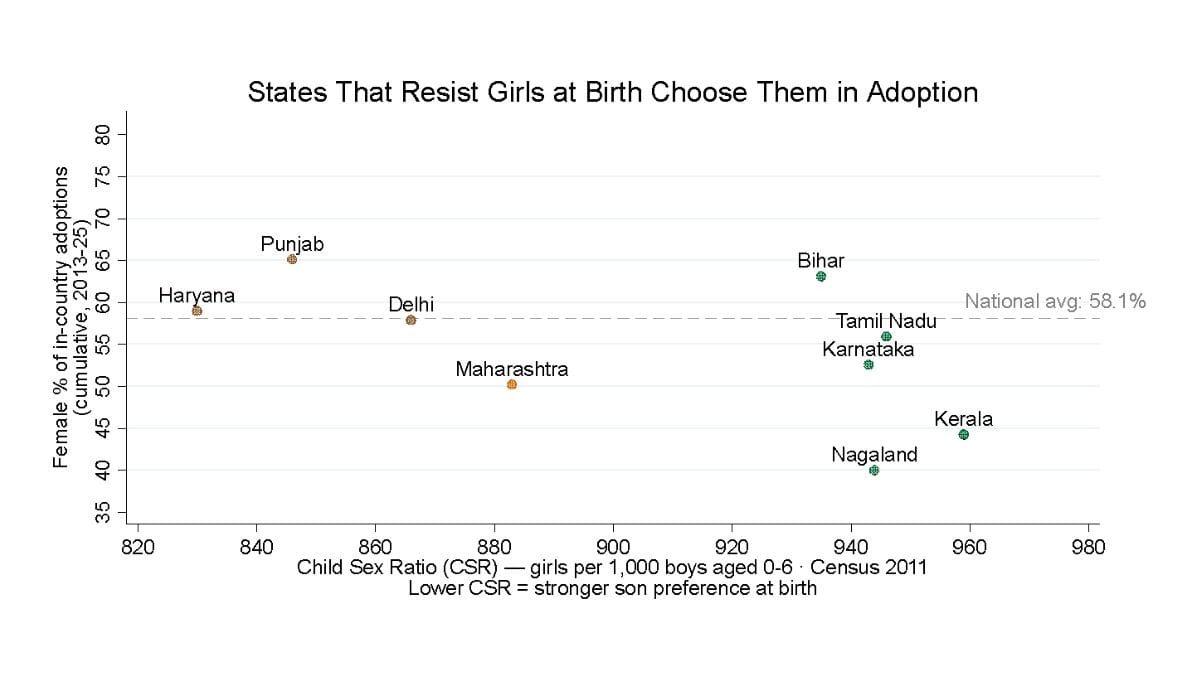
Punjab, according to Census 2011, has a Child Sex Ratio of 846. Yet 72 per cent of children adopted in Punjab are girls: the highest female adoption preference in any state. Haryana (CSR: 830) shows 63.6 per cent female preference. Bihar (CSR: 935) shows 69.9 per cent. Kerala (CSR: 959), where son preference at birth is comparatively mild, records 48.3 per cent female adoptions: close to parity.
The policy implication is specific. Male children wait longer in institutional care and age out of the system at higher rates than girls. For a boy placed in institutional care in Punjab or Haryana, the gender preference data means a materially longer wait, and a higher probability of never being placed at all. Faster referral processing for male children, paired with honest public communication about equal need, would improve outcomes without reducing adoption rates overall.
The big change needed
The geographic and gender data together make a single case: the constraints on adoption in India are administrative. Families want to adopt. The children are there. What is missing is the institutional connective tissue, i.e., registered agencies, compliant childcare institutions, functioning processing systems, that joins one to the other. Three changes and one structural reform would begin to build it, and all four could produce measurable results within two years.
- CARA registration compliance: An estimated 4,000 childcare institutions remain unregistered with CARA. A 12-month compliance deadline (with genuine incentives for registration and consequences for non-compliance) would begin moving children from legal invisibility into the adoption pool. Each institution that registers is estimated to add 10-30 children annually.
- Agency expansion: Most districts in Uttar Pradesh, Bihar, Madhya Pradesh, and Rajasthan have no CARA-registered adoption agency. Targeted registration drives, partnering with local NGOs, with streamlined approval timelines and modest facilitation support, would address the single largest source of geographic inequality in the system.
- Emergency audit of structurally declining states: Andhra Pradesh has fallen from 272 in-country adoptions in 2013–14 to 100 in 2024–25—a compound annual decline of 8.7 per cent. Tripura: from 24 to 3, a collapse of 88 per cent. Jharkhand: from 153 to 60. In all three cases, the decline predates COVID and has continued through the national recovery. The question the data cannot answer is whether Child Welfare Committee (CWC) capacity has collapsed, whether agencies have attrited without replacement, or whether something has changed in district-level administration. Further investigation should be made into this matter.
- Institutionalisation: CARA’s data is published but not routinely analysed for performance management. A basic annual dashboard for tracking per-capita adoption rates, agency counts, CWC processing times, and waiting-list ratios by state would allow the national government to identify declining states in year one rather than year eleven. The data already exists; the practice of reading it systematically does not. This is the lowest-cost recommendation on this list and the one that makes all the others accountable.
Also read: Judge’s Tinder scam shows one thing. Shame is the biggest obstacle to investigation
Conclusion
The 12-year CARA dataset is a live account of which children in India are finding families and which are not, updated every year and available to anyone who looks. The record year of 2024–25 demonstrates that the number is not fixed: that deliberate intervention moves it. The findings here show where intervention is most needed: the unregistered institutions, the zero-agency districts, the states in structural decline, the boys who wait longer than girls and age out before anyone arrives.
These are not intractable problems. They are known, located, and in several cases already subject to a Supreme Court mandate that simply lacks enforcement. What is missing is not political will so much as institutional attention: the habit of reading the data, tracking the gaps, and asking year after year whether each child who needed a family found one.
Payal Seth is the lead economist and Head of the Centre of Data for Economic Decision-making (CoDED) at Pahle India Foundation. Views are personal.
(Edited by Ratan Priya)