






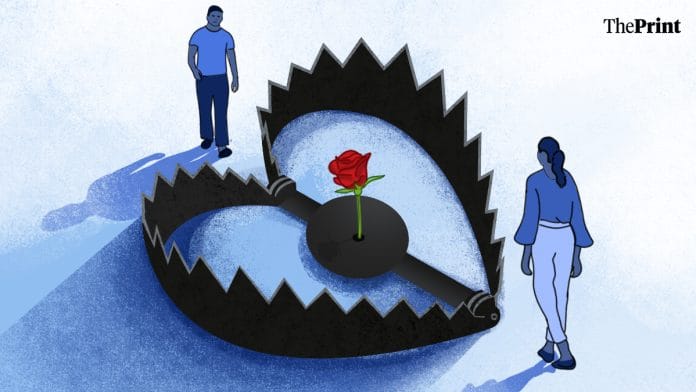


Behind every right swipe, match and message lies a distinctly human desire—for emotional intimacy, validation, companionship or the fulfilment of basic human needs. The desperation for connection can sometimes be so intense that a person knowingly overlooks warning signs and places trust in someone whose online profile may be entirely fabricated. It is within this space that many individuals fall into what is popularly known as a honey trap.
The issue has recently come into sharp focus following reports of a case involving a Haryana judicial officer who allegedly lost approximately Rs 52 lakh after connecting with a person through the dating app Tinder. While denying bail to the accused, a Delhi court reportedly questioned why the complaint had initially been lodged through the judicial officer’s domestic worker when the financial trail appeared to indicate that the judicial officer herself was the real victim. The court also expressed concern about shortcomings in the investigation and the manner in which the case had been handled.
While this incident has attracted attention because of the status of the alleged victim, the underlying problem is far from uncommon. Every year, individuals from different professions and social backgrounds fall prey to schemes in which emotional intimacy is used as a pathway to financial exploitation. The details vary, but the pattern is familiar: Trust is cultivated, personal information is exchanged, emotional dependence is encouraged and money ultimately changes hands.
An important legal point is often overlooked. While “honey trap” is not a recognised offence under Indian criminal law, the law recognises the acts that often accompany such schemes—cheating, personation, extortion, criminal intimidation, criminal conspiracy, identity fraud and various cyber offences depending upon the facts of each case.
Therefore legal remedies are not the issue. The real difficulty in curbing these instances lies elsewhere.
Also read: Gurugram men are quitting dating apps, alcohol, hiring lawyers. A woman on Bumble did this
Privacy and dignity
The recent case involving the Haryana judicial officer illustrates this in an unusually stark manner. If even a judicial officer—someone trained in law and familiar with the justice system—appears reluctant to come forward directly after becoming the victim of an alleged romance scam, what does that tell us about the social stigma attached to such incidents?
The answer lies in the peculiar nature of romance fraud itself. Unlike many other crimes, a honey trap does not merely exploit money. It exploits trust, intimacy and emotional vulnerability. Victims often fear that reporting the offence will expose not only the fraud but also their personal choices, private conversations and emotional lives to public scrutiny.
That fear is not unfounded. When a person reports a romance scam, the investigation often requires an examination of conversations, financial transactions and other personal details that many would rather keep private. That creates a paradox: The victim seeks justice, while simultaneously withholding the very material that may be necessary to secure it. (moved up)
Chats are deleted. Facts are selectively disclosed. Relationships are described incompletely. Embarrassing details are omitted. In some cases, the desire to protect personal dignity, reputation or professional standing inadvertently weakens the prospects of legal redress.
The problem with this is that investigators cannot piece together a deception if only half the story is disclosed.
This is where the modern honey trap raises questions extending beyond cybercrime. It exposes what might be called the “shame barrier”—the gap between victimisation and reporting, created not by law but by social stigma. The fraud may be digital, but the silence that follows is deeply human.
The first few days after a romance scam are often the most important. Yet many victims, driven by panic, embarrassment or concerns about reputation, delete conversations, photographs and other digital records that may later prove critical. The recent Haryana judicial officer case offers a possible illustration of these pressures. Whatever the explanation for filing the case via the domestic worker, the episode underscores how concerns about privacy and reputation can complicate the reporting of romance fraud. Better awareness, earlier reporting and timely preservation of evidence could substantially improve both investigations and outcomes.
Also read: Liars, fakers, scammers—Jamtara has entered online dating
Social, not legal
Equally important is a change in how society views such cases.
The objective should not be to shield evidence from scrutiny, but to reduce the personal cost of disclosure. A victim who fears embarrassment, professional consequences or social stigma is less likely to tell the whole story. Any meaningful response to romance fraud must therefore encourage candour rather than punish vulnerability.
The law’s response to honey traps is not constrained by the absence of legal provisions. Existing criminal laws are already capable of addressing most forms of deception, extortion, impersonation and cyber-enabled fraud. The greater challenge lies in ensuring that victims come forward early, preserve evidence and disclose the facts completely.
The larger lesson from the recent judicial officer case is therefore not about Tinder, online dating or even fraud alone. It is about the complex intersection of intimacy, privacy, reputation and justice. The law can investigate deception and punish wrongdoing. What it cannot do is eliminate the embarrassment that often accompanies victimhood in such cases.
In many honey trap investigations, the greatest obstacle is not identifying the alleged fraudster. It is persuading the victim to tell the whole story.
Jitendra Mohananey is an advocate and former corporate finance professional. He writes on constitutional law, family law, and the evolving legal framework governing personal relationships in India. Views are personal.
(Edited by Theres Sudeep)