





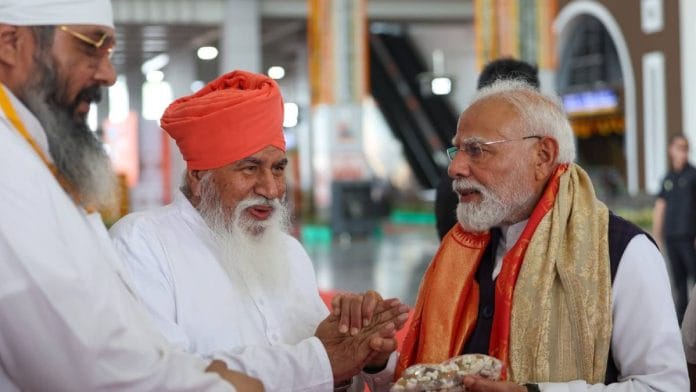


Chandigarh: Last week, when Prime Minister Narendra Modi was in Jalandhar to inaugurate a new railway station, one of the few persons he chose to specially meet was Sant Niranjan Dass, head of the influential Dalit Dera Sachkhand Ballan.
The meeting would have gone largely unnoticed but for the PM posting pictures of it on X.
The warmth between the PM and the Dalit dera appears mutual. In December last year, Sant Dass had first met Modi inviting him to the dera on the occasion of Guru Ravidas Jayanti, and the PM visited the dera in February to participate in the ceremony.
The dera chief was also honoured with the civilian award Padma Shri last month.
Apart from the growing personal friendship, the PM’s open patronage of Punjab’s largest Dalit dera can also be read politically as part of the Bharatiya Janata Party’s (BJP) outreach to Dalit voters ahead of next year’s assembly polls.
ThePrint explains the emergence of Dera Sachkhand Ballan, located at Ballan in Jalandhar, and its political significance in Punjab.
Also Read: Road to power in Punjab runs through its farms. How BJP’s laying groundwork to go solo in 2027
Three prominent deras
Deras, widespread in Punjab, are socio-religious centres of various sects and organisations. Unlike Sikh gurdwaras, where the Guru Granth Sahib is considered a living guru, deras are generally led by a living guru with a personal following.
Dera Radha Soami Satsang Beas, Dera Sacha Sauda (headquartered in Sirsa) and Dera Sachkhand Ballan are the three most followed deras in Punjab, commanding a following running into several lakhs.
Though the dera Beas, located in the Majha belt, is considered to be apolitical, the BJP has in the past few years made multiple efforts to cement the party’s bond with dera chief Baba Gurinder Singh. The outreach has included the PM meeting Baba Gurinder Singh on several occasions.
The dera at Sirsa, which has a large following in Malwa, is headed by Gurmeet Ram Rahim currently in jail serving multiple sentences for rape and murder. He is considered to be close to the BJP, with the administration allowing him breaks from jail several times in the year.
Now, the bonhomie with a prominent Dalit dera in the heart of Doaba completes the picture.
Dalits hold the key
Dalits constitute almost 32 percent of Punjab’s population, the highest proportion of Scheduled Caste (SC) population among all Indian states, according to the 2011 Census. They are divided among Sikh, Hindu and Christian faiths, and many flock to deras. Dalits also do not vote en bloc in Punjab.
Among the Dalits, the Ravidasias, Ramdasias and Ad-Dharmis are the major sub-groups, concentrated in the Doaba region comprising the districts of Jalandhar, Hoshiarpur, SBS Nagar and Phagwara.
Ronki Ram, from the department of sociology, Panjab University Chandigarh, had in his seminal study on Punjab Dalits reported that the Ravidasias are the most prominent Dalit community in the state.
“Out of the 39 SC castes in Punjab, the four major castes of Chamar (23.45 percent), Ad-dharmi (11.48 percent), Balmiki (9.78 percent) and Mazhabi (29.72 percent) constitute 74.44 percent of the total SC population,” he wrote in his research paper titled ‘Caste within Caste: Predicament of Political Solidarity among Scheduled Castes in Contemporary Punjab’.
“Chamars are further divided into Ravidasias (leather workers) and Ramdasias (weavers). The Ravidasias have utilised the availability of reservation in education well, and are more upwardly mobile than Ramdasias,” he told ThePrint.
The Ravidasias are followers of Guru Ravidas, a 15th-century Bhakti saint and social reformer of the Chamar caste whose egalitarian message resonated with Dalit communities.
“Ravidas was born into the Chamar caste, also known as Kutbandhla, one of the Scheduled Castes (SC) in Uttar Pradesh. Chamars are known by their profession of leather and tanning. They were oppressed and their touch and sight were considered polluting by the upper castes. Ravidas revolted against this inhuman system of untouchability. He adopted bhakti as a mode of expression for his revolt,” reads Ronki Ram’s research paper.
Guru Ravidas’s poetic hymns are also included in the holy text of the Guru Granth Sahib.
Every year, trains full of devotees from Sachkhand Ballan head to Shri Guru Ravidas Janam Asthan in Varanasi to mark the guru’s birth anniversary. During his visit to Jalandhar last week, the PM also flagged off the Sant Ravidas Express connecting Amritsar to Varanasi to facilitate devotees travelling from Punjab.
The Sachkhand Ballan Dera is the largest dera of the Ravidasias in Punjab.
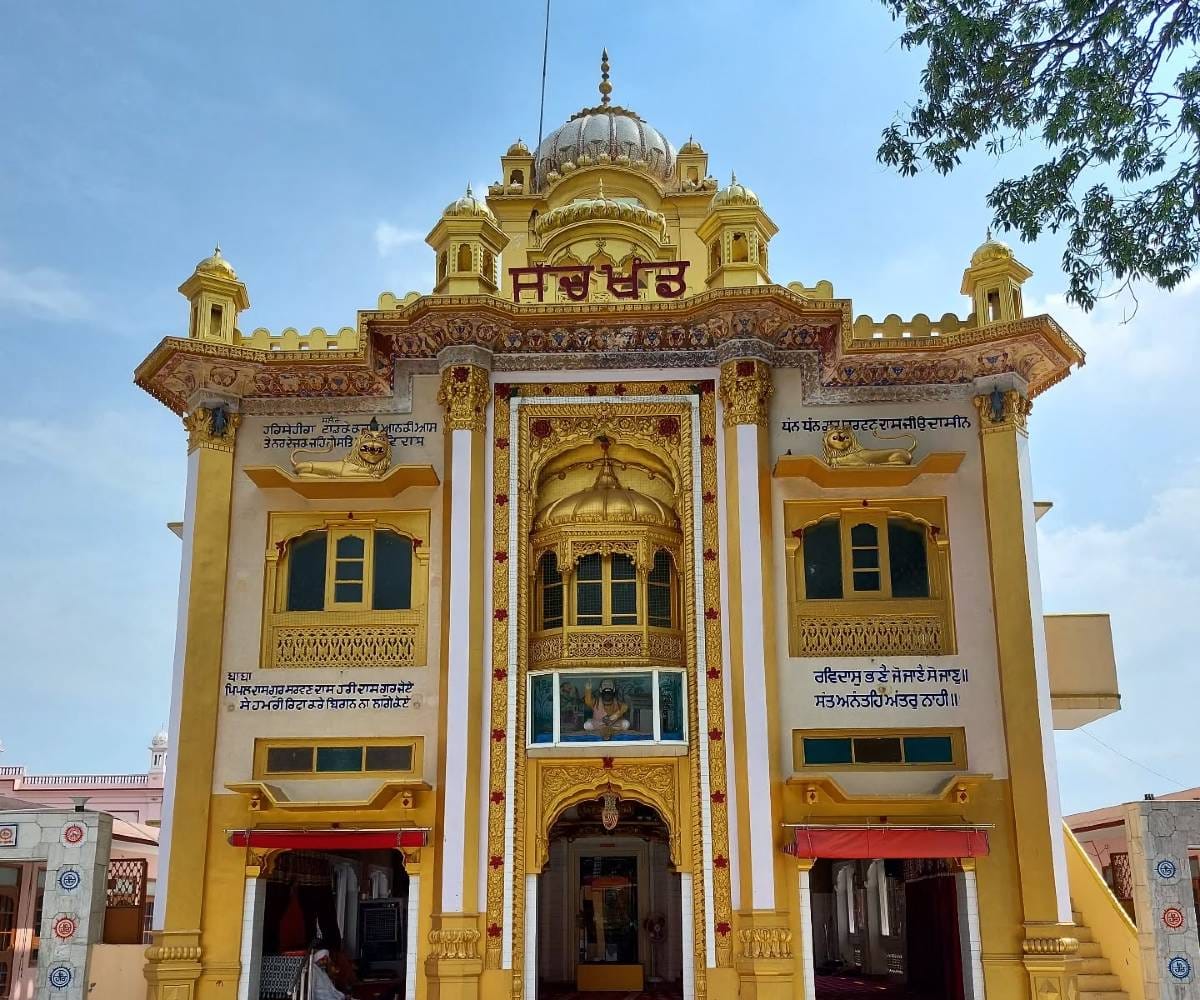
Sachkhand Ballan
According to Ronki Ram, the growth and expansion of Sachkhand Ballan is an example of the upward mobility of Ravidasias.
“Many Ravidasias went abroad and have earned well and have invested in Guru Ravidas deras. They have built temples, gurdwaras, bhawans (memorial halls), educational institutions/chairs, cultural organisations and hospitals in his name all over Punjab. They are also networked and, as a community, enjoy political clout. The growth and expansion of Sachkhand Ballan is an example of this upward mobility of Ravidasias,” he said.
A faultline among Ravidasias and radical Sikhs emerged in 2009 when six armed men attacked a Ravidasia congregation at Ravidas Gurdwara in Vienna in Austria, where Sant Ramanand, the then second in command of the dera, was fatally injured.
Sant Niranjan Dass, who was heading the sect even then and was with Sant Ramanand, was injured.
Sikh extremists saw some Ravidasia practises as divergent from orthodox Sikh canon. They objected to keeping the Guru Granth Sahib at the same level as a human guru.
The 2009 attack triggered protests in Punjab, with clashes among Sikhs and Ravidasias reported in Jalandhar, Hoshiarpur, and other areas. Several vehicles were burnt in the riots that ensued. A passenger train was torched after passengers were asked to evacuate. Then Prime Minister Manmohan Singh had to appeal for peace.
In September 2010, a Vienna court sentenced the main attacker to life in prison for murder and attempted murder, while four accomplices received 17 to 18-year sentences and a sixth received six months.
Demand for separate identity
The Vienna incident was pivotal in galvanising the community’s sense of a separate identity.
The next year, the Ravidasias, refusing to align either with the Sikhs or the Hindus, and declared themselves to be part of a separate religion, with a distinct identity, religious traditions, and scripture the “Amritbani Satguru Ravidas Ji”.
The Amritbani replaced the Guru Granth Sahib in the Ravidasias’ place of congregation and worship.
“The Ravidasias have been demanding recognition as an independent community, and the BJP intends to do just that—leverage identity recognition, aligning with the community’s demands for national visibility and respect for its spiritual leadership,” said Dr Kanwalpreet Kaur, from the department of political science, DAV College, Chandigarh.
Dera Sachkhand Ballan commands significant social influence in at least 19-20 assembly seats of Doaba. Politically, the Ravidasias—like many Dalit sub-groups—do not vote as a monolith, but their collective influence in key constituencies makes them a prize for any party seeking power in Punjab.
All major political parties in Punjab—the Congress, the ruling Aam Aadmi Party (AAP), the Shiromani Akali Dal (SAD) and others—have courted this community, with prominent leaders making a beeline for the dera to seek blessings, especially during election season.
When Congress leader Charanjit Singh Channi, now an MP, became the first Dalit chief minister of Punjab in 2021, one of his first visits after he became CM was to the Dera Sachkhand Ballan, where he was welcomed by its chief.
Channi has also promised to establish a research institute to study the life and teachings of Guru Ravidas.
(Edited by Nida Fatima Siddiqui)
Also Read: BJP’s Ravidas Jayanti push to woo Dalits in poll-bound states — shobha yatras, sant sammelans