



New Delhi: Thousands of protesters in Delhi and across the country wound up their protests Saturday evening after the government finally agreed to their demands—including the resignation of Union education minister Dharmendra Pradhan—for accountability, transparency and reform in India’s education sector.
The Cockroach Janta Party (CJP), which led the protests, particularly in Delhi, has provided a platform not just for India’s youth, but for anyone and everyone who wanted to show up and demand that their country do right by them.
Jantar Mantar was packed as Indians, their voices raised and their hearts hopeful, doing what so many before them have done—something that comes naturally to the world’s largest democracy: Protest.
Protesting is one of India’s most enduring and vital social traditions. The events of this week are evidence, yet again, of how deeply it continues to thrive within the fabric of a nation of over 140 crore people.
This raises the question: What causes have brought Indians to the streets in the past? And, more importantly, what have these mass movements accomplished?
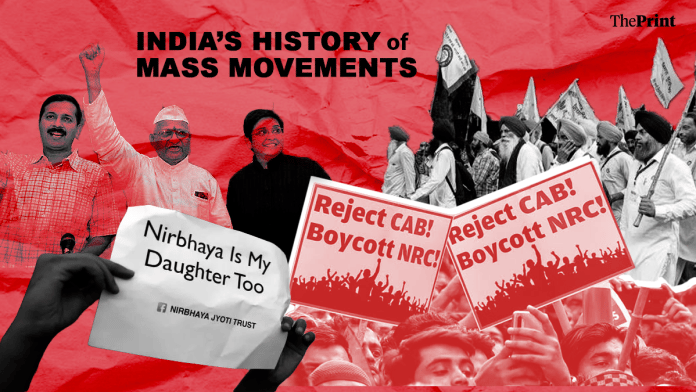
Here is a broadly chronological look at 15 of the most significant mass movements in India’s Independent history, and the grievances, demands, and aspirations that brought the Indian people onto the streets.
Andhra State movement and Potti Sriramulu’s fast: 1952-1953
The movement for a Telugu-speaking state provided one of the earliest tests of how a nascent India would accommodate its extraordinary linguistic diversity. Telugu speakers in the composite Madras State believed that political power, public employment, and administration were unfairly concentrated around the Tamil-speaking capital of Madras.
Enter Gandhian activist Potti Sriramulu, who turned this long-standing demand into a national crisis when he began a fast for a separate Andhra State. His death in December 1952, after 58 days without food, triggered demonstrations, strikes, public disorder, and intense pressure on Jawaharlal Nehru’s government.
While Nehru had initially resisted linguistic states out of fear that regional nationalism might weaken the newly unified country, the agitation forced him to reconsider. Andhra State was created in 1953, and the wider controversy around the movement led to the States Reorganisation Commission and the States Reorganisation Act of 1956.
The movement helped establish linguistic identity as a legitimate basis for reorganising the Indian Union—Maharashtra, Gujarat, Punjab, and several later statehood movements would follow comparable paths.
India’s present-day map, therefore, cannot be understood without Sriramulu’s fast and the mass mobilisation that followed his death.
Anti-Hindi agitations in Tamil Nadu: 1965
The anti-Hindi agitations arose from fears that the Union government would allow Hindi to displace English as the principal language of central administration after the Constitution’s transitional period ended.
For many Tamil speakers, Hindi dominance appeared capable of placing non-Hindi speaking citizens at a disadvantage in Union government employment, education, and national politics. Students became the most visible force in the 1965 agitation, joined by the Dravida Munnetra Kazhagam (DMK), writers, intellectuals, and other prominent sections of Tamil civil society.
Protests took many forms, including demonstrations, strikes, shutdowns, and acts of self-immolation. The government met these with arrests, prohibitory orders, and police force.
The intense unrest compelled the Centre to assure non-Hindi states that English would continue alongside Hindi. The Official Languages Act’s 1967 amendment formalised that compromise.
Politically, this agitation helped the DMK defeat Congress in the 1967 Tamil Nadu election, which ended Congress dominance in a state it has since never governed on its own. A lesson was quickly learned: Indian national unity cannot depend on linguistic uniformity.
Naxalbari and the Naxalite-Maoist movement: 1967-present
The Naxalite movement began with a farmers’ uprising in Naxalbari, West Bengal, in 1967, but developed into a far larger and longer revolutionary challenge to the Indian state. Its early supporters argued that parliamentary democracy had failed to dismantle a semi-feudal social order marked by landlessness, landlord domination, exploitative labour, and caste oppression.
Later Maoist organisations established their strongest presence in forested regions where Adivasi communities faced displacement, mining expansion, restrictions on forest access, and limited state services. Protest and resistance moved beyond just demonstrations and into actions like land seizures, armed squads, guerrilla warfare, and parallel structures of authority.
The government consequently treated the movement primarily as an internal-security threat by addressing it through arrests, bans, police, and paramilitary operations, intelligence campaigns, and infrastructure expansion—alongside welfare and development programmes.
The movement’s influence placed land reform, forest rights, tribal autonomy, displacement, and mining on the national agenda. Its armed character distinguishes it from the conventional civil protests in India’s history of mass movements.
Chipko movement that redefined India’s environmental protest: 1973-1980s
The Chipko Movement emerged in the Himalayan districts of what was then Uttar Pradesh, now Uttarakhand, where villagers opposed commercial logging arrangements that gave outside contractors access to forests while restricting local communities dependent on them for fodder, fuel, and water. Villagers connected deforestation directly to erosion, landslides, floods, declining water supplies, and the growing burden placed on women responsible for gathering essential resources.
Protesters used Gandhian forms of protest like marches, songs, meetings and nonviolent resistance: Most famously embracing trees to prevent them from being felled. Chandi Prasad Bhatt and Sunderlal Bahuguna became nationally recognised leaders, but village women—including Gaura Devi and the women of Reni—were especially central to the movement’s success.
In 1980, Indira Gandhi’s government imposed a long-term prohibition on green felling in sections of the Himalayan forests. Chipko also strengthened the political environment surrounding the Forest Conservation Act, 1980. Against the backdrop of the present government’s ambitions to establish India as a global power, the movement raises a question that continues to reverberate across Indian politics: Who enjoys the benefits of “development”—and who is made to bear its costs?
Nav Nirman Movement in Gujarat: 1973-1974
Like today’s CJP protests, the Nav Nirman Movement began with student grievances that appeared limited to education, but quickly became a wider demand for government accountability.
It began in late 1973 as a protest against increased food and hostel charges at an engineering college in Ahmedabad, before rapidly developing into a statewide campaign against inflation, corruption and the Congress government of Chief Minister Chimanbhai Patel.
Students organised strikes, demonstrations, shutdowns and boycotts; traders, professionals, and opposition parties subsequently joined the agitation.
The government responded with arrests, curfews and police force as protests spread across Gujarat and increasingly disrupted public life. Approximately 103 people were killed during the agitation, including 88 who died in police firing. As violence and political instability intensified, Patel resigned in February 1974 and the state assembly was first suspended and later dissolved, clearing the way for fresh elections.
Although Patel subsequently returned to power years later as the head of his own political party (Kisan Mazdoor Lok Paksha), the movement demonstrated that sustained street mobilisation could force an elected state government from office. Nav Nirman also became an important precursor to the Jayaprakash Narayan Movement in Bihar, helping transform local anger over prices and corruption into a wider national challenge to Congress rule and the increasingly centralised authority of Indira Gandhi’s government.
Jayaprakash Narayan Movement: 1974-1975
What began as a student agitation against inflation, corruption, unemployment, food shortages, and administrative failure in Bihar developed into the most serious popular challenge faced by Indira Gandhi’s government.
Veteran socialist Jayaprakash Narayan, popularly known as JP, gave the campaign national direction through his call for Sampoorna Kranti, or ‘Total Revolution’—a transformation not just of the government, but of India’s political, economic, educational, and moral life.
Students, opposition parties, trade unions, and civil-society organisations participated in marches, strikes, and civil disobedience, while campaigning for elected state assemblies to be dissolved and fresh elections to be held.
The authorities responded promptly with arrests, baton charges and police firing; Narayan himself was injured during a police assault. After the Allahabad High Court invalidated Gandhi’s 1971 election, the confrontation escalated—culminating in the Emergency.
On 25 June 1975, Gandhi’s government declared the Emergency, detained opposition leaders, censored the press, and suppressed political mobilisation. The movement was initially crushed, but its historical victory came in 1977, when voters removed Congress and installed India’s first non-Congress Union government.
The 44th Constitutional Amendment later placed stronger safeguards around Emergency powers. The JP movement remains a key historical reference point whenever contemporary protesters, journalists, and opposition leaders warn of democratic backsliding and executive overreach in Indian democracy.
The Assam Movement: 1979-1985
The Assam Movement grew from anxieties over migration, demographic change, control of land and employment, and the preservation of the Assamese cultural and political identity. Led primarily by the All Assam Students’ Union and the All Assam Gana Sangram Parishad, protesters demanded that people identified as undocumented immigrants—referring mainly to those who had entered from Bangladesh—be detected, removed from electoral rolls, and deported.
For six years, the movement manifested itself in strikes, shutdowns, mass rallies, civil disobedience, election boycotts, and resistance to government administration. The Centre alternated between negotiation and coercion, proceeding with the disputed 1983 Assembly election, despite a widespread boycott.
The period was also marked by devastating ethnic violence, most notoriously the 18 February 1983 Nellie massacre in which an estimated 3,000 people, most of whom were Bengali-speaking Muslims, were killed.
The 1985 Assam Accord fixed 24 March 1971 as the principal cut-off date for determining citizenship in the state and promised constitutional, legislative, and administrative protections for Assamese identity. Movement leaders then formed the Asom Gana Parishad and won the state election, which brought Prafulla Kumar Mahanta to power as the youngest chief minister in India at the age of 33.
The unresolved question of how India should reconcile citizenship, migration, and electoral rights with the cultural and demographic anxieties of its border-state populations remains deeply relevant to the country’s politics today.
Ram Janmabhoomi Movement & rise of Hindutva politics: 1980s-2024
The Ram Janmabhoomi movement transformed a disputed religious site in Ayodhya into the centre of a nationwide campaign over history, faith, and what it means to be Indian. Hindu nationalist organisations argued that the Babri Masjid had been built at Ram’s birthplace after the destruction of an earlier temple and demanded that the land be transferred for the construction of a Ram temple.
The Vishwa Hindu Parishad (VHP), Rashtriya Swayamsevak Sangh (RSS), Bharatiya Janata Party (BJP), and associated organisations mobilised supporters through religious processions, public meetings, consecrated-brick campaigns, and L. K. Advani’s 1990 rath yatra.
Successive governments alternated between accommodation, negotiation, litigation and coercion. Advani was arrested during the rath yatra, but mobilisation continued. On 6 December 1992, ‘kar sevaks’ demolished the Babri Masjid despite assurances that it would be protected, triggering communal violence across India.
The Centre dismissed BJP-led state governments, temporarily banned several organisations, and established the Liberhan Commission. The movement’s most significant consequence was political: It helped transform the BJP from a limited parliamentary force into a major national party and placed Hindutva at the centre of Indian politics. In 2019, the Supreme Court awarded the disputed land for temple construction, while describing the mosque’s demolition as an unlawful act.
The movement’s deeply contentious legacy continues to shape elections, Hindu-Muslim politics, and fundamental disagreements over the role and consequences of religious nationalism in Indian democracy.
Movements that created Uttarakhand, Jharkhand, Chhattisgarh: 1970s-2000
The creation of Uttarakhand, Jharkhand and Chhattisgarh in 2000 was the product of distinct regional movements united by a belief that existing state governments had neglected peripheral communities.
In the Himalayan districts of Uttar Pradesh, Uttarakhand supporters argued that the administration dominated by the plains failed to address mountain employment, ecological vulnerability, infrastructure, and cultural identity.
The movement used marches, strikes, rallies and political organisation, and was marked by severe police violence, particularly the 1994 Rampur Tiraha incident.
In Jharkhand, Adivasi organisations and regional parties sought control over a mineral-rich territory where indigenous communities experienced land alienation, mining displacement, and chronic underdevelopment.
Chhattisgarh advocates similarly argued that their region’s linguistic identity, natural resources, and developmental needs were neglected within Madhya Pradesh.
After decades of delay, Parliament passed the Madhya Pradesh Reorganisation Act, the Uttar Pradesh Reorganisation Act, and the Bihar Reorganisation Act in 2000, creating Chhattisgarh, Uttarakhand, initially named Uttaranchal, and Jharkhand, respectively.
Their formation demonstrated that India could accommodate regional demands by redrawing internal boundaries, instead of branding and treating every assertion of distinctiveness as separatism.
Statehood still did not automatically remedy the grievances that produced these movements, as contemporary conflicts over mining, forest rights, migration, and uneven development in the three states persist.
Mandal Commission implementation and anti-reservation protests: 1990
Prime Minister V. P. Singh’s 1990 decision to implement the Mandal Commission’s recommendation introduced a 27 percent reservation for Other Backward Classes (OBC) in central government employment. The decision substantially expanded OBC representation within the state and intensified the role of caste-based mobilisation in electoral politics.
OBC organisations viewed the policy as a long-overdue compensation for the long-standing ‘upper’ caste domination of state institutions and government employment. Many ‘upper’ caste students, particularly in northern India, regarded it as an attack on merit and their employment prospects.
University shutdowns, road blockades, strikes, and demonstrations spread across cities, accompanied by highly publicised self-immolation attempts—including the widely-remembered case of Delhi University student Rajiv Goswami.
Police used arrests and force, but the government did not withdraw the policy. In Indra Sawhney v. Union of India of 1992, the Supreme Court upheld OBC reservation while requiring exclusion of the “creamy layer” and generally maintaining a 50 percent ceiling.
Mandal’s greatest consequences were electoral: It accelerated the rise of OBC leaders and regional parties in Bihar, Uttar Pradesh, and elsewhere—which substantially weakened a political order dominated by ‘upper’ castes and Congress.
Contemporary debates over caste census, sub-categorisation, and reservation remain firmly rooted in the political transformation produced by Mandal. The implementation of the Mandal Commission’s recommendations helped redistribute political voice and changed who could credibly claim to represent northern India.
Right to Information movement: 1990s-2005
The Right to Information movement began in rural Rajasthan, where workers discovered that government records often showed wages paid and public works completed even when neither existed on the ground. Citizens could suspect corruption, but lacked a practical, meaningful, and lawful right to inspect muster rolls, bills, and expenditure accounts.
The Mazdoor Kisan Shakti Sangathan, associated with Aruna Roy, Nikhil Dey, Shankar Singh, and local workers, responded by organising jan sunwais, or public hearings. Official records were read aloud and compared with testimony from villagers, which helped turn opaque government paperwork into publicly verifiable evidence.
Sit-ins and campaigns gradually spread the demand that access to information was necessary for exercising every other democratic right. Officials initially resisted disclosure by invoking administrative secrecy, but Rajasthan and other states eventually adopted information measures before Parliament enacted the Right to Information Act in 2005.
The law created Central and State Information Commissions, required public authorities to appoint information officers and authorised penalties for unjustified delay or denial. Its contemporary significance is truly difficult to overstate. Journalists, activists, and ordinary citizens have used RTI applications to uncover corruption and administrative failure.
India Against Corruption and the Anna Hazare movement: 2011-2013
India Against Corruption emerged amid public anger over a series of corruption controversies associated with the United Progressive Alliance government. Its central demand was a strong and independent Lokpal, or national anti-corruption ombudsman, capable of investigating senior public officials.
Gandhian activist Anna Hazare became the campaign’s symbolic centre through hunger strikes, while Arvind Kejriwal, Kiran Bedi, Prashant Bhushan, and other activists played prominent organisational and public roles.
The movement combined fasting, rallies, and occupation of public spaces—also using continuous television coverage and rapidly expanding social-media mobilisation to the advantage of their cause.
Gatherings at Delhi’s Ramlila Maidan turned the Lokpal demand into a national political spectacle. Hazare’s brief detention before one proposed fast further intensified criticism of the government.
The Centre negotiated with activists, formed a joint drafting committee, and introduced competing versions of the legislation. Parliament eventually enacted the Lokpal and Lokayuktas Act in 2013, although it did not reproduce the activists’ complete Jan Lokpal proposal and implementation was delayed.
The movement also produced an unexpected outcome: Kejriwal and his supporters created the Aam Aadmi Party, which became a dominant political force in Delhi. It remains a prominent example of how an anti-establishment campaign can itself become part of the electoral establishment.
Nirbhaya protests and India’s reckoning with sexual violence: 2012-2013
The gang rape and fatal assault of a young woman on a Delhi bus on 16 December 2012 generated nationwide outrage over sexual violence, victim-blaming, unsafe public spaces, and failures of policing and criminal justice.
Students, women’s organisations, and citizens gathered in Delhi and cities across India for marches, vigils, and demonstrations. India Gate and other prominent locations in the Capital became sites of confrontation as protesters demanded faster trials, stronger laws, and greater government accountability. Delhi Police erected barricades and used water cannons, tear gas, and baton charges, and authorities restricted access to protest areas.
Yet this scale of public anger also forced a rapid institutional response. The government appointed the Justice J. S. Verma Committee, which consulted civil society and proposed extensive reforms. Parliament then passed the Criminal Law (Amendment) Act, 2013, broadening the legal definitions of sexual offences, recognising stalking, voyeurism and acid attacks, and increasing penalties. Fast-track courts were introduced for some cases and the Nirbhaya Fund was established.
The government did not accept every Verma Committee recommendation, notably on marital rape and command responsibility. The protests, nonetheless, fundamentally altered how sexual violence was discussed in Indian homes, newsrooms, courts, and in Parliament.
They helped establish that violence against women was not merely a “women’s issue” confined to private life, but a matter of collective responsibility and equal citizenship—one for which the government must absolutely be held accountable.
Anti-CAA-NRC Movement and the battle over Citizenship: 2019-2020
The anti-Citizenship Amendment Act movement began after Parliament created an accelerated citizenship route for specified non-Muslim migrants—Hindus, Sikhs, Buddhists, Jains, Parsis, and Christians—from Afghanistan, Bangladesh, and Pakistan who had entered India by 31 December 2014.
This drew nationwide opposition, with critics arguing that making religion an explicit criterion for naturalisation violated India’s secular constitutional order. There was fear that the law, if combined with a nationwide National Register of Citizens, could disproportionately expose Indian Muslims without sufficient documentation to statelessness or exclusion.
Students, women, Muslim organisations, civil-society groups, and secular activists organised marches, university demonstrations, and prolonged sit-ins. At Shaheen Bagh in Delhi, women maintained a continuous occupation that became the movement’s most evident symbol.
Protesters read the Constitution aloud, displayed the national flag, and used public art to assert the movement’s dissent as a defence of India’s founding principles.
Police entered university campuses, detained protesters and used force, while internet restrictions and criminal cases were imposed in several places. The movement did not secure the repeal of the CAA, and the pandemic brought its physical mobilisation to an abrupt end.
Nevertheless, its use of constitutional patriotism, female leadership, and decentralised sit-ins continues to influence protest movements that confront contentious questions surrounding citizenship, minority rights, and state power.
Farmers’ Protest that forced the repeal of the three farm laws: 2020-2021
The farmers’ movement emerged in opposition to three Union laws intended to liberalise agricultural marketing, facilitate contract farming, and ease certain restrictions on stockholding. The government argued that the legislation would increase farmers’ choices by encouraging private investment and allowing cultivators to sell outside state-regulated markets.
Protesters, particularly from Punjab, Haryana, and western Uttar Pradesh, feared that these reforms would gradually weaken the agricultural produce market committees—thereby undermining the practical security of minimum support prices and leaving small farmers vulnerable in negotiations with large corporations.
Farmers established prolonged encampments at Singhu, Tikri, and Ghazipur on Delhi’s borders, creating kitchens, medical facilities, and stages that allowed the protest to survive for approximately a year. They also organised tractor rallies, highway blockades, village campaigns, and nationwide shutdowns.
The government held repeated negotiations but initially refused repeal, while police erected barricades, used tear gas and water cannons, filed criminal cases, and restricted internet access in some areas.
In November 2021, Prime Minister Narendra Modi announced that the laws would be withdrawn. Parliament subsequently passed the Farm Laws Repeal Act on 30 November 2021. The movement demonstrated that sustained organisation and pressure on the government could force even a powerful parliamentary majority to reverse enacted national legislation.
Protest is democracy’s lifeline
Mass movements are in India’s DNA. After all, India itself was born out of a nationwide mobilisation around the cause of creating the independent country we know today. Mass movements remain a lifeline for democracy, resuscitating a people-centric system at the moments when it needs them most.
As the world’s most populous country and largest democracy, India has repeatedly relied on mass movements as an indispensable means through which people of every background can articulate their wants, their needs, and their demands of a government that exists to serve them. Protests remind those in power who they are beholden to, who put them there, and, ultimately, who they work for.
(Edited by Viny Mishra)
Also read: From JNU to Jamia & now Jantar Mantar—Delhi Police faces similar questions over use of force
The mass protests listed here are good for democracy. However unnecessary protests called by political parties are a nuisance. I remember protests happening every 5-6 months during the 1980s, 90s over flimsy reasons by communist parties CPI, CPI(M). After BJP came to power now Congress is tried its best to protest on every flimsy reason, although unsuccessful till yet. Congress tried to take advantage of this CJP protest, but could not get anything.