



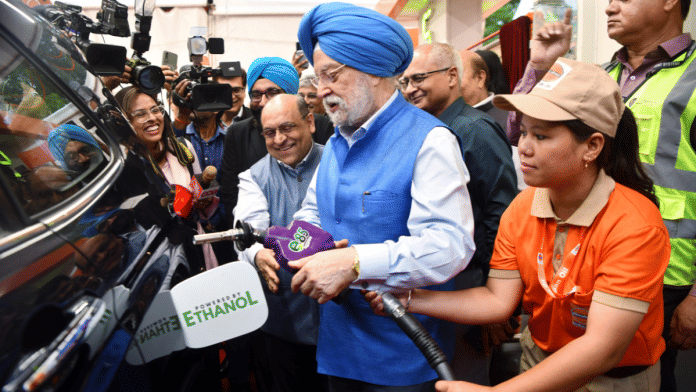
New Delhi: E85 fuel may need to be about 25 percent cheaper than petrol to deliver the same running cost per kilometre under an illustrative scenario, according to a white paper by researchers at the Indian Institute of Technology (IIT) Delhi and the All-India Distillers’ Association (AIDA) released Monday.
E85 is a high-ethanol fuel containing about 80-85 percent ethanol. It is meant specifically for flex-fuel vehicles (FFVs), which are designed to run on a range of ethanol-petrol blends. India launched E85 at 48 retail outlets of public-sector oil marketing companies in June 2026, with plans to expand availability to 500 outlets by December 2026 and about 5,000 by December 2027.
The rollout is still at an early stage compared with E20, the petrol blend being supplied nationwide. The government has clarified that introducing E85 for certified FFVs does not mean India is raising its overall blending level beyond 20 percent.
The government has said no decision has been taken to increase blending beyond E20, and any future move would only come after further technical studies and consultations.
E85 is, therefore, being developed as a separate fuel for FFVs rather than as a replacement for E20 in conventional petrol vehicles.
Also read: E85 launched, but India’s ambitious flexible fuel roadmap is facing a chicken & egg problem
Cost at pump vs cost per km
The paper argues against treating the 25 percent differential as a fixed pricing benchmark. Instead, it proposes assessing E85 based on the cost of travelling a kilometre, rather than simply comparing the price of a litre of fuel.
The white paper, ‘Flex-Fuel Vehicles: Enabling Energy Security and Sustainable Mobility in India’, has been authored by Prof. P. M. V. Subbarao, Professor and Head, Department of Mechanical Engineering, IIT Delhi, and Saptashish Deb, Research Scholar, IIT Delhi.
The authors argue that consumers ultimately pay for the distance they travel, not the volume of fuel they buy. Since ethanol has lower energy density than petrol, vehicles can travel fewer kilometres on a litre of E85, meaning a lower pump price does not automatically translate into lower running costs.
The paper says, “consumers purchase mobility (distance travelled), not fuel volume,” and recommends comparing fuels based on their cost per kilometre.
In its illustration, the paper assumes petrol costs Rs 100 a litre and a vehicle delivers 20 km per litre on petrol and 15 km per litre on E85. At an E85 price of Rs 82 a litre, the fuel would cost about Rs 5.47 per km, compared with Rs 5 per km for petrol, despite being 18 percent cheaper at the pump.
Under the same assumptions, E85 would need to cost around Rs 75 a litre – 25 percent below petrol – to bring the running cost down to Rs 5 per km. The paper stresses that this is an illustrative example and not a recommended national pricing benchmark.
Paper proposes dynamic E85 pricing
The authors argue that the price advantage of E85 can change depending on the vehicle and petrol prices. They, therefore, propose “a dynamic ethanol-gasoline price linkage framework” that would compare the two fuels based on prevailing prices and vehicle-specific fuel economy.
The framework could also consider E85 availability, regional driving conditions, FFV (flex-fuel vehicles) penetration, consumer fuel-switching behaviour and ethanol supply.
The authors propose developing a vehicle-specific fuel economy ratio (VFER) to help consumers compare the running costs of different fuels. Such information could potentially be included in Bureau of Energy Efficiency vehicle labels, vehicle dashboards or mobile applications.
Oil marketing companies could also display real-time ethanol-gasoline price ratios and model-specific fuel-cost comparisons at fuel stations.
The paper notes that ethanol economics also depend on feedstock and logistics costs. For Ethanol Supply Year 2025-26, it cites procurement prices ranging from Rs 57.97 per litre for C-heavy molasses-based ethanol to Rs 71.86 per litre for maize-based ethanol. Delivered costs can rise further because of transportation, storage, handling and taxes.
Two-wheelers need separate ethanol strategy
Beyond pricing, the authors propose a phased approach to E85 fuel and FFV adoption, starting with technical validation, industry-readiness assessments and controlled pilots before wider commercialisation.
The paper says two-wheelers deserve specific attention because of their 60 percent contribution to petrol consumption and their importance in everyday mobility. It calls for “a dedicated two-wheeler-centric ethanol adoption strategy” rather than treating motorcycles and scooters simply as part of the broader FFV programme.
The strategy would include testing E20, E30 and eventually E85-compatible motorcycles and scooters, along with ethanol-compatible fuel-system components, engine calibration, durability and fuel-efficiency testing.
The paper also calls for “coordinated expansion of E85 dispensing infrastructure along high two-wheeler use corridors.”
The authors recommend expanding E85 only after there is enough evidence on vehicle performance, fuel availability, infrastructure and consumer response. The paper also calls for E85 infrastructure to be expanded in line with FFV demand and for ethanol supply and infrastructure needs to be planned in advance.
(Edited by Ajeet Tiwari)
Also read: 20% ethanol, 80% anger: BJP’s core voter is furious and looking for answers