





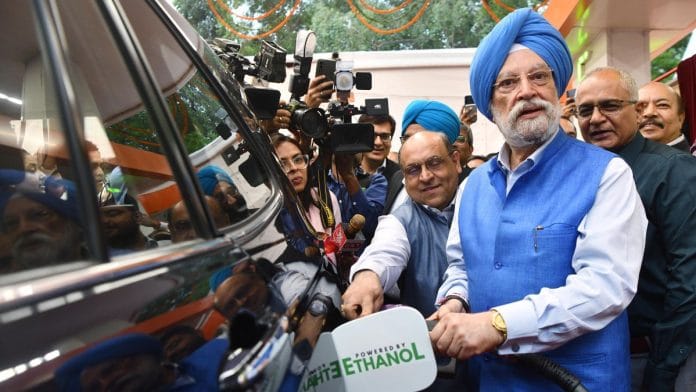

New Delhi: The launch of E85 fuel by Petroleum Minister Hardeep Singh Puri last week marks the Centre’s most ambitious push yet towards building a flexible fuel, or flex-fuel, vehicle ecosystem. It is now available at 48 retail outlets across the country. The Modi government plans to expand availability to 500 outlets by December this year, and around 5,000 by December 2027.
However, experts say that the programme’s success will depend on whether India can overcome the hurdles to the ambition, ranging from limited availability of flex-fuel vehicles (FFVs) and fuel outlets, to concerns over fuel economics and feedstock sustainability.
E85 is a blend of around 85 percent ethanol and 15 percent petrol, designed for FFVs capable of running on ethanol blends ranging from E20 to E100.
The Centre has pitched E85 as a cleaner, cheaper alternative to petrol that can help reduce India’s dependence on imported crude oil. According to the petroleum ministry, it will be priced nearly Rs 20 per litre lower than conventional petrol, and can potentially reduce lifecycle greenhouse gas emissions by around 61 percent.
The move is aimed at building on India’s ethanoSHl-blending programme, which has increased blending levels from 1.53 percent in 2014 to 20 percent in 2026. The government estimates it has helped save more than Rs 1.84 lakh crore in foreign exchange and substitute nearly 302 lakh metric tonnes of crude oil imports.
Since April 2026, E20 has become the default petrol available at fuel stations across the country, making E85 the next milestone in the government’s ethanol roadmap.
“India imports over 85 percent of its crude oil. Thus, widespread E85 adoption may help reduce India’s import dependency, increase energy security and save foreign exchange,” Shifali Goyal, associate at independent policy think tank Centre for Social and Economic Progress (CSEP), told ThePrint.
She added that while electric vehicles are central to decarbonisation, their share in India’s passenger-car market remains in single digits, and a complete transition will take years. “Ethanol-based fuels, like E85, may play an important role in decarbonising this massive internal combustion engine ecosystem.”
Also Read: Govt bets on coal gasification projects to cut import dependency, targets Rs 4 lakh crore investment
Infrastructure & cost hurdles
For experts, the biggest challenge is building the ecosystem required to support E85 adoption.
“Large-scale adoption in the near-term will be difficult,” Umud Shokri, energy leader and senior visiting fellow at US’ George Mason University told ThePrint. “The rollout is important symbolically and strategically, but the current ecosystem is still very limited.”
E85 is available currently at only 48 retail outlets nationwide, while commercial availability of FFVs is still limited. Experts describe this as a classic “chicken-and-egg” problem: consumers are unlikely to buy FFVs if fuel is difficult to find, while manufacturers and fuel retailers may hesitate to invest in FFVs until demand materialises.
“Without enough vehicles and enough pumps in the same markets, E85 risks remaining a niche pilot, rather than a national transition,” Shokri said.
According to Goyal, three developments are critical for the programme to succeed: Launch of mass-market passenger FFVs, expansion of dispensing infrastructure in line with government targets, and uninterrupted ethanol supply.
The automobile industry is still preparing for the transition. Hero MotoCorp has launched two E85-compatible two-wheelers—Splendor Plus and HF Deluxe—while passenger car options are limited. Carmakers, such as Maruti Suzuki and Toyota, have developed flex-fuel technologies, but broad market deployment is yet to take place.
ThePrint attempted to reach Auto Car India and Society of Indian Automobile Manufacturers (SIAM) for comments. This report will be updated if and when a response is received.
Another hindrance is availability. Transitioning to E85 requires technical modifications. As ethanol is more corrosive than petrol, manufacturers must upgrade engine components, fuel systems and sensors using specialised materials, says Goyal.
Consumers are also likely to focus on total ownership costs, including vehicle price, mileage, maintenance, resale value and fuel availability. Both Goyal and Shokri argue that additional incentives may be needed initially, including tax benefits for FFVs and greater transparency around E85 pricing.
According to K.K. Gandhi, former executive director at SIAM and convenor at Centre for Auto Policy and Research, FFVs are inherently more complex because they require multiple sensors to determine fuel blends and adjust ignition timing.
“These additional systems make FFVs costlier than conventional petrol vehicles,” Gandhi said. That could make consumer adoption more difficult, given that buyers typically base purchasing decisions on both vehicle acquisition costs and running costs.
While the government has pitched E85 as cheaper than conventional fuel, Gandhi noted, ethanol contains less energy per litre than petrol. “The government needs to make E85 more economically viable. At Rs 20 per litre lower than petrol, it is still not an attractive price.”
Goyal said, “Ethanol has roughly 30 percent less energy by volume compared to standard petrol.” Lower fuel efficiency for some vehicle models could offset some of the savings at the pump, she added.
‘India can’t replicate Brazil model’
The Centre has frequently cited Brazil’s flex-fuel success story, where ethanol blending has become mainstream and FFVs dominate sales. But experts caution against assuming that the Brazilian model can be replicated easily.
“India can replicate parts of Brazil’s experience, especially policy coordination and consumer choice, but it will need an India-specific version based on sugarcane, maize, second-generation ethanol and careful sustainability safeguards,” Shokri said.
Goyal explained that Brazil’s success was built over decades, benefiting from vast land availability and dedicated energy crops.
India’s ethanol supply currently comes largely from sugarcane and food grains, such as maize and rice. Experts warn that excessive reliance on food-based feedstocks could create pressure on food supplies and prices, particularly in weak monsoon years.
According to Gandhi, India is a water-scarce country and cannot continue to rely on food crops, like sugarcane and rice, to produce ethanol as it consumes thousands of litres of water during irrigation.
For now, E85 fuel offers India another pathway to reduce oil imports and lower emissions. But whether it evolves into a mainstream fuel will depend less on the launch itself, and more on execution.
“The real test, as always, is execution: sustainable feedstock supply, infrastructure, consumer incentives and policy consistency,” Shokri remarked.
(Edited by Mannat Chugh)
Also Read: Why Uttar Pradesh is facing excessive power outages despite ‘record electricity supply’
Fuck off modi government he didn’t knw condition of middle family
Grow that sugarcane in water abundant UP/Bihar/Bengal, not in drought prone Punjab/Vidarbha.