




Lucknow: As power outages emerge as a major issue in Uttar Pradesh, the state government is facing criticism not only from the Opposition and the public, but also from BJP legislators, who have begun raising concerns over prolonged electricity disruptions across districts.
While state’s Power Minister A.K. Sharma has maintained that there is no electricity shortage and only minor technical problems, which are being addressed, Chief Minister Yogi Adityanath has reportedly directed officials to treat the situation with urgency.
Though power department officials have largely avoided speaking publicly, informal discussions with officials and sector experts point to three key reasons behind the worsening crisis.
These include delayed fault repairs due to staff shortages, rising electricity demand exceeding system capacity, and the shutdown of multiple thermal power plants during May.
Staff shortage
According to sources in Uttar Pradesh Power Corporation, the biggest reason for the electricity crisis is the removal of more than 20,000 contractual employees from the corporation in the last financial year. The reduction has severely affected the number of field teams available to repair local faults and technical breakdowns.
Officials say that until last year, multiple repair teams were available to address faults simultaneously. However, after downsizing, faults are now handled sequentially, leading to long delays in restoring the power supply. This has significantly worsened outages during the peak summer season.
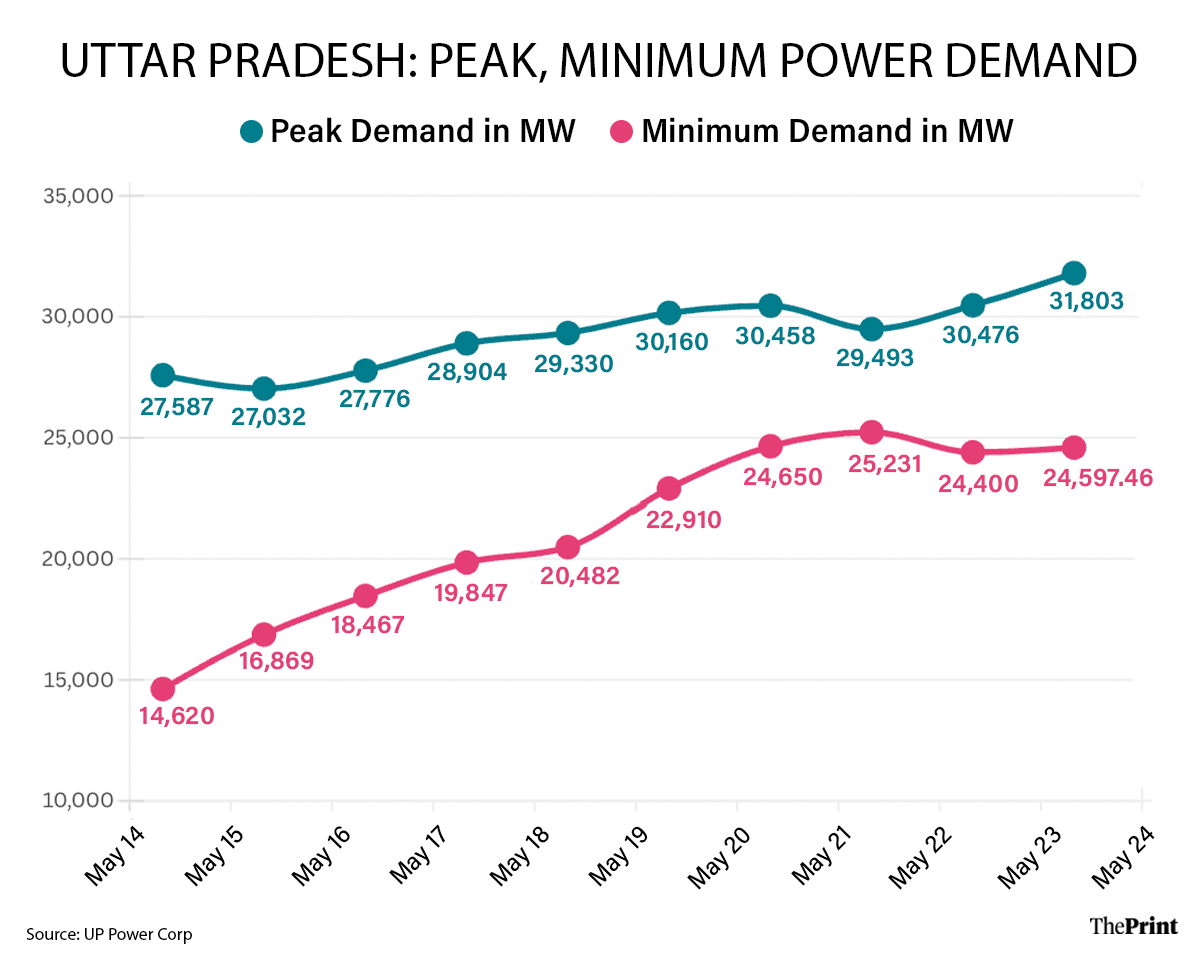
The crisis appears more serious this year despite power demand levels being comparable to last year.
According to officials, Uttar Pradesh recorded its highest electricity supply this month at 31,803 MW (megawatts), surpassing last year’s peak demand of 31,486 MW. Yet consumers across the state continue to report severe outages and erratic supply.
Awadhesh Kumar Verma, chairman of the Rajya Vidyut Upbhokta Parisha (State Electricity Consumers Council) and member of the State Advisory Committee, said the scale of disruption despite adequate supply indicates serious administrative and management failures within the UP Power Corporation.
According to Verma, a new operational policy allowing only one repair team per substation at a time has worsened the situation.
Since a single substation often serves several feeders, simultaneous faults cannot be addressed simultaneously, forcing consumers in affected areas to wait for hours in extreme heat.
He added that earlier, the UP Power Corporation maintained emergency and backup repair teams, but those arrangements have now been discontinued, weakening the distribution network.
Power plant shutdowns
ThePrint has learnt that several thermal power units in Uttar Pradesh and other states remained shut for extended periods in May due to technical and operational reasons. These plants supply electricity to the state under power purchase agreements.
Experts say the shutdown of these generating units is a major reason for unannounced power cuts at a time when demand is surging.
Questions are now being raised about maintenance planning, coal management, and the preparedness of the power sector ahead of the summer season.
According to consumer council estimates, the shutdowns affected thousands of megawatts of generation capacity, forcing utilities to impose heavier load-shedding, especially in rural areas.
Verma said that the prolonged shutdown of these units during peak demand season cannot be dismissed as routine maintenance. He added that if these plants had remained operational, the state’s peak demand figures could have climbed even higher due to improved supply availability.
According to government data accessed by ThePrint, several major thermal power plants remained shut for varying durations in May, worsening the electricity crisis in Uttar Pradesh.
The 660-MW Ghatampur plant remained closed for 18 days, while the 660-MW Lalitpur plant was shut for 11 days. JSW’s 1,000-MW KSK Mahanadi unit remained non-operational for 10 days. The 200-MW Obra B station stayed shut for 9.5 days, while the 660-MW Obra-C plant remained closed for eight days.
The 500-MW Anpara-D unit was shut for 6.5 days, and the 660-MW Jawaharpur plant as well as the 210 MW Anpara unit remained closed for four days each. The 600 MW Lanco and 250 MW Parichha plants were shut for three days, while the 660 MW Khurja plant was non-operational for one day.
Distribution capacity lower than sanctioned load
Another major structural issue flagged by power department functionaries is the mismatch between sanctioned electricity load and actual infrastructure capacity.
The state has nearly 3.73 crore electricity consumers with a combined sanctioned load exceeding 8.57 crore kilowatts. However, the total capacity of the state’s 132 KV substations stands at only 6.25 crore kilowatts.
One senior functionary told ThePrint, “This means the system is incapable of handling the full sanctioned demand if consumers use electricity at expected levels during peak summer months. The situation becomes worse as rising temperatures push consumption beyond sanctioned load levels.”
Also Read: No heavyweight portfolios for new & upgraded ministers, Yogi retains iron grip on key UP govt depts
Demand continues to rise sharply
Electricity demand has risen steadily over the past 10 days as day and night temperatures remain unusually high, leaving little relief even after sunset.
Officials say the narrow gap between day and night temperatures has kept electricity demand elevated continuously. This continuous load is overburdening transformers and damaging aerial bunch conductors (ABC cables), leading to a rise in local faults and transformer failures.
More than 700 transformers are reportedly failing every day across the state.
Some officials believe that while transformer failures usually rise during April, May and June, many current breakdowns are linked to burning ABC cables which subsequently trigger short circuits and transformer damage. They also questioned the quality of cables being installed.
In many areas, consumers are allegedly being pressured to bear transformer replacement costs, especially in underdeveloped colonies and high-rise residential complexes.
Meanwhile Jitendra Singh Gurjar, General Secretary of the Vidyut Parishad Engineers Association, said that more than 25 percent of transformers in the state have already exceeded their operational life, while many others have crossed permissible repair limits.
Questions in political circles
Questions are now being raised in political circles over the worsening power crisis. Samajwadi Party chief Akhilesh Yadav, in a post on X, attacked the government over the electricity shortage and accused it of failing to increase power generation capacity.
”Setting up new power plants was neither within the BJP’s capability nor within the scope of its narrow thinking. At least you could have uttered ‘3×660 Supercritical Thermal Power Plant’, even hearing it would have provided some relief to people suffering in the scorching heat,” Yadav remarked.
He further alleged that under the BJP government in Uttar Pradesh, “only the demand and price of electricity are increasing, not the supply”.
Meanwhile, several BJP MLAs, including Neeraj Bora and Rajeshwar Singh, have also written to Energy Minister Sharma, urging immediate steps to resolve the crisis.
Amid mounting criticism over the power crisis, Uttar Pradesh Energy Minister A.K. Sharma defended the government’s performance in a series of posts on X.
“Whether people accept it or not, we are supplying the highest amount of electricity in Uttar Pradesh’s history. At 2.33 am on Sunday, the state’s peak power supply crossed 31,000 MW. By 10.01 pm, we broke all previous records with a peak supply of 31,774 MW. Tonight itself, the figure may touch 32,000 MW,” he wrote.
“Believe me, this is the highest in the state’s history and among the highest in the country as well. We have broken our own record. Our competition is with ourselves. Har Har Mahadev,” he added.
Sharma also claimed that the impact of Chief Minister Yogi Adityanath’s strict monitoring was visible in the power sector’s performance.
ThePrint attempted to reach Sharma, but his office said he was not available for comment.
(Edited by Sugita Katyal)