



In the 1930s, a farmer in Iowa, USA, encountered a decision his father had never faced. The introduction of hybrid corn, which promised higher yields, came at a higher cost and required annual purchase. Within a few years, most local farmers adopted this innovation, while their counterparts in Alabama delayed for several years. In 1957, Zvi Griliches, a young economist, sought to explain this disparity in a paper that became highly cited within the field. His findings indicated that the rapid adoption of the new seed was driven more by economic calculations than by education or persuasion; the seed spread fastest where it was most economically advantageous.
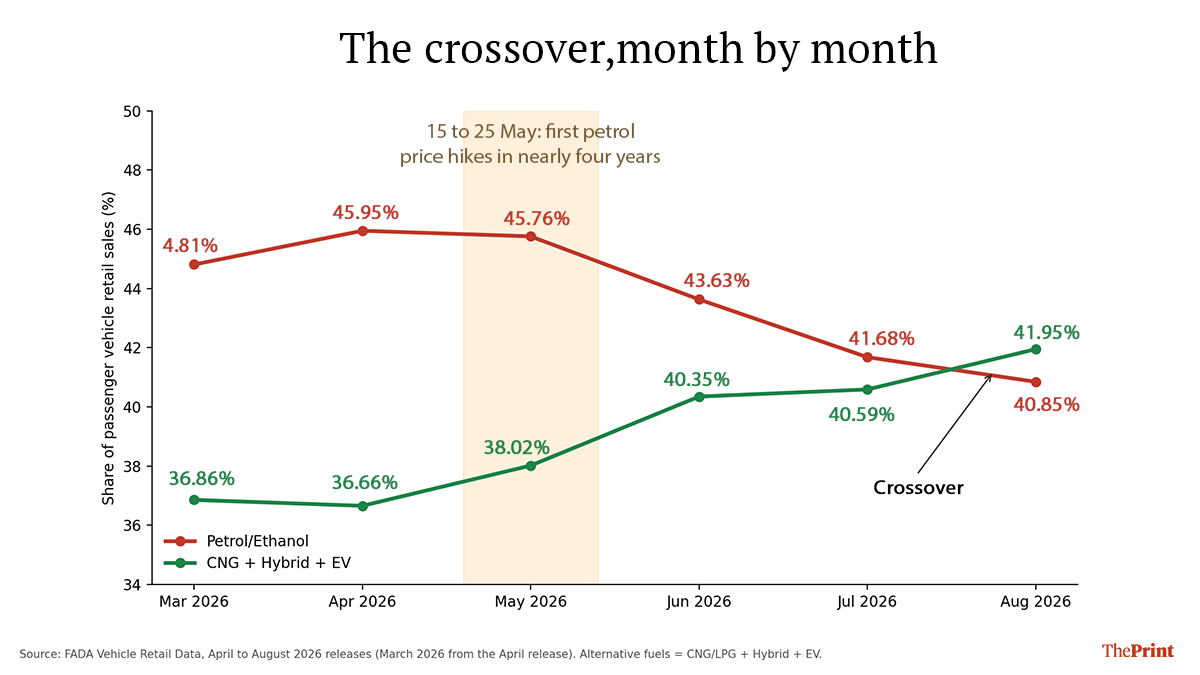
Nearly 70 years later, similar economic principles have subtly transformed India’s automotive market. In August 2026, data from the Federation of Automobile Dealers Associations (FADA) revealed that CNG, hybrid and electric vehicles constituted 41.95 per cent of passenger vehicle sales, surpassing petrol-powered vehicles at 40.85 per cent for the first time in Indian automotive history. Just 16 months earlier, petrol vehicles led by nearly 17 percentage points. While this milestone may be read as a story about automobiles, the data tells a more compelling one: auto-rickshaw drivers, not car buyers, led the initial transition.
The driver who did the maths first
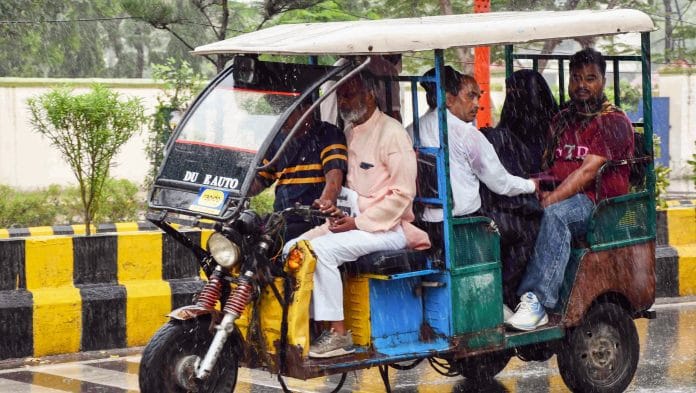
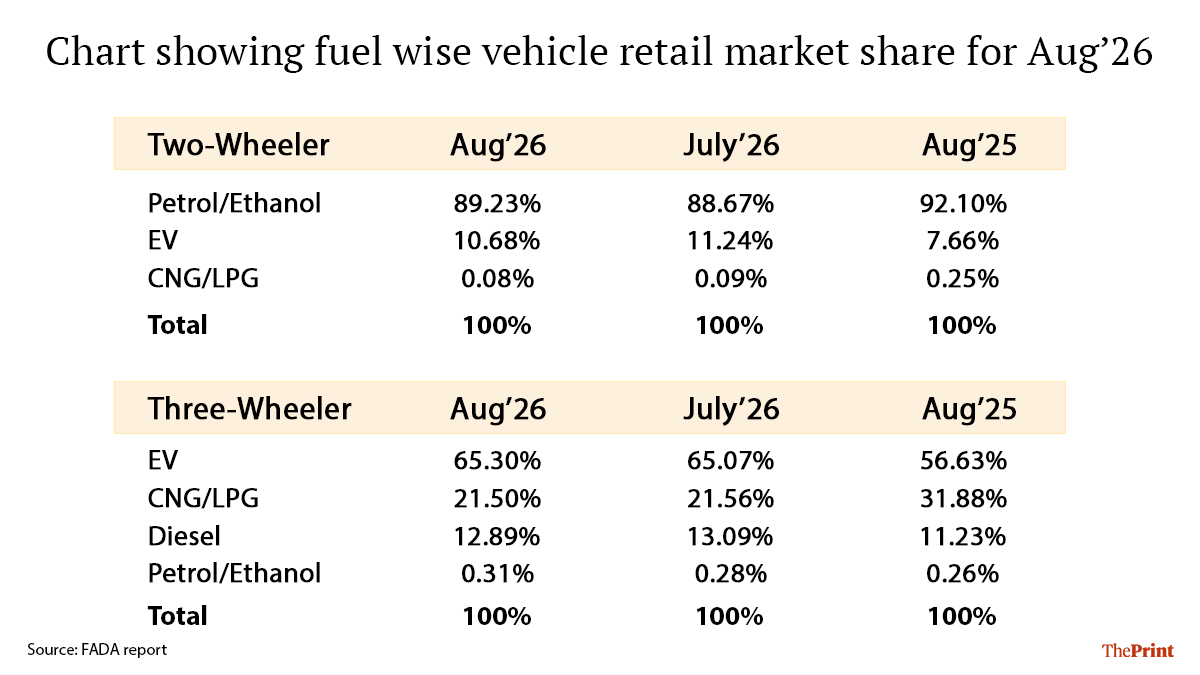
Consider a three-wheeler driver in any Indian city, operating from early morning until late at night. For this individual, fuel is not merely an occasional expense but the highest cost of running the business. As a result, every rupee saved per kilometre directly contributes to personal income. This economic incentive aligns with Griliches’ predictions and prompts early adoption of electric vehicles. In August, 65.30 per cent of three-wheelers sold in India were electric, an increase from 56.63 per cent the previous year, leading FADA to characterise the segment as “structurally electric.”
Similarly, delivery vans and small trucks, which also generate revenue per kilometre, are transitioning to electric power, with their electric share more than doubling from 2.26 per cent to 5.18 per cent between April and August. Additionally, two-wheelers, which serve India’s commuters and a significant portion of its delivery workforce, surpassed the 10 per cent electric threshold for the first time in June.
The rationale for this sequence is straightforward. Although an electric vehicle incurs a higher initial purchase cost, its operational expenses are lower. Consequently, increased usage accelerates the recoupment of the initial investment. The family car, which remains parked most of the day, exemplifies the other end of this spectrum, explaining its delayed transition.
The data concerning two-wheelers further indicate that this transition is not primarily driven by subsidies. In March, the proportion of electric two-wheelers surged to 9.79 per cent as consumers hurried to buy before the expiration of certain incentives. However, in April, this figure declined to 7.76 per cent. If demand had relied solely on incentives, the share would have remained low. Instead, it continued to rise, reaching a record 11.24 per cent in July. While incentives influenced purchase timing, cost-effectiveness per kilometre determined vehicle choice.
Also read: India is going electric without a grid and charging network ready for it
How the family car caught up
The rise in petrol prices helps explain the initial shift in car purchases and the subsequent need for family cars to gain momentum, which happened in May. For nearly four years, petrol prices at the pump remained relatively stable. However, as tensions in West Asia drove up crude oil prices, oil companies raised petrol prices on 15 May and continued to raise them, taking the price up by about Rs 7.50 per litre within ten days. In Delhi, the price per litre has remained at Rs 102.12 since then.
Nobel laureate Christopher Sims offers a theoretical framework to comprehend the subsequent developments. His theory of rational inattention posits that attention is a limited resource, leading individuals to disregard prices that remain unchanged. After four years of stable pump prices, few car buyers worried about running costs, but the May price increases brought the issue back to the forefront in showrooms. Dealers reported to the FADA a noticeable increase in inquiries for fuel-efficient vehicles, and buyers also expressed caution about the transition to E20 petrol. The share of alternative-fuel vehicles in car sales, which was 36.66 per cent in April, increased to 38.02 per cent in May and 40.35 per cent in June, eventually surpassing petrol sales in August.
Will this shift persist if oil prices decline? Research on trade indicates that it will. In 1989, Richard Baldwin and Paul Krugman elucidated why the significant fluctuations in the dollar in the 1980s had enduring effects. Foreign firms that incurred substantial costs to enter the American market remained in the market even after the dollar depreciated. Economists refer to this phenomenon as hysteresis.
Similarly, a household’s decision to purchase a CNG vehicle this year commits it to that fuel for several years, regardless of future crude oil prices, thereby gradually reducing the country’s reliance on petrol. The FADA appropriately warns that this year’s sales growth is exaggerated by a weak base, which influences the number of cars sold but not the types of vehicles consumers select.
Also read: Deathtrap or economic miracle? Rise of e-rickshaws show safety should go beyond cars
Lending to the next wave
What factors are impeding the advancement of the next wave? Historically, economists attributed this to short-sightedness. In 1979, Jerry Hausman of MIT discovered that American consumers purchasing air conditioners valued future electricity savings as if they were subject to an interest rate of approximately 20 per cent annually, with lower-income households discounting these savings even more significantly. However, in 2013, Meghan Busse, Christopher Knittel, and Florian Zettelmeyer demonstrated that the behaviour of American car buyers suggested discount rates similar to the interest rates they actually paid on their car loans. This indicates that buyers were not disregarding future savings but were instead balancing them against the actual cost of borrowing.
This shifts the issue from the buyer to the lender. In 1981, Joseph Stiglitz and Andrew Weiss illustrated that when banks are unable to assess a borrower’s risk, they often opt not to increase the interest rate but rather to deny the loan. A delivery rider or small fleet owner with limited credit history, seeking to secure a loan against a battery whose resale value remains uncertain to banks, exemplifies the type of borrower likely to be rejected.
FADA’s dealers have consistently reported slow financing for commercial vehicles this year. Credit guarantees for vehicles operating for extended hours, along with certified standards for battery health, would benefit these buyers more than a larger discount on the initial price. Charging stations should follow the same logic: establish them first at fleet depots, along highways, and at taxi stands, enabling taxis and ride-hailing vehicles to use infrastructure already built by the automotive industry.
Iowa farmers adopted hybrid corn not because of lectures on the future of agriculture, but because it increased yields. Similarly, India’s auto drivers needed no lectures; they needed a more cost-effective kilometre, and once they got it, they transitioned. The family car is now beginning to follow this trend, and if policy supports the workhorse and infrastructure is developed where the demand is, the rest of India’s roads will follow the path set by the autorickshaw.
Bidisha Bhattacharya is ThePrint Consulting Editor (Economics) and an Associate Fellow, Chintan Research Foundation. She tweets @Bidishabh. Views are personal.
(Edited by Prashant Dixit)