





During a recent conversation, a former automotive journalist, now in the communications sector, remarked on how much ‘automotive’ journalism has changed. Because the job has moved from understanding how vehicles performed as mechanical beings — looking at acceleration, braking, handling and the motor’s performance — to grappling with electricity.
From having to relearn inorganic chemistry, and go beyond a simple understanding of the subject because lithium-battery chemistry is constantly evolving, automotive journalists now have to move into adjacent sectors. Adjacency earlier might have meant machining and manufacturing, possibly at a stretch petroleum refining. Now, I find myself not just trying to get a grip with the job that involves understanding not just battery manufacturing but also the electrical grid, charging infrastructure, renewables and energy storage.
The automotive industry has undergone a seismic shift, particularly in the past decade. As I have argued in recent columns, if you are buying a passenger vehicle for daily commuting, not buying an electric vehicle is a poor choice.
And it isn’t just passenger vehicles, but also two-wheelers, three-wheelers, trucks and buses. Everything is going electric. And global geopolitics is playing a role as well.
And frankly, if we have learned any one thing from the current crisis in West Asia, it is that we cannot depend on a steady flow of crude oil or fully trust the US.
Although Donald Trump will go down in history as someone who did more to encourage electric vehicle adoption than hundreds of other politicians, with the exception of the Politburo of the Chinese Communist Party. Not in quite the way he intended, though.
Increasing electrification
Sales of electric vehicles have spiked in India, at a shade under 10 per cent of new car sales, and executives from Tata Motors, the country’s largest EV manufacturer, openly admit that demand far outstrips supply by almost three times. In Europe, the share of battery electric vehicles in new car registrations touched an all-time high of 27.7 per cent in August, up from 17.8 percent in the same month last year.
A trip to Europe a few weeks ago was eye-opening. Diesel prices at the pump in Germany touched the equivalent of Rs 260 per litre and recently have even hit Rs 300 per litre. India’s spare refining capacity, as highlighted by Minister of Petroleum and Natural Gas Hardeep Puri at a recent conference, has played a vital role in insulating Indians from the spikes of global fuel prices. But for how much longer?
Speaking at the launch of JSW Greentech, the JSW Group’s entry into electric commercial vehicles, last week, the conglomerate’s chairman, Sajjan Jindal, highlighted the global diesel crisis and mentioned that India must move towards electrifying even heavy-duty freight and tipper trucks. Electrifying the bus fleet is, of course, low-hanging fruit. And there are huge cost benefits to electrification as well, as Parth Jindal pointed out while conversing with me during a recent conversation, with operating costs declining by almost a third on electric vehicles and margins also dramatically improving.
But as I wrote at the start of this article, noted earlier, buying an electric vehicle is a no-brainer for urban commuting. Heck, new EVs like the MG Hector Tomahawk I drove recently can easily manage over 400-450 kilometres on a single charge, so even most medium-distance highway runs are easily doable. There are still too many caveats, however.
Also read: New Mercedes GLC 400 electric is big, fast, and feature-loaded. It lacks one thing
The charging hurdle
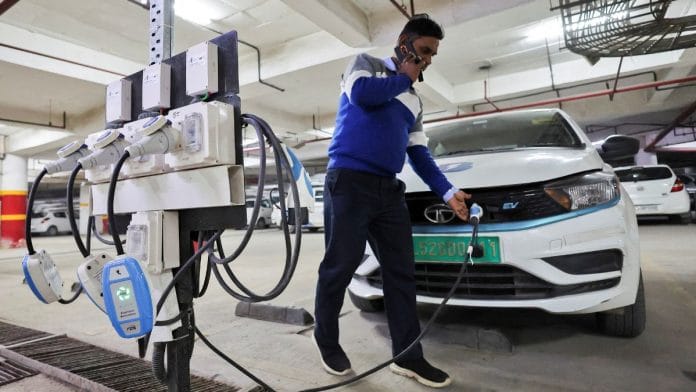
The big caveat remains charging, particularly home charging. The crisis of charging in apartment complexes has been highlighted by automotive influencers and even in articles out here in this publication. Speaking to others Conversations across the country suggest this is not an isolated problem in Gurugram or Noida, but a nationwide issue, with Resident Welfare Associations breaking out in civil war frequently at loggerheads with local authorities, who only add fuel to the fire with various municipal and building laws regarding charging equipment being in conflict that conflict with one another.
Add to this poor electricity supply and creaking grid infrastructure in some states like Punjab and Tamil Nadu, and the ‘no-brainer’ aspect becomes one of having ‘no brain cells whatsoever’ if you go electric. Although other states like Kerala have really taken to electrification.
In fact, at the Ather Community Day, one of the more interesting services that Chief Executive Tarun Mehta announced was ‘Ather Node’, essentially a load management system (LMS). Understanding that the number of electric transformers was limited, these are the big boxes you might see that bring down the high voltage transmission to the everyday voltage we use at home. ‘Ather Node’ aimed to manage the load inside apartment complexes because, as Mehta mentioned, electric vehicles, both cars and two-wheelers, are becoming mainstream and everybody will want their own charger.
But Mehta recognised that it was unviable for an apartment complex to buy a new transformer for ₹50 lakh plus to enhance its load just because more people are buying electric vehicles. So an LMS would increase or decrease the charging rate according to the amount of spare electricity available and automate the billing process. This was not something the two-wheeler manufacturer had conceived as a profit centre; instead, they would license it out to builders and charging point operators. Mehta recognised it as a crucial investment by Ather to spread electrification.
These are not isolated issues. Other start-ups should develop LMSs, and more electrical transformers have to be made to deal with the shortage. But most importantly, the Ministry of Power and state governments will play the biggest role in this. Fixing and improving the finances of state-run power utilities and distribution companies, along with a rapid move towards renewables and energy storage, are now urgently needed to keep the blood flow of Indian mobility going.
Talking of energy storage, I’ve been reading and watching far too many videos on the latter topic, and some developments, such as mass compressed-air storage and ‘Iron-Air Batteries’, where rusting and ‘unrusting’ iron is used to store electricity, are beyond fascinating. But that is something for another column.
Kushan Mitra is an automotive journalist based in New Delhi. He tweets @kushanmitra. Views are personal.
(Edited by Prashant)