



Gurugram: At 12.52 pm on 24 October last year, a data entry operator at the Haryana State Pollution Control Board (HSPCB) in Panchkula sent a message to a banker called Abhay Kumar. No longer with IDFC First Bank, Kumar had been relieved four months earlier, on 10 June 2025. The message for him showed, however, that he continued to represent IDFC First Bank.
The message outlined the split of the board’s fixed deposits that were falling due. “25 cr aapko (IDFC) 25 cr bandhan ko (Rs 25 crore for IDFC, Rs 25 crore for Bandhan),” the message read. The operator, Saurav Sharma, added: “Ye likha kapil ne (This is what Kapil wrote).” Kapil was the personal assistant to the board’s member secretary. A minute later came the full list. Rs 25 crore each for IDFC, Bandhan, IndusInd and Ujjivan, and Rs 77 crore for HARCO (bank).
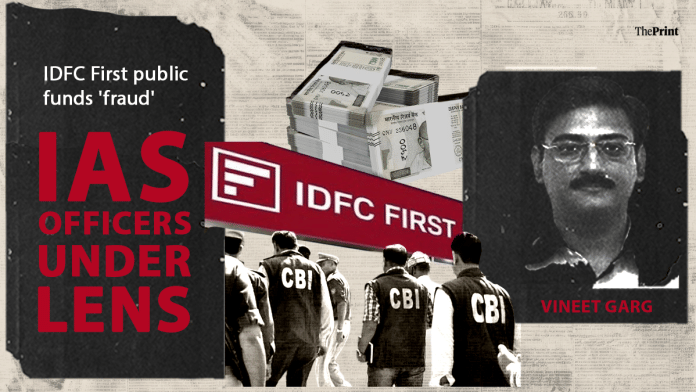
Chairman of the board Vineet Garg, a 1991-batch IAS officer, had not yet passed his order. The Central Bureau of Investigation (CBI) says so in the chargesheet it has drawn up in the Rs 645-crore public funds embezzlement case involving IDFC First Bank.
The chargesheet says that the figures changed when Garg, one of six IAS officers named as accused, did pass the order the same day. Garg did not simply approve the member secretary’s (IAS officer Pardeep Kumar, already in judicial custody) recommendation; he changed it further to the advantage of IDFC First Bank.
The CBI says he “struck it out in his own hand”, moving the Rs 25 crore meant for IndusInd Bank to IDFC First Bank, making the latter’s share in that cycle Rs 50 crore. Its total with the board rose to Rs 163.68 crore, more than three times the Rs 50-crore ceiling for a newly empanelled bank.
In the same note, the CBI points out, Bandhan Bank was held to Rs 25 crore. It had quoted 7.30 per cent; IDFC had quoted 7.25. The IDFC quotation was a single page with no bank stamp and no signatory’s name. Its quotation was dated 15 October, a week after the last date for quotations.
The phone records for that afternoon add to the sordid picture. According to the chargesheet, the phone of Abhay Kumar, an ex-relationship manager with the bank’s Sector 32 branch in Chandigarh, shows 11 calls with a man named Manish Jindal between 12.15 pm and 5.15 pm.
At 1.09 pm, Jindal received a call from Ribhav Rishi, the IDFC First Bank branch manager, which lasted 4 minutes and 13 seconds. Jindal held no post in any bank at the time. The CBI says that in his chats with Abhay Kumar he called Garg “sir”.
The chargesheet says that Garg’s actions on 24 October were not in isolation. It says they were one of six such placements, over 14 months, with a bank that had lost every open bid for the board’s money before he took over.
The account is in the supplementary chargesheet the CBI filed on 2 September before the Special CBI judge, Panchkula, a document ThePrint has seen. In the chargesheet, the CBI has set out each of the accused IAS officer’s alleged role in the fraud in detail, one after the other. This report deals with Garg, accused No. 27.
ThePrint sought Garg’s comments on the CBI charges by means of a text message on WhatsApp along with a PDF file of the federal agency’s 559-page chargesheet on Monday. This report will be updated if and when he responds.
Four months of losing
The rest of the CBI’s case against Garg is built on files, notings and dates.
The HSPCB is a regulatory body. It gives consent to industries, checks air and water, and recovers environmental compensation from polluters. Its expenses are modest, the chargesheet says, and money keeps coming in. So it keeps a working balance in savings accounts and parks the rest in fixed deposits, renewing them as they mature.
IDFC First Bank was empanelled with the Haryana government. The CBI says it wanted the board’s deposits. For nearly four months before Garg took over, it competed for them through its Government Banking Group in Chandigarh. Shamim Dar, its area head, sent in quotations. The CBI says those rates were genuine, approved by the bank. The bank lost each time. Not a single board deposit came to it.
Garg took charge as chairman of HSPCB on 2 December 2024. The chargesheet calls that day “the turning point”.
“What the bank could not obtain in the market on merit came to be obtained thereafter by other means,” it says.
What changed
The CBI lists the changes it attributes to Garg himself. It says they came in a row, and that each one helped the bank.
As a first major change, the work of comparing bank rates and awarding fixed deposit receipts (FDRs) was taken out of the board’s e-office system, which keeps a record of every entry, and put on a physical file. The charge sheet says the board’s records can’t be altered without a trace, while a paper file can.
The field was widened to newly empanelled private banks and small finance banks. Till then, the board had put its money in nationalised banks and the big three private banks—HDFC, Axis and ICICI. The CBI says this is the opening through which IDFC First Bank got in. It is also the account from which the board’s money was allegedly siphoned off.
Garg, it is said, directed that the comparative chart of bank rates must always begin on a fresh page of the notesheet. It could not be written on the back of a notesheet or in leftover space on a running one. The chargesheet quotes Kapil, the personal assistant to the member secretary, who says this was done so that entire notesheets could be replaced.
Member Secretary Pardeep Kumar, an IAS officer and accused number 26, would carry each notesheet personally to Garg’s office for discussion before signing it. The changes Garg suggested were put in by Kapil. The amended sheet was then signed by Pardeep Kumar and sent up to Garg, who wrote “as proposed”.
Then the bank itself changed. From February 2025, the quotations stopped coming from Shamim Dar’s Government Banking Group. They began to come from the bank’s Sector-32 branch in Chandigarh, over the signature of Abhay Kumar, then relationship manager. The first, dated 24 February 2025, quoted 8.25 per cent. The bank has told the CBI that no such rate was then prevalent.
The middleman
The CBI says Garg knew Manish Jindal from earlier. Jindal was with HDFC Bank, and later IndusInd Bank, as regional head. Garg was then at the Haryana Vidyut Prasaran Nigam, whose account was with HDFC. “A professional association grew between the two,” the chargesheet says.
Jindal held no post in any bank in 2025. The CBI says he still ran errands between the bankers and Garg.
The agency claims to have read Jindal’s chats with Abhay Kumar. It says Jindal called Garg “sir” in them, passed his instructions down to the bankers, and carried news of progress back up to him. One trail, the CBI says, started with Abhay Kumar and Rishi and ended at Jindal. The second started at Jindal and ended at Garg.
Phone records add to this purported trail. The CBI says there were 847 calls between Jindal and Rishi from 20 February 2025 to 21 February 2026. There were 673 calls between Jindal and Abhay Kumar up to 18 February 2026. Calls between Jindal and Abhay Kumar were “very few” before 20 February 2025, the day the board invited quotations.
Also Read: A ‘seen’ file noting did in Haryana IAS officer. Tried to bury IDFC scam before raising alarm—CBI
The gold coins
Another episode listed in the chargesheet is set in a garden in Sector 7A, Chandigarh, four or five days before Diwali in 2025.
Amritpal, identified as a courier who worked for Ribhav Rishi, told the CBI that Rishi asked him to collect two gold coins of 50 grammes each from Sawan Jewellers in Sector 35. He was to deliver them at House No. 3, Sector 7A. The chargesheet gives this as Garg’s present address. Sawan Jewellers is itself an accused, listed as A-17. The CBI says Arun Kumar, an employee of the firm, handed over the packet.
Amritpal reached the house at about 7 to 7.30 pm. It looked like a government officer’s residence, he said. Two or three police patrol vehicles were parked nearby; a guard was posted at the gate. On Rishi’s instruction, the guard let him in.
Rishi and Jindal were in the garden. A thin-built man came out of the house, Amritpal said. Rishi and Jindal greeted him with “Good Evening, Sir”. Rishi took the packet from Amritpal and handed the contents to the man. Then he signalled Amritpal to leave.
The CBI says the man was Vineet Garg. The chargesheet describes him as “matching the characteristics” of Garg “approximately”. It relies on mobile phone records for 16 October to back Amritpal’s statement.
According to the chargesheet, Garg’s phone hit a tower in Sector 8B at 6.31 pm. Jindal’s phone pinged a tower near a public park in Sector 7B at 7.19 pm. Rishi’s phone stayed on the same towers from 7.21 pm to 7.49 pm. Amritpal’s phone moved from Sector 34 and Sector 35 to towers near Sector 8B and Sector 7A between 7.15 pm and 7.30 pm. The CBI says the records “corroborate the presence and movement” of the four.
The CBI calls the coins an “undue advantage”. It says Garg performed his duty of approving the board’s placements “in expectation of and in consequence of obtaining undue advantage”.
Six placements, one limit
A finance department memo of 12 July 2024 limits how much a government body can put in a newly empanelled bank. The limit is Rs 50 crore. The board’s own member secretary quoted the limit in his first note on 8 March 2025.
The chargesheet says Garg approved six placements with IDFC First Bank between March 2025 and January 2026. These were:
- 8 March 2025: Rs 50 crore at 8.25 per cent.
- 27 March 2025: Rs 17.90 crore at 8.25 per cent, although Jana Small Finance Bank had quoted 8.45 per cent.
- 2 July 2025: Rs 37.78 crore at 7.10 per cent. IndusInd Bank had quoted the identical rate.
- 1 October 2025: Rs 8 crore into a savings account, on the strength of a single unstamped letter.
- 24 October 2025: Rs 50 crore at 7.25 per cent, although Bandhan Bank had quoted 7.30 per cent.
- 22 January 2026: Rs 45.74 crore at 7.40 per cent.
By the CBI count, this took the bank’s total to Rs 209.42 crore against a ceiling of Rs 50 crore. Its own table gives the running total of FDRs at Rs 163.68 crore before the last two entries.
Lower rate on bigger sum
The CBI describes the last placement on 22 January 2026 as the plainest of all.
New Member Secretary Yogesh Kumar had held back Rs 42.22 crore of the Environment Compensation Fund. He has told investigators that he did not write down why, as he had discussed it informally with Garg, whose order of 22 January released the same funds. It also dropped Rs 21.99 crore that had been recommended for HARCO Bank without a word. It sent Rs 45.74 crore to IDFC First Bank at 7.40 per cent and Rs 18.46 crore to Jana Bank at 7.45 per cent.
“He thus applied the higher rate to the smaller sum and the lower rate to the larger sum, upon a single sheet of paper,” the chargesheet says.
The CBI says the exercise had been disclosed to one bidder before it began. On 12 January, Saurav Sharma messaged Abhay Kumar that quotations would be invited and the total was “around 111 crore”. Abhay Kumar had been relieved from his position on 10 June 2025.
An account with no bank’s name
There is another tell-tale file. It is the board’s account for the Central Pollution Control Board’s Gap Funding Support Scheme. The CPCB had asked the board to open a separate interest-bearing account.
On 23 May 2025, Garg approved the opening of the account. The CBI says the approval named no bank. The notesheet carried no proposal for IDFC First Bank, no comparison of banks and no selection. Yet the account, No. 10232117148, was opened with IDFC First Bank.
The CBI says Abhay Kumar came to the board’s office and filled in every entry of the form himself. He only took the signature of Parveen Kumar, then the senior accounts officer. No approval was taken from the finance department, and no post facto approval was sought.
The CBI says a note by Parveen Kumar dated 4 June 2025 reads: “Add proof of newly opened account today”. This, it says, shows the record being made after the event.
What Garg knew
The chargesheet does not leave Garg’s knowledge to inference. It says the record proves it.
Before he came to HSPCB, Garg was Additional Chief Secretary, School Education. There, the CBI says, two Kotak Mahindra Bank accounts of the Haryana School Shiksha Pariyojna Parishad were opened in June 2024 without the finance department’s prior approval. A proposal for post facto approval was moved on 24 September 2024. Garg approved it on 25 September.
The finance department did not treat it as a formality. It asked for a list of all such accounts and for an explanation for the delay. Garg saw these queries on 4 October and approved the compliance reply on 8 November. Post facto approval was refused. He was transferred on 2 December 2024. He joined the pollution board that very day.
So, the CBI says, Garg knew three things. Prior approval was mandatory. It did not come as a matter of course. And an account opened without it would invite questions.
Then, at HSPCB, the chargesheet says, he “chose to keep quiet throughout”. The CBI says sending the IDFC accounts to the finance department risked two things. The approval could have been refused. And any scrutiny would have exposed the false rate on the strength of which the bank kept being shown as the highest bidder.
The money that was not there
The CBI says the bank’s forgeries are the other half of the story.
According to the chargesheet, seven FDRs with a principal of Rs 201.42 crore and a maturity value of Rs 217.16 crore “are not reflected in the official records” of IDFC First Bank’s Sector-32 branch. They were handed over physically at the board’s office. The CBI says Abhay Kumar forged them. It traced drafts of the FDRs to an email account, seo.aman@gmail.com.
The board’s money went into an account, No. 10219084990, that the CBI says the board never opened. The chargesheet says the account was opened without any approval, and that the pollution board has denied opening it. Its welcome kit reached the board’s office on 3 March 2025, five days before Garg approved the first placement.
The CBI says the account’s mobile number belonged to Abhishek Singla, Abhay Kumar’s brother-in-law, and its email ID differed by one letter from the board’s real one. Cheque books were issued within days. The first lot of 400 leaves was taken by Abhay Kumar himself, the CBI says, and never reached the board.
The chargesheet says 47 fraudulent debits totalling Rs 187.26 crore were made from this account, against five credits totalling Rs 17.90 crore. Some money went to Swastik Desh Projects, which the CBI calls a shell entity.
What the CBI charges
The CBI puts the loss to the board at Rs 1,59,85,95,089 (nearly Rs 160 crore). It breaks the figure into three parts. Interest lost is Rs 43,80,962 (Rs 43.8 lakh). The principal placed for creating and re-creating FDRs, other than the first Rs 50 crore, is Rs 1,51,42,14,127 (Rs 151.4 crore) . The Rs 8 crore put in the savings account is the third.
The chargesheet says Garg “entered into and participated in the criminal conspiracy” with Rishi, Abhay Kumar, Jindal, Pardeep Kumar, Parveen Kumar, Saurav Sharma and others. It says the object of the conspiracy was the dishonest misappropriation of the board’s funds.
Garg is charged under Bharatiya Nyaya Sanhita sections on criminal conspiracy, criminal breach of trust, cheating and forgery. He is also charged under the Prevention of Corruption Act, including Section 7(c) and Section 13(1)(a). The chargesheet lists him as not arrested.
(Edited by Nardeep Singh Dahiya)