



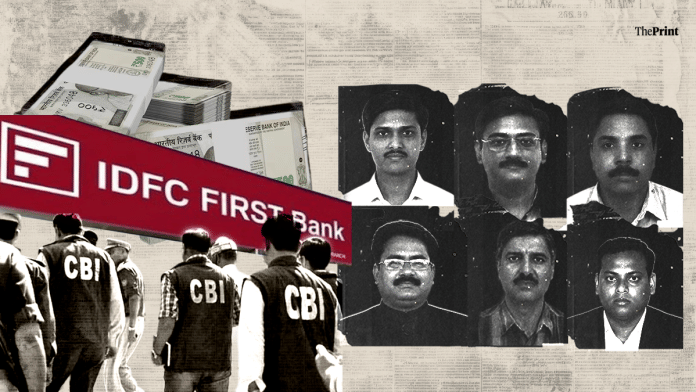
New Delhi: From lavish parties and escort services at five-star hotels to ‘mujras’ at a private farmhouse, and gold and cash through hawala channels, the CBI has detailed a startling trail of alleged inducements involving at least four IAS officers now in the dock in the alleged Rs 590-crore IDFC public funds scam in Haryana.
Interestingly, the bills for some of these parties at five-star hotels were relatively modest—under Rs 1 lakh.
According to the latest CBI chargesheet in the case, these indulgences were part of an alleged quid pro quo in a planned conspiracy to move government funds out of the state exchequer, and park them in specific branches of the private bank before allegedly siphoning them off.
“Public money was allegedly traded for dances, drinks and escorts—besides crores in cash and gold worth lakhs paid by mastermind Ribhav Rishi, then an IDFC First Bank manager in Chandigarh,” a source said.
Funds belonging to eight Haryana government departments—including the Haryana State Agricultural Marketing Board (HSAMB), Haryana Power Generation Corporation Ltd (HPGCL), Haryana State Pollution Control Board (HSPCB) and the Haryana School Shiksha Pariyojna Parishad (HSSPP)—kept in various empanelled banks were allegedly transferred to specific branches of IDFC First Bank and AU Small Finance Bank, where the now-accused bank officials were posted.
Accounts were opened at these branches and the government funds routed into them as part of the alleged conspiracy.
According to the CBI, the fraud operated through a four-level ‘scheme’ involving bank officers and government officials, with public funds siphoned off through fake fixed deposits, forged cheques, shell companies and layered transactions.
First, accused bank managers allegedly persuaded government officials handling the accounts to park public funds in fixed deposits with their banks. Second, bank insiders allegedly siphoned off the money using fake debit notes and forged cheques, while suppressing transaction alerts to conceal the transfers. Third, a network of shell companies was allegedly used to layer and route the siphoned funds through multiple channels.
And then, jewelers and real estate players were identified to convert the diverted money into assets. The CBI has found in its probe that alleged mastermind, Ribhav Rishi, then an IDFC First Bank manager in Chandigarh, bought a plush apartment in Dubai, luxury watches worth crores, and a brand new BMW car in just two years of starting this “scheme”.
These details form part of the third chargesheet filed on Wednesday by the CBI against six IAS officers—Vineet Garg, Pankaj Agarwal, Mohd Shayin, Dr Saket Kumar, Pardeep Kumar and Ram Kumar Singh—in the IDFC First bank-AU Small Finance Bank scam case. The chargesheet was filed before the special judge for CBI cases in Panchkula.
Besides the six IAS officers, nine other Haryana government officials and four bank officers have been named in the chargesheet. A total of 37 people have been chargesheeted in the case so far.
Of the six accused IAS officers, Pankaj Agarwal, Pardeep Kumar and Ram Kumar Singh have been arrested and are in judicial custody, while the other three have been chargesheeted without being arrested.
The alleged fraud first surfaced in February 2026 when a Haryana government official found discrepancies between departmental records and the actual balance in an account while trying to close it.
The case was taken up by the Haryana State Vigilance and Anti-Corruption Bureau. In March, the Haryana government sought a CBI probe, and the central agency formally took over the case and registered an FIR in April.
Also read: IDFC FIRST Bank fraud: CBI arrests IAS officer who oversaw Assembly, Rajya Sabha polls in Haryana
‘Escorts, mujras, and lakhs showered’
According to the CBI, senior IAS officer Pankaj Agarwal, who allegedly played a central role in the fraud as the then chairman of the HSAMB, received “undue advantages” ranging from ‘mujra’ parties and luxury hotel stays to the alleged arrangement of escorts—all paid for by Ribhav Rishi of IDFC in cash.
The CBI alleges that the proceeds of crime went into funding these luxury parties attended by several accused. Women dancers were allegedly brought from Delhi for some parties in Chandigarh. On one occasion, the agency claims, currency notes running into lakhs of rupees were showered on the dancers.
“As a favour in return for opening accounts by bypassing FD guidelines, Ribhav of IDFC provided illegal gratification to him in the form of mujra dance parties, arrangement of women for sexual favours, liquor, luxury hotel stays and other expenses,” a source said.
According to another CBI source, several such parties were allegedly organised by Rishi at a private villa in Mohali’s Zirakpur on Agarwal’s demands.
The sources said that Aggarwal would specifically request for parties at the villa with specific dance groups with foreign artistes. In fact, lakhs in fresh currency notes were procured for showering on dancers.
Speaking to ThePrint, Vishal Garg, lawyer representing Pankaj Agarwal said, “These allegations are baseless. No recovery has been made from him, even in the searches that were carried out at his residence. He is innocent.”
Deepanshu Bansal, Advocate for Ribhav Rishi also said that the allegations on face of it are false. “We are not supplied with supplementary report filed against these IAS officials by CBI but the allegations are strongly and categorically denied in their entirety,” he said
He added, “It is important to emphasise that allegations contained in a chargesheet are not proof of guilt. Every allegation has to be established by legally admissible and cogent evidence before the competent court. As of now, supplementary report has not been given to us, and charges are not even framed. My client reserves his right to respond to and challenge each and every document, statement and piece of evidence relied upon by the investigating agency in accordance with law,” he said.
“The attempt to portray allegations as established facts, without adjudication by the competent court, is wholly unwarranted and prejudicial to my client’s rights,” he said.
Meanwhile, explaining Agarwal’s alleged role in the alleged scam, the source said it was he who introduced Rishi to Rajesh, the department’s chief financial adviser (CFA), even before any proposal to open an IDFC First Bank account had originated within the department.
It is alleged that the accounts were subsequently opened at Agarwal’s instance, giving IDFC preference over other empanelled banks.
The agency has also raised questions over Agarwal’s conduct after an allegedly fraudulent debit of Rs 10 crore from an HSAMB account with IDFC FIRST Bank surfaced in February 2026.
“Instead of directing that the matter be reported to the bank, Finance Department or law-enforcement agencies, Agarwal played down the transaction and continued to withhold directions to lodge a complaint,” the source said.
Chargesheeted in the case, 2000-batch officer Agarwal is among the senior-most of the six accused IAS officers. A civil servant trusted by the BJP government, he served as Haryana’s Chief Electoral Officer during the 2019 and 2024 Assembly elections, and was returning officer for the 2026 Rajya Sabha elections.
‘Meals at Koyo Koyo, drinks at Corby’s’
In its list of the alleged “undue advantages” received by IAS officers, the CBI has claimed that Mohammad Shayin—then the managing director of the HPGCL—dined on multiple occasions at the Koyo Koyo, and Corby’s at the Hyatt Centric, a five-star hotel in Chandigarh, with his wife and friends, with bills paid by alleged mastermind Ribhav Rishi.
Besides this, Shayin also received cash in crores, source said.
“He received undue advantage in terms of cash in crores and visits for dining at five-star hotels with his family and friends in exchange for facilitating quick approvals for opening accounts and placing fixed deposits with IDFC,” the source said.
Mohammed Shayin is a 2002-batch Haryana-cadre IAS officer who served as Commissioner and Secretary, Housing for All Department, and earlier as Managing Director of HPGCL.
The CBI has linked the alleged favours to the manner in which HPGCL funds were moved to IDFC. It alleges that a savings account opened in the name of the Dry Fly Ash Fund bypassed Finance Department safeguards: no prior approval was sought, no requirement was recorded and no quotations were invited from empanelled banks.
The account was also opened at the branch where Rishi was manager rather than the branch nearest to the HPGCL. It subsequently remained dormant for eight months, which shows that they were preparing for the offence, the CBI alleged.
It further alleges that, to benefit IDFC, a running, interest-earning fixed deposit with IndusInd Bank was prematurely broken and the funds shifted to IDFC.
“The move was justified on file through a purported offer of 14% compensatory interest, a rate that investigators found had never been offered by the bank,” the source said.
According to the CBI, the promised 14 percent return was instead a private commitment by the accused, Rishi. While genuine bank interest was automatically credited at ordinary rates, the difference was allegedly paid through demand drafts funded by entities controlled by the accused.
The agency claims this money itself came from funds siphoned from other government bodies, including the HSPCB and the Haryana School Shiksha
Pariyojna Parishad, the Welfare Board and the Panchayat Department.
Investigators have also cited repeated follow-ups with Rishi for payment of the promised “interest”, arguing that genuine bank interest would have been credited automatically. The CBI’s case is that the HPGCL was effectively being paid the additional “interest” with public money allegedly siphoned from other government entities.
ThePrint contacted Mohammad Shayin through calls and text messages over WhatsApp. He just said, “no comments”.
‘Crores worth hawala transactions’
Ram Kumar Singh, a promoted 2012-batch IAS officer who was then the Commissioner, Municipal Corporation Panchkula, and simultaneously District Municipal Commissioner with supervisory control over Kalka Municipal Council, was allegedly the biggest beneficiary of the scam.
According to sources, he played a key role in facilitating the placement of municipal funds with IDFC First Bank. “Ram Kumar Singh received several
crores in multiple tranches through hawala. Some were paid at his Sector 19A residence in Chandigarh,” a source said.
The CBI alleges the payments were made in return for Singh facilitating the placement of municipal funds with IDFC.
Investigators have also flagged the speed at which the transaction was pushed through. Singh allegedly signed a quotation letter on 30 October last year giving banks only until 31 October to respond. The entire process—from evaluation and approval to premature withdrawal of deposits and creation of Rs 80 crore in FDRs was completed on 31 October.
“It was all done in such a short span to favour IDFC, as the deal to book FDs after opening accounts and transferring funds from other banks had already been done,” a source said.
ThePrint contacted Advocate DS Chawla representing Singh, over WhatsApp calls and messages but did not receive a response. The report will be updated if and when he responds.
Crores in cash, gold worth lakhs
The CBI alleged Vineet Garg, as the then chairman of the HSPCB, played a key role in the alleged conspiracy, and received crores in cash and also gold in turn.
“Everything was supervised and controlled by him. He received amounts worth crores through a middle man, including gold worth lakhs,” the source said.
According to the CBI investigation, Garg facilitated IDFC First Bank’s entry into the Haryana State Pollution Control Board (HSPCB), allegedly removing hurdles and enabling the bank to secure business it could not have obtained on merit.
Investigators allege that until Garg took charge, the Board’s funds were largely placed with nationalised banks and major private lenders such as HDFC, Axis and ICICI, while smaller banks were not considered. This allegedly changed during Garg’s tenure, paving the way for IDFC.
The CBI has also flagged his decision to shift the process from e-files to physical files and alleged that he personally vetted relevant notesheets.
The agency has further cited what it describes as a similar episode during Garg’s earlier tenure as Additional Chief Secretary, School Education. Two bank accounts of the Haryana School Shiksha Pariyojna Parishad were allegedly opened with Kotak Mahindra Bank in June 2024 without mandatory approvals, a matter the CBI says Garg had personally dealt with.
The 1991-batch IAS officer of Additional Chief Secretary rank is at number four in Haryana’s bureaucratic hierarchy.
ThePrint contacted Vineet Garg over text messages and phone calls but did not receive a response.
(Edited by Ajeet Tiwari)
Meaning no disrespect to private banks, some of which are truly world class. For government entities, the most prudent course of action would be to place their funds in public sector ( nationalised ) banks. Ideally SBI.