





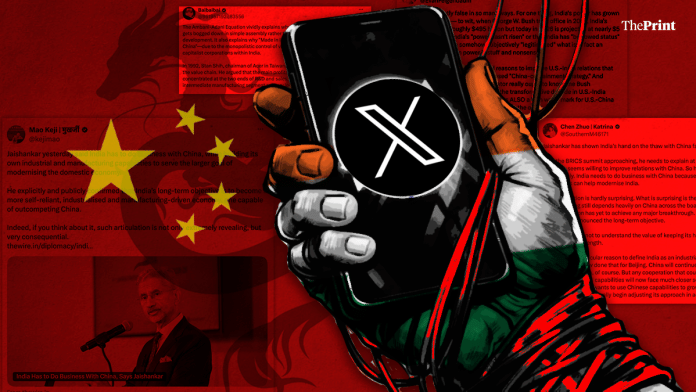

New Delhi: China’s researchers on India and its foreign policy have found a new wind in their sails, especially over the past few months, through the myriad social media platforms. Their comments often follow a simple dictum: Indian policy vis-a-vis China in the last half decade or more has been guided by the US.
Often enough, they argue New Delhi bet on the wrong horse, with President Donald Trump’s current foreign policy the perfect illustration. The increasingly assertive views a number of Chinese thinkers share on X—a social media site technically blocked in China as a part of its internet great wall—points to their growing interest to join the growing conversations on Indian foreign policy and its view about the world.
In recent months, those who have found increasing purchase and space in conversations surrounding India’s approach to foreign policy and ties with China are a few commentators on X, such as Chen Zhou, a South Asian analyst and PhD student affiliated with Fudan University and Mao Keji, the Deputy Division Director at the International Cooperation Centre, National Development and Reform Commission.
Both are extremely active on X, with Chen Zhou even writing articles for Indian publications on topics such as the idea of de-Americanisation of Indian foreign policy and on how China is currently reading India’s international relations.
Former Indian ambassador to China Ashok K. Kantha told ThePrint President Xi Jinping launched the idea of establishing well-endowed and world-class “new type think tanks with Chinese characteristics” in January 2014.
“The core idea was that China needed think tanks that could serve as sources of intellectual support and policy advice for the Party and the state, but structured differently from Western models. China’s academic outreach has long been through its traditional think tanks, which are often affiliated with different government entities. However, in recent years, there has been an understanding that these messages may encounter certain guard-rails in India, which has led to a more nimble approach to sharing their ideas here,” he said.
Mainstream think tanks in China have long been backed by the state, he added. “However, in recent years, other private think tanks are clearly being given space within China, and they may even be mildly critical of the establishment…These new think tanks have scholars who are interested in India, but they have a subtext to their perspectives fully in sync with the narratives of the party-state.”
Traditional think tanks, such as the Shanghai Institute for International Studies (SIIS) or the China Institute for International Studies under the Ministry of Foreign Affairs have had long ties and exchanges with their Indian counterparts.
Between 2006 and 2019, at least five Chinese delegations visited India on average annually, according to annual reports published by the Institute for Chinese Studies (ICS) and noted in a paper published by the Centre for Social and Economic Progress (CSEP), an Indian-based think tank.
Published in December 2025, the CSEP paper highlights that from 2020 onwards, there has been a sharp decline in the academic exchanges, which could be attributed to the diplomatic chill in India-China ties as a result of the summer clashes in Galwan that year (2020).
Jaishankar yesterday said India has to do business with China, while building its own industrial and manufacturing capabilities to serve the larger goal of modernising the domestic economy.
He explicitly and publicly confirmed that India’s long-term objective is to become a…
— Mao Keji | मुखर्जी (@kejimao) August 23, 2026
Since 2023, some exchanges have continued, but there remains a sense of wariness in India, given the breakdown in ties between the two countries. Indian government think tanks including the Manohar Parrikar Institute for Defence Studies and Analyses (MP-IDSA) – affiliated with the Ministry of Defence – hosted Chinese scholars in April 2024, even before the disengagement agreement was struck as a part of its efforts to maintain the exchanges.
In October 2025, Ambassador Sujan R. Chinoy, Director General of MP-IDSA led an eight-member delegation to Chengdu for track II dialogues hosted by Sichuan University.
While the two governments have taken steps in a calibrated fashion to stabilise ties, the process remains linked to the situation at the border, as External Affairs Minister S. Jaishankar has repeatedly stated.
In this situation, there has been a growth in the sharing of ideas through other channels, which has increasingly become a mode of conversation between academics of the two countries.
Chen Zhou, a PhD student and Editor-in-Chief of the South Asia Study newsletter, has found a voice through Indian publications in the last couple of months. Mao Keji, another active commentator, has interacted with Indian delegations visiting China in recent months, while also remaining active on X. It should be noted that Chen Zhou has also been a part of those delegations interacting with visiting Indian delegates.
Also read: India and China need to build trust—not manage rivalry
China’s nimble-footed approach to public diplomacy
Chinese President Xi in October 2014 called for a new type of think tanks, one that would promote China’s modernisation, as well as strengthen Beijing’s soft-power. In 2015, the Communist Party of China’s Central Committee (CPCCC) and the state council jointly issued a document titled “Opinions on strengthening think tanks with Chinese characteristics,” with the dual aim of promoting scientific decision making domestically and promoting China’s soft-power globally, notes the CSEP discussion paper.
As a part of the revolution, a new age of thinkers have emerged. Mao Keji, for example, pondered Wednesday on the value that India brings to the Shanghai Cooperation Organisation (SCO) in response to an article by C. Raja Mohan, the noted Indian foreign policy analyst for Foreign Policy.
Mohan argued the SCO’s diminishing returns for India is linked to the increasing role China plays in shaping the discussions within the forum, but pushed for continued engagement to minimise potential avenues for anti-India narratives.
Jaishankar has shown India’s hand on the thaw with China far too early.
With the BRICS summit approaching, he needs to explain at home why India suddenly seems willing to improve relations with China. So he laid out the logic quite plainly. India needs to do business with China…
— Chen Zhuo | Katrina (@SouthernM46171) August 23, 2026
“If the SCO now offers India almost nothing of use, and if India’s membership serves mainly as a hedge against the worst-case scenario for itself, what value does India bring to the organisation? Why should the other members bear with it?” Mao Keji said on X.
In an opinion piece for the South China Morning Post (SCMP) Tuesday, Mao Keji and Yaxin Mao, analysed what they perceive as India’s paradoxical approach to economic engagement with China.
Mao Keji has commented on everything from reports indicating a potential privatisation of parts of India’s space programme, to Bangladesh’s interest in the Mecca Pact, to commenting on Trump’s approach to foreign policy and even the growth of defence exports as a result of Operation Sindoor.
Chen Zhou earlier this month in an article for the magazine India’s World, highlighted their perspective that the US’ interest in supporting India’s growing role in geopolitics comes at a price – that New Delhi’s growth in power is only limited to serving the US’ interests.
The article was called out by Feignbaum as “especially insulting” to believe that India’s status is “borrowed” on the back of the US’ power.
Chen Zhou responded on X, “I honestly didn’t expect a calm argument to make such a senior scholar this angry. Maybe the real problem is that a Chinese scholar said out loud what American strategists prefer to leave unsaid.”
She added: “Of course India has grown stronger. Nobody disputes its GDP growth or expanding international ties. But none of those basic facts answers my point. Many pro-US officials and analysts in India keep selling America’s priorities as India’s own.”
The line drawn in many of the positions is one centring around India’s role in geopolitics, as an extension of the US’ strategy in the Indo-Pacific, or one that sees China as a potential economic power.
Within the Chinese academics exist their own divisions on Indian statements. Chen Zhou took an exception to Jaishankar’s recent statements on needing to do business with China in order to build its own domestic capabilities.
“Indian manufacturing still depends heavily on China across the board, and India’s industrialisation has yet to achieve any major breakthrough. Yet its foreign minister has already announced the long-term objective. India still seems not to understand the value of keeping its head down and quietly building up its strength,” she argued on X.
Mao Keji in comparison called Jaishankar’s comments “consequential” and “revealing.”
The conversations in the last few months have found a growing space within India’s own think tank circles, especially as Chinese authors are able to share their ideas in domestic publications. As the calibrated stabilisation in ties continues, and President Xi is expected for his visit to India in seven years, the ability of China’s academic community to interact with Indians continues to evolve, even as the wariness remains.
Growth of less-transparent channels of communication
While these commentators are scholars in their own right, there is a growing sense of China using social media as a part of its larger network of information warfare against foreign countries.
The importance of social media and its role in directing conversations has found mention in the literature of the People’s Liberation Army (PLA) as early as 2015, according to reports.
There are reported instances of anonymous accounts pushing information from a certain perspective with the aim of legitimizing certain ideas while promoting China as a better example.
One user on X – whose account was opened in October 2025 – has been far more critical on India, most recently taking aim at an “Ambani-Adani Equation” which focuses on assembling in India rather than research and development.
The post further highlights the successes of China’s EV-industry as further proof that India cannot compete when it comes to global manufacturing.
The origins of such accounts are obfuscated, while the comments take a clear pro-China tilt. Some Chinese scholars follow such accounts, which may not indicate support for the views, but highlight the ways in which these accounts interact with public accounts.
(Edited by Ajeet Tiwari)
Also read: India-China agree to push for ‘early harvest’ deal on boundary question after Doval-Wang talks