





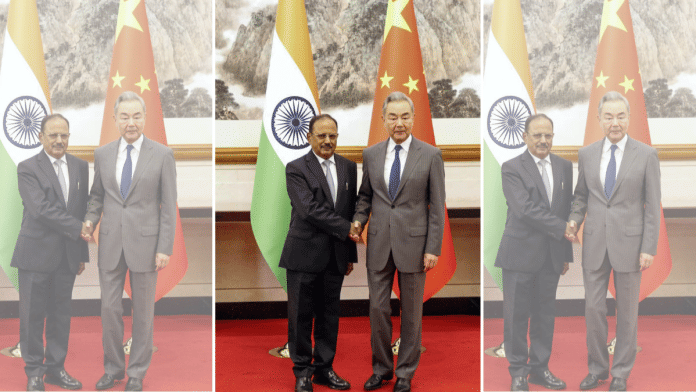

New Delhi: India and China Tuesday agreed to “advance discussions on an early and substantial harvest of boundary limitation” as part of an eight-point consensus arrived during the meeting between National Security Adviser (NSA) Ajit Doval and Chinese Foreign Minister Wang Yi in Beijing.
An early and substantial harvest of boundary limitation would in essence allow the two countries to identify areas where boundary disputes do not exist and move quickly to agree on the demarcation accordingly. It is part of the larger idea that it allows for the difficult issues to be discussed at a later date, while creating positive momentum for the same.
“The Expert Group on Boundary Delimitation and Working Group on Border Management under the WMCC would respectively advance discussions on an Early and Substantial Harvest of boundary delimitation and Border Management. The first task for both these groups would be to agree on their respective Terms of Reference,” the Ministry of External Affairs (MEA) said in a statement Wednesday.
The consensus was arrived at during the 25th meeting of the Special Representatives on the Boundary Question mechanism. Doval represented India as its special representative during a two-day visit to Beijing from 24 to 25 August.
The MEA statement added: “With the objective to improve the border management measures, an additional two meeting points were agreed for holding the General Level Mechanism/ Senior Highest Military Commander meeting (SHMC). Similarly two additional channels of border military hotline in the Eastern and Middle Sectors were agreed.”
The Expert Group and Working Group within the Working Mechanism for Consultation and Coordination on India-China Border Affairs (WMCC) was established following the last meeting of the SR-level mechanism in New Delhi in August 2025.
The two new groups were a part of an effort of India and China to move boundary discussions forward, following steps taken to stabilise ties. Diplomatic relations between the two countries cratered in 2020 following the clashes in Eastern Ladakh.
The two countries agreed to disengage across the friction points in October 2024, which has since allowed for the political processes to proceed forward. Prime Minister Narendra Modi met with Chinese President Xi Jinping twice in the last two years—in the Russian city of Kazan for the BRICS Summit in 2024, and Tianjin for the leaders summit of the Shanghai Cooperation Organisation (SCO) in August 2025.
The two leaders have called for confidence building measures to help stabilise the relationship. Amongst the steps taken, direct flights have resumed, while India is issuing visas for Chinese nationals. China resumed the Kailash Mansarovar pilgrimage in the summer months of 2025, which was held again this summer.
“Both sides noted the progress on trans-border cooperation. The Indian side appreciated the efforts made by the Chinese side to increase the number of batches of Indian official pilgrimage Kailash-Manasarovar Yatra (KMY) in the Tibet Autonomous Region of China. Both sides appreciated the reopening of the three designated border trading points,” said the MEA statement.
Doval during his discussions with Wang underlined that “peace and tranquility” at the borders is necessary for further moves to stabilise ties. Wang highlighted that the India-China ties possess “global and strategic significance” and are no longer just a bilateral relationship.
The two countries agreed to advance negotiations based on the framework set up through the 2005 agreement on the ‘Political Parameters and Guiding Principles for Settlement of the India-China Boundary Question’. The outcome was first agreed to by both parties last August.
The revival of the 2005 agreement assumes significance as it is seen as an opportunity by Beijing to delink tensions across the border from the overall relationship with India. New Delhi resisted that framing following the 2020 clashes, with External Affairs Minister S. Jaishankar pointing out that the tensions in Eastern Ladakh undermined over three decades of agreements, in earlier statements.
(Edited by Gitanjali Das)
Also Read: BRICS Summit: Xi, Putin, Pezeshkian among international leaders expected next month in New Delhi