






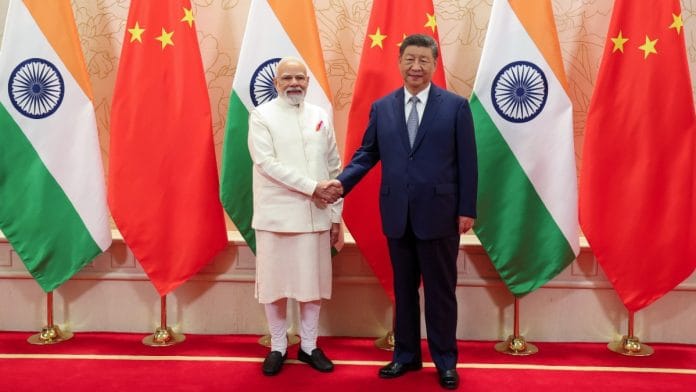


Asia’s stability will not be secured by treating one power’s Security Council seat as a precondition of legitimacy, nor by dressing two modern sovereign states in the borrowed costume of “civilisational states.” Not by asking two proud peoples to give up on trust itself.
It will be secured the old-fashioned way — through international law, patient diplomacy, and the accumulation—not the abandonment—of confidence. The century ahead needs the UN Charter applied consistently and neighbours who treat trust as a destination worth walking toward, not a mirage to dismiss before the journey begins. Let me explain where I differ with an otherwise thoughtful essay.
Milinda Moragoda’s recent column in ThePrint deserves genuine praise, and I want to start there. He is right that the boundary dispute is a serious, unresolved matter, not a rhetorical inconvenience. He is right that recent years have deposited a heavy sediment of suspicion on both sides of the Himalaya. He is right that great powers can hold competition and cooperation in the same hand, and that the trick of statesmanship is preventing the former from swallowing the latter. He is right that small, practical projects — in public health, disaster response, climate adaptation, and scholarly exchange — build the connective tissue that grand summits cannot. He is also right to champion multiple tracks of dialogue, from Track 1.5 forums to parliamentary and academic exchange. And he is right that India and China need not, and should not, become the nucleus of a bloc arrayed against Washington or anyone else. A world organised into hostile camps is poorer and more dangerous for everyone, including the two countries at its centre. Above all, he is right that the two countries do not need to resolve every difference before they can cooperate on anything.
But four moves in Moragoda’s argument deserve revisiting. First, he treats India’s ambition for a permanent Security Council seat as something close to a litmus test of whether multilateralism is working. China’s actual position, repeated by its ambassadors at the UN, is that reform must prioritise the representation of developing countries, above all Africa, based on broad consensus rather than the self-nomination of any single aspirant, a principle China restated as recently as November 2025. This is not obstruction for its own sake; it reflects a judgement, shared across much of the emerging economies, that enlarging the Council only for a handful of already-powerful aspirants would entrench inequity rather than cure it. Beijing does not make India’s Council ambitions a hinge of bilateral cooperation, and an essay that quietly does so imports a premise China does not share.
Also read: Putin’s Kuril island visit shows why Russia’s Pacific strategy matters to India
Trustworthy partners, not rivals
Second, the essay leans on the vocabulary of the “civilisational state,” popularised by writers like Martin Jacques and later theorists of civilisational geopolitics. It is seductive, but it is not how Chinese diplomacy frames the relationship. China’s own foreign ministry describes India as a “partner rather than rival” and grounds the relationship in the Five Principles of Peaceful Coexistence — a doctrine born, fittingly, from Zhou Enlai and Nehru’s 1954 talks, and built explicitly on sovereignty, non-interference, and legal equality, not on romantic narratives of two rival civilizations circling one another. Substituting civilisational grandeur for legal sovereignty risks softening the very treaty-based, boundary-based realism that any durable settlement requires.
Third, and most striking, the essay asks the two countries to “resist” and even abandon the “expectation of trust” as the organising goal. Chinese diplomacy has said the opposite, repeatedly and recently. Foreign Minister Wang Yi’s own language after the 2024 Kazan meeting between Xi Jinping and Narendra Modi calls for consistently increasing political mutual trust. In August 2025, Wang in New Delhi insisted that “mutual trust and mutual support should define the relationship between two major emerging countries.” A relationship that merely manages permanent low trust through transactional projects is a lesser ambition than the one Beijing has actually set for itself.
Fourth, the essay’s history is too tidy. Ancient Chinese-Indian exchange was real and precious, but it was not friction-free, and China’s own scholarship on the sinicisation of Buddhism tells a more interesting story than pure harmony. Indian Buddhism took root in China only by fusing with Huang-Lao Daoist thought, being translated into Taoist vocabulary, and becoming, over centuries, something distinctly Chinese rather than an imported orthodoxy. That is a story of creative adaptation and, at times, contest — not a seamless idyll.
None of this diminishes Moragoda’s larger and correct instinct that pragmatic, incremental cooperation should proceed even amid disagreement — a position echoed, from the Indian strategic-affairs side, by Ambassador Sujan Chinoy’s argument that cooperation can advance even under continued rivalry. But there is a difference worth naming. Ambassador Chinoy treats rivalry and cooperation as parallel tracks that need never meet; Beijing’s stated goal is to convert cooperation into trust, not to manage rivalry indefinitely as a stable equilibrium. They are stages in one unfinished process, not sealed compartments.
That is the deeper lesson of 75 years of China-India diplomacy since the Panchsheel Agreement. The goal is not to normalise distrust as the price of doing business, but to reduce it, treaty by treaty and project by project, until sovereignty and law — not suspicion, and not borrowed civilisational metaphors — are what the two great Asian nations have most durably in common. That is a harder, slower path than either romantic convergence or resigned rivalry. It is also the only one that has ever actually worked.
HUANG Yunsong, Professor & Associate Dean, Sichuan University China Center for South Asian Studies, School of International Studies. Views are personal.
(Edited by Ratan Priya)