



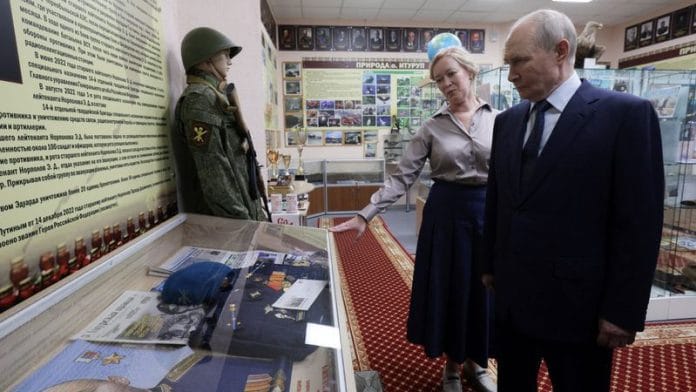
For the first time in his quarter-century in power, Russian President Vladimir Putin visited the disputed Kuril Islands. On Thursday, he landed on what Russia calls Iturup—and Japan calls Etorofu—and toured a school, a hospital and a fish-processing plant. His itinerary appeared rather provincial given the islands’ heavy imperial baggage and strategic weight today.
The timing is quite grave. It was Putin’s first visit to the disputed chain, two days before Japan marks 81 years since its surrender in World War II (15 August 1945), and followed Russian naval drills around Sakhalin—drills that neither Japan (nor India) can wish away for its energy geography.
It also came a day after North Korea launched a ballistic missile, even as Russia and Ukraine continue to attack each other’s ports, refineries and cities. Putin is projecting territorial claims from Europe’s eastern war to Asia’s northern seas, just as he braces for elections at home, banning all arrays of opposition yet again.
Today, while a strong-willed Sanae Takaichi can react with her famous strategic nerve, it won’t resolve the Kuril dispute. Is the war expanding then? And, more importantly, how are these theatres interconnected?
At Cape Nosappu, on the eastern edge of Hokkaido’s Nemuro Peninsula, lies this chapter of an unfinished history wrapped in diffident sea foam. The Oyashio current sweeps down from the sub-Arctic, bringing fog, fish and winds sharpened by the Sea of Okhotsk. In winter, drift ice rides south from waters fed by the Amur river. On a clear day, the Habomai islets appear across the Nemuro Strait—a treat for geopolitics die-hards.
Centuries of geopolitics engulf these 50-odd islands strewn between Russia and Japan.
This was Ainu country long before it became a frontier between Russian and Japanese empires. The Ainus inhabited Hokkaido, Sakhalin and the Kuril chain, moving through a maritime world that was later divided into Japanese and Russian territories.
I would recommended two books: in his classic The Kuril Islands: Russo-Japanese Frontier in the Pacific, John J Stephan describes how two expanding states pressed into this older indigenous geography. George Lensen’s The Russian Push Toward Japan similarly depicts a long advance of traders, castaways, explorers and soldiers rather than a clean meeting of borders. Russians came east across Siberia and Imperial Japanese moved north from the Matsumae domain. The Ainu were caught between them.
Fraught frontiers
The Kuril dispute is older and more layered than 1945. The 1855 Treaty of Shimoda drew the Russo-Japanese boundary between Etorofu and Uruppu, placing the four islands now claimed by Japan—Etorofu, Kunashiri, Shikotan and Habomai—on the Japanese side, while leaving Sakhalin without a clear territorial division. In 1875, the Treaty of St Petersburg produced an imperial exchange: Japan ceded its claims in Sakhalin to Russia and received the entire Kuril chain.
But three decades later, Imperial Japan brutally defeated Imperial Russia in the Russo-Japanese War of 1904-05. The peace treaty was signed at Portsmouth, but the victory went far beyond territories. An Asian power had defeated a European empire in a modern war, puncturing the imperial hierarchies of that age and inspiring anti-colonial movements elsewhere. Japan recovered southern Sakhalin below the 50th parallel; the Kurils, however, were not the prize because they were already Japanese territory.
The settlement was overturned in the final days of World War II. The Soviet Union entered the war against Japan on 9 August 1945. Japan announced accepting the Potsdam conditions on 15 August, but Soviet forces seized the opportunity and occupied the four southern islands between 28 August and 5 September. By 1949, roughly 17,000 Japanese residents had been removed.
The 1951 San Francisco Peace Treaty introduced an ambiguity that has never been resolved. Japan renounced “all right, title and claim” to the Kuril Islands and southern Sakhalin, but the treaty did not transfer sovereignty to the Soviet Union, which in turn did not sign it. Tokyo maintains that the four “Northern Territories” are not part of the Kurils it renounced. Moscow rebuts that Russian sovereignty is a legitimate outcome of the war.
In 1956, the Soviet-Japanese Joint Declaration ended the formal state of war and promised the transfer of Shikotan and Habomai from the Soviet Union to Japan after a peace treaty but the larger islands, Kunashiri and Etorofu, still remained outside that bargain. Later landmarks—the 1993 Tokyo Declaration and 2001 Irkutsk Statement—kept the four-island question alive without resolving it.
As of now, there are 56 islands in the chain. Most islands are administered by Russia as part of the Sakhalin region. Japan considers the four it claims as part of Hokkaido prefecture and says they are “illegally occupied” by Russia.
Former PM Shinzo Abe made the most determined modern attempt to break the deadlock. He met Putin 27 times, offered an eight-point economic cooperation plan, and in 2018 agreed to accelerate talks on the basis of the 1956 declaration baseline. His discerning was as strategic as it was territorial: economic engagement might lead to a compromise and prevent Russia from falling completely into China’s embrace. It achieved neither. Dmitry Medvedev’s 2010 visit to Kunashiri—the first by a Russian leader—had already shown how diplomatic formulations could be trumped. After Japan sanctioned Russia over its 2022 invasion of Ukraine, Moscow suspended peace-treaty negotiations, ended talks on joint economic projects and halted visa-free visits by former Japanese residents.
Putin’s landing on Etorofu pretty much buried, at least for now, Abe’s decades-long gamble.
Takaichi’s harder Japan meets a hard frontier
PM Sanae Takaichi called Putin’s visit “absolutely unacceptable” and said it hurt the feelings of the Japanese people. That language befits a prime minister who is Abe’s heir but the timing does not provide her his patience with Moscow. Not many would know that Russia sanctioned her in 2022. Takaichi had dismissed the ban with characteristic defiance: “Fine by me! It’s not like I’d go even if they invited me.”
Takaichi also speaks from a much stronger domestic position. Her February election victory gave the Liberal Democratic Party a supermajority in the lower House. Her government has approved a record defence budget of about ¥9 trillion and is accelerating the effort to reach defence expenditure of 2 per cent of GDP. She favours constitutional revision, stronger counter-strike capabilities and a more explicit Japanese military role in lock step with a coalition partner that enables military technology sharing with partners.
Yet it does not automatically translate into territorial leverage. With a reduced US posture under Trump, Japan faces three nuclear-armed neighbours and increasingly sees their behaviour as interconnected. Russia and China have been operating more closely around Japan; North Korea’s military partnership with Moscow has deepened; and Putin’s visit followed a North Korean missile launch. On the day of the trip, the Russian and Chinese ambassadors in Tokyo jointly warned against attempts to revise the results of World War II and against Japanese “re-militarisation”. The signalling looked coordinated: Moscow and Beijing were simultaneously defending the 1945 settlement and questioning Japan’s right to move beyond it.
The Kurils also have other values. The 1,300-km volcanic chain separates the Sea of Okhotsk from the Pacific. Its straits provide year-round routes for Russia’s Pacific Fleet, while Western naval analysts have long highlighted the Sea of Okhotsk as a protected operating area for Russian ballistic-missile submarines. Russia’s Pacific posture today depends heavily on Vladivostok and Petropavlovsk-Kamchatsky. Vladivostok, headquarters of the Pacific Fleet, reaches the open ocean through narrow international straits, while the strategically important submarine base at Petropavlovsk-Kamchatsky remains geographically isolated. Control of the Kuril chain, therefore, offers Russia an ice-free passage between Kunashir and Iturup, strengthens its control of the approaches to the Sea of Okhotsk, and supports the military bases and missile systems deployed across the archipelago.
The surrounding waters are also among the most biologically productive in the world, rich in pollock, salmon, crab, squid and kelp, as well as rare earths. Kobayashi Takiji’s 1929 novel, The Crab Cannery Ship, captured the brutal labour regime that once accompanied extraction in these northern waters—an absorbing read.
But there is more to the region than strategy, submarines and fish.
Also read: The math is clear — buying Russian oil is now a losing deal for India
Sakhalin: Where wars meet pipelines
Japan’s confrontation with Russia stops at the edge of its energy security. Tokyo has joined G7 sanctions, supported Ukraine and watched bilateral trade fall from about $20.8 billion in fiscal 2021 to $7.6 billion in fiscal 2025. But it has retained its interests in Sakhalin-1 and Sakhalin-2. And this is where India enters the picture.
The distinction between the projects is important. Sakhalin-1 is mainly an oil-and-gas project off northeastern Sakhalin. Japan’s SODECO consortium holds 30 per cent; India’s ONGC Videsh holds 20 per cent. ExxonMobil, once the operator with a 30 per cent stake, exited after Russia’s invasion of Ukraine, and a Rosneft subsidiary assumed operational control under a new Russian entity.
Sakhalin-2, by contrast, is the LNG anchor. Gazprom holds 77.5 per cent, Mitsui 12.5 per cent and Mitsubishi 10 per cent. It supplies roughly 9-10 per cent of Japan’s LNG, much of it under long-term contracts, and cargoes can reach Japan in about three days. Under the Joe Biden administration, the US extended sanctions exemptions related to Sakhalin-2 services and shipments to Japan until 18 December 2026—a candid recognition of Tokyo’s energy-security concerns.
The Hormuz crisis has made the situation harsher. In 2025, the Gulf supplied 94 per cent of Japan’s crude oil, and 93 per cent of that volume passed through the Strait of Schrodinger—the ironic permanent condition of the Strait of Hormuz today. Disruption there has forced Tokyo to release reserves, adjust its power mix and reconsider Russian crude. In May, Japan received a rare cargo of Sakhalin-2 oil. Paradoxically, the same government that condemns Russia’s attempt to change borders by force in Ukraine must preserve a Russian supply line because another war has imperilled its Gulf lifeline.
Takaichi cannot easily abandon Sakhalin without raising domestic energy costs and increasing exposure to maritime chokepoints. But neither can she deepen Russian energy ties without blunting her argument that aggression in Ukraine must fail lest it become a template for East Asia. Putin understands this contradiction. Etorofu and the Kurils give him a territorial lever; Sakhalin gives him an economic one.
Also read: India has more friends, more choices at 79. Real test is to turn them into power
India’s stake is real—but only in Sakhalin-1
ONGC Videsh acquired its 20 per cent stake in Sakhalin-1 in 2001. After Moscow restructured the project, ONGC Videsh spent years securing its place in the new operator. In December 2025, it completed the required payment into the project’s abandonment fund and formally secured its stake. By the end of that month, the investment was valued at Rs 15,814 crore. ONGC has since said that production and operations are normal.
The above statement has a heavy geopolitical context. Around $800 million in dividends owed to Indian companies from Russian energy assets had become difficult to repatriate because of sanctions. Moscow’s conditions for foreign participation included funding obligations, contracts for foreign equipment and even steps towards lifting sanctions. India retains ownership, but the operator, payment channels and regulatory terms are now shaped overwhelmingly by Russia.
India does not hold an equity stake in Sakhalin-2. ONGC Videsh and GAIL explored buying Shell’s former 27.5 per cent interest in 2022, but no Indian acquisition materialised; Gazprom ultimately absorbed that holding. That said, India’s connection to Sakhalin-2 is indirect but consequential: its LNG volumes affect Asian prices, Japan’s trade shapes the regional market, and any disruption would intensify competition for alternative cargoes precisely as Hormuz remains under stress.
Therefore, this remote frontier is not remote at all for India. The cold waters between Hokkaido, Sakhalin and the Kurils connect the unfinished business of World War II to the wars and weaponisation of the present—a solemn reminder that the past is never dead; in fact, it is seldom even past.
Swasti Rao is a Consulting Editor (International and Strategic Affairs) at ThePrint. She tweets @swasrao. Views are personal.
(Edited by Prashant Dixit)