





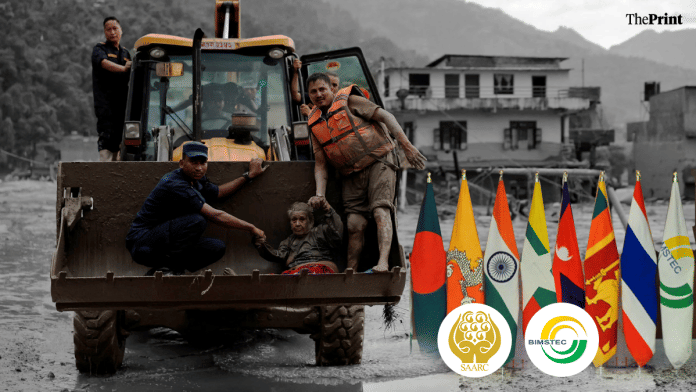

New Delhi: Two regional South Asian blocs—SAARC and BIMSTEC—have been absent from disaster relief efforts in Nepal, a member of both groupings, even as individual countries, including India, have mounted individual Humanitarian Assistance and Disaster Relief (HADR).
For both South Asian Association for Regional Cooperation (SAARC) and Bay of Bengal Initiative for Multi-Sectoral Technical and Economic Cooperation (BIMSTEC) disaster management has been a key priority area.
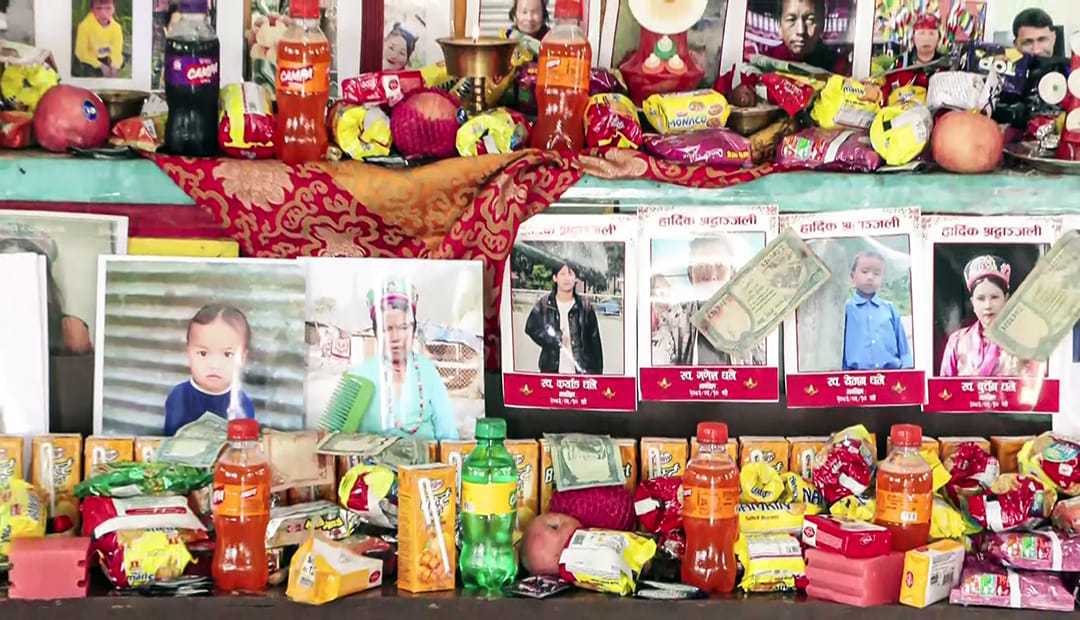
In the last week of August 2026, a glacial lake outburst hurtled through Nepal, killing more than 1,200 people, with the toll likely to go up, and leaving thousands more either missing or displaced. The point zero lay along the Bhote Koshi river in Rasuwa district, situated along the Nepalese border with the Tibet Autonomous Region of China.
Though no adverse impact has yet been recorded in the Indian states bordering Nepal, Uttar Pradesh and Bihar were on alert for rising water levels, with the National Disaster Response Force (NDRF) deploying its teams there as a precaution.
A flood originating along the Nepal-China border and carrying the potential to reach Indian states has once again spotlighted how tightly interlinked disaster risk is across South Asia, and how elusive a regional Humanitarian Assistance and Disaster Relief (HADR) framework remains.
Also read: India and Nepal need to build a growth corridor, not just trade across a border
Bilateral trumps regional
Nepal’s foreign ministry expressed gratitude to India, China, Japan, the United States, the United Arab Emirates, the Republic of Korea and other countries for providing bilateral aid.
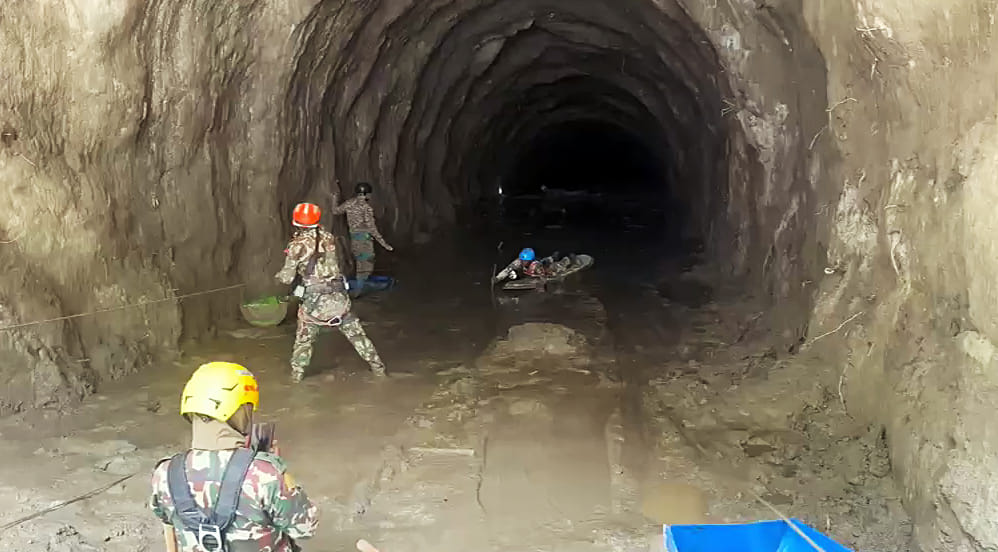
Indian tunnel rescue teams are working closely with the Nepali Army at the Chilime and Langtang hydropower sites, while a Chinese team is working in coordination with the Nepali Army at the Upper Trishuli 3A project site.
Any form of regional or multilateral cooperation, however, is missing. BIMSTEC’s presence was limited to just a condolence message posted by its Secretariat’s official account on X. The Secretariat thanked the member states for providing help to Nepal.
The SAARC developed a Comprehensive Framework on Disaster Management in 2006 and an Agreement on Rapid Response to Natural Disasters in 2011.
The BIMSTEC, too, finalised a “BIMSTEC Plan of Action to improve Preparedness and Coordination for responding to Natural Disasters in the Bay of Bengal Region”, with the body having conducted four tabletop exercises thus far.
At the Sixth BIMSTEC Summit in 2025, India even proposed the establishment of a BIMSTEC Centre of Excellence for Disaster Management, in addition to the Centre for Weather and Climate it already houses in Noida, Uttar Pradesh.
Regional frameworks, then exist only on paper, in agreements, centers and tabletop exercises. When Nepal was struck by a high-magnitude earthquake in 2015, prominent countries like the United States, India, and China were quick to come to its aid and sought to project soft-power through disaster response diplomacy, but regional multi-national bodies were found missing in action.
What has stayed unchanged between then and now is the glaring absence of any South Asian regional response.
Disasters in other countries reveal a similar picture. When Myanmar, also a BIMSTEC member state, was struck by an earthquake in March 2025, Quad and ASEAN mobilised and coordinated their assistance. India also launched Operation Brahma.
But yet again, BIMSTEC was nowhere, barring a leaders’ joint statement expressing condolences to the governments and peoples of Myanmar and Thailand.
Bihar Governor Lt Gen Syed Ata Hasnain, a former member of the National Disaster Management Authority (NDMA), told ThePrint one of the reasons is the lack of political trust within groupings such as SAARC and BIMSTEC.
The BIMSTEC Secretariat expresses its deepest condolences and solidarity with the People and Government of Nepal following the devastating floods.@MofaNepal @IndraManiPR#Nepal #HADR #HumanitarianAssistance #RegionalCooperation #BIMSTEC #Solidarity pic.twitter.com/xhcZyUGiYb
— BIMSTEC (@BimstecInDhaka) August 27, 2026
“Regional cooperation ultimately rests upon the quality of bilateral relationships. The sum of those relationships creates the political environment within which any regional mechanism has to function. South Asia unfortunately has not always enjoyed the degree of political trust necessary to build a strong and routinely activated regional disaster-response architecture,” he said.
“The case for regionalism nonetheless remains compelling. South Asia would benefit enormously from greater sharing of satellite and hydrological data, common warning protocols, scientific collaboration, pre-identified relief capabilities and periodic joint exercises. The capability exists. What is required is the political trust and institutional framework that allows it to be used collectively. Until that matures, bilateral cooperation will probably remain the most effective instrument of disaster response in South Asia,” said Lt Gen Hasnain.
Status of regional bodies
SAARC was established in 1985 and headquartered in Kathmandu. Following the Uri attack in September 2016, India – and subsequently other neighbouring member states – boycotted the SAARC summit scheduled to be held in Islamabad that November and the body has since been effectively dysfunctional.
‘A summit for Himalayan states is needed. There are political hurdles, but they have to be overcome. It is a matter of life and death,’ says Ambassador Ranjit Rae, India’s ambassador to Nepal during 2015 quake.
Gujarat houses the SAARC Disaster Management Centre. But with the larger body not functioning, it remains paralysed.
That leaves BIMSTEC as the only functional regional grouping that Nepal is a member of. Established in 1997, and headquartered in Dhaka, BIMSTEC, like SAARC, has never to disasters impacting its member states.
This is despite the bloc being nearly three decades old and, unlike SAARC, not hobbled by India-Pakistan rivalry. Disaster management is a sub-sector within the BIMSTEC’s security vertical, which is headed by India.
“Although, in the past decade BIMSTEC has undertaken steps in disaster management, these were primarily aimed at enhancing the member states’ disaster preparedness and response capacities,” said Sohini Bose, an Associate Fellow at the Observer Research Foundation
“Even the Guidelines for the Maritime Component of Humanitarian Assistance and Disaster Relief adopted as late as July 2026, at the 5th Meeting of the BIMSTEC National Security Chiefs, are designed to help member countries undertake relief operations expeditiously. While this may be interpreted as a preliminary step towards curating a future regional response mechanism under BIMSTEC, no such institutional arrangement currently exists,” she said.
She said affected member countries continue to seek HADR bilaterally, as is the norm in South Asia. “For SAARC and BIMSTEC to become alternative sources of support in such emergencies, there is a need for stronger political will, economic commitment and a genuine desire for collective response. However, a practical evaluation of the need for such multilateral efforts is essential, especially as bilateralism continues to serve well.”
That Nepal wrote to the Fund for Responding to Loss and Damage (FRLD), a global climate mechanism created at COP27 and operationalised at COP28, seeking financial assistance instead of a regional institution reflects the state of a regional HADR architecture.
Can Indian subcontinent rise to the occasion
South Asia is among the world’s most climate-vulnerable regions and its geography compounds the risk, for shared ecosystems, rivers and mountains mean that disasters and climate shocks do not recognise geopolitical boundaries.
“There needs to be greater cooperation among Himalayan countries because they are equally concerned. If regional frameworks have not delivered, then we must examine why. A summit for Himalayan states is needed and requires strong political impetus. There are political hurdles, but they have to be overcome. It is a matter of life and death”, Ambassador Ranjit Rae, who served as India’s ambassador to Nepal during the 2015 quake, told ThePrint.
On India’s part, bilateral HADR operations have served its interests well. India’s foreign affairs ministry often packages the country’s HADR initiatives as a symbol of friendship and goodwill that help foster cooperation and diplomatic ties with recipient nations.
“HADR plays a critical role in India’s Neighbourhood First policy and India remains the first responder for nearly every crisis and is prepared to provide assistance, subject to approval of the request of host countries,” said Rae.
Referring to India’s most expansive HADR operation, codenamed Operation Maitri, launched following the 2015 quake in Nepal, Rae said, “India arrived a couple of hours after the earthquake and the military-to-military cooperation went extremely smoothly,”.
Notably, though, Indian media faced backlash during 2015 quake over its insensitive reportage.
“There are several learnings from Op Maitri, most significantly on media. Indian media is very popular in Nepal and everybody watches it. There were certain misunderstandings resulting from the projection of Op Maitri, but India-Nepal relations got over that and everybody appreciated New Delhi’s help. Indian media needs to be well-briefed when covering sensitive HADR operations”, Rae told ThePrint.
Perhaps cognisant of this experience, New Delhi has avoided naming its rescue and relief operations this time around, at least from what has been reported so far. This is unusual for India, given it almost invariably codenames its large-scale international HADR operations.
Nepal, too, appears to have learnt from its experience. Initially, the Balen Shah government appeared hesitant to accept foreign aid. This likely stemmed from the mismanagement caused by foreign search-and-rescue teams in 2015 and the ensuing competition among countries to outdo each other in the relief effort.
Nepalese government officials, however, have since rejected reports of Nepal rebuffing foreign aid, with the Nepal’s prime minister even thanking India and China for their help.
Civil activists in Nepal have called for the government to collaborate with other countries of the Himalaya-Hindu Kush region to better understand phenomena such as global warming and permafrost thawing. Going forward, a collective regional response may only grow more imperative due to the complexities of disasters.
“We increasingly have to prepare for cascading events – an earthquake triggering landslides, a rock-ice collapse becoming a debris flow, or an event in one country affecting river systems and populations across an international boundary. Tabletop exercises, joint simulations, exchange of specialists and sharing of scientific and early-warning data can therefore be extremely valuable,” Lt Gen Hasnain told ThePrint.
Asked whether NDMAs, or their equivalents in member-states, could train more frequently to better prepare for similar calamities, Lt Gen Hasnain said, “There is considerable merit in doing so”.
“NDMAs can progressively develop common operating procedures, share lessons from major disasters, train specialists together and periodically test communication and warning mechanisms. The institutional possibilities already exist,” he said.
The degree to which this domain can be energised will ultimately depend upon political relationships and the strength and relevance of regional organisations, he added. “Disaster management can, however, also become one of the less contentious areas through which greater regional confidence is gradually built.”
(Edited by Ajeet Tiwari)
Also read: India, Pakistan need to move on for sake of SAARC, BIMSTEC no alternative: Nepal envoy