






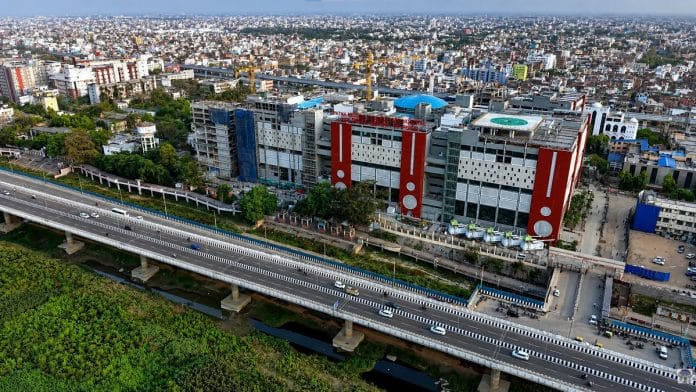

India often imagines urbanisation through two contrasting pictures: the city of high-rises and cement roads versus the village of farms and mud houses. The more consequential transition, as we have written before, happens between these images. A settlement can remain a village administratively while its economy, population, land use and service requirements are already becoming urban.
In transition areas, density rises, land values increase and traffic intensifies. Demand for piped water, drainage and waste management grows. Livelihoods become less dependent on agriculture. Yet the institution governing the settlement may continue to be a Gram Panchayat. The economy and physical form can therefore become urban before the governance system does.
Our analysis of Local Government Directory data points to substantial rural-to-urban institutional transition since the 2011 Census. The fiscal architecture is beginning to reflect the same change. The Sixteenth Finance Commission has increased the share of local-government grants allocated to Urban Local Governments from 36 per cent under the Fifteenth Finance Commission to 45 per cent, alongside a Rs 10,000-crore Urbanisation Premium linked to rural-to-urban transition policies. If the settlement, its economy and even the fiscal architecture are changing, what else should?
Also Read: Villages in UP, Gujarat & Kerala become towns differently. Why it matters for development
Governance logic differs for villages & towns
The 73rd Constitutional Amendment created the framework for Rural Local Bodies (RLBs), while the 74th established the framework for Urban Local Bodies (ULBs).
The Eleventh Schedule lists 29 broad subjects for Panchayats, including agriculture, drinking water, rural roads, education, health and poverty alleviation. The Twelfth lists 18 municipal functions, including urban planning, land-use regulation, water supply, sanitation, solid waste management and public amenities. But the important distinction is not simply 29 subjects versus 18 functions. The governance logic changes.
Panchayat governance is substantially oriented toward livelihoods, community development, rural infrastructure and access to welfare. By contrast, urban governance requires more spatial planning, regulation, networked services and the management of complex systems.
Drinking water, for example, moves from a question of access in a village to the management of a networked utility in an urban centre. In cities, roads become connected to drainage, mobility and traffic management. Housing intersects with land use, building permissions and development control. Waste becomes a system requiring collection, transportation, processing and disposal.
Some functions also change fundamentally or disappear in the transition. Small-scale industries, khadi and village industries are recognised as rural functions, but have no direct equivalent in the municipal functional framework. Others become more complex, change form or disappear from the local-government mandate altogether.
There is a fundamental institutional difference as well. A Gram Panchayat sits within a three-tier Panchayati Raj architecture, connected to intermediate and District Panchayats for planning, coordination and administrative support. However, each ULB is an independent elected local government. It is not another tier in a vertically integrated municipal structure analogous to Panchayati Raj. Depending on the function, it may interact with state urban development departments, development authorities and specialised agencies.
Four kinds of preparedness
A Rural-to-Urban Transition Policy should begin with function preparedness. Before a settlement is converted, the state should identify which responsibilities will move to the ULB, which will remain with departments, which will be shared and which will be performed by specialised agencies. For every function, there should be clarity on who plans, finances, implements, regulates and maintains it. A notification changing legal status is not the same as transferring functional capacity.
The second is fund preparedness. This is not simply about how much money a new ULB receives. Urbanisation changes both the revenue base and expenditure responsibilities of local government. A municipality needs systems to mobilise own-source revenue through property tax, user charges, licences, fees and other legally permitted sources. Property tax is not simply a tax on houses. It requires a property database, assessment, valuation, billing, collection and enforcement. As land values and development activity change, states must also examine land- and development-related revenues where legally applicable.
The third is functionary preparedness. A Sarpanch and Panchayat Secretary working with block and district institutions operate in a different governance environment from elected representatives and officials managing municipal issues. But the transition also raises a more basic question about the people already working in the rural system.
Let’s take the case of a Gram Rozgar Sahayak, whose work has been built around MGNREGA, muster rolls and wage employment in a Gram Panchayat. Many of those responsibilities may no longer exist in the same form after the settlement becomes urban. What happens to that functionary? Does the role disappear, get absorbed into another function, or require a completely different set of skills?
Urban transition therefore requires more than transferring staff or conducting a training programme. States need to determine which personnel will move, which technical positions are required, what new competencies elected representatives and officials need, and where specialised capacity will come from. Capacity is not only about having the right people; it is also about giving them the authority, technical support and institutional systems required to act.
The fourth, and often least considered, is citizen preparedness. Under Panchayati Raj, accountability is relatively direct through the Gram Sabha; after transition, it can be distributed across councillors, municipal offices, departments and parastatal agencies. The transition can create greater distance between citizens and local government, with accountability spread across a more disconnected chain of institutions.
Rural-to-Urban Transition Policies must therefore treat citizens as participants in institutional transition, not simply as recipients of a new administrative arrangement. Citizens need to know who is responsible for what, where to raise an issue and who is accountable for its resolution.
Also Read: Mumbai to Bengaluru—Indian cities are unlivable despite economic growth, says report
Urbanisation process needs policy support
India needs to recognise that rural-to-urban transition is a governance process. And a settlement can change its economic character faster than its institution can adapt.
Fiscal policy may recognise the growing importance of urban local governments but cannot create the administrative and democratic capacity required to govern urbanisation.
This gives us a simple policy framework: Functions, Funds, Functionaries and Citizens. The first three are the institutional foundations of decentralisation. The fourth is what makes that architecture accountable to the people it governs.
States experiencing significant urbanisation should formulate Rural-to-Urban Transition Policies based on this framework before or alongside the conversion of settlements into urban local governments. The 73rd and 74th Constitutional Amendments cannot operate as separate worlds when settlements themselves are moving between them. They need to talk to each other.
Pallavi Laungani is a PhD student at O.P. Jindal Global University, researching rural-urban transitions in India. Tarun Arora is an Associate Dean and Associate Professor at O.P. Jindal Global University, specialising in economics, urban policy and public policy. Views are personal.
(Edited by Asavari Singh)