






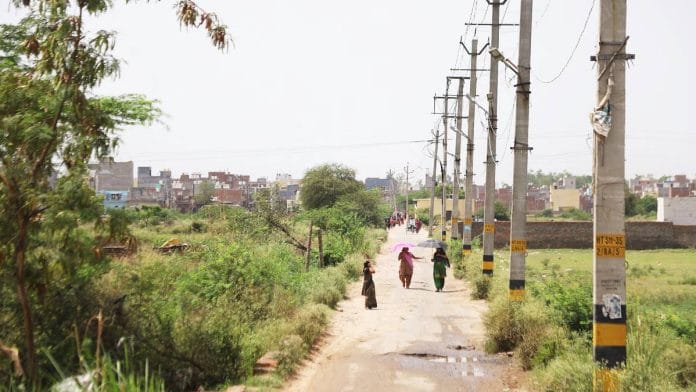

India’s urban future is not being shaped only inside existing cities. Many rural settlements are turning urban in all but name. Agricultural land gives way to residential layouts and commercial activity; non-farm work expands; commuting and labour exchange extend beyond village boundaries; and expectations from local government increasingly resemble those of urban residents: piped water, drainage, solid waste management, better mobility. Urbanisation, therefore, often begins long before municipal notification.
This reality is now finally reflecting in fiscal policy. The Sixteenth Finance Commission report, tabled this Budget, proposed a Rs 10,000-crore incentive—the Urbanisation Premium—for states to bring peri-urban villages into Urban Local Bodies. Each grant is to be calculated at Rs 2,000 per person in the area being incorporated, based on its Census 2011 population. More importantly, access to the premium is conditional on states preparing Rural to Urban Transition Policies. The Finance Commission expects these policies to identify transitional settlements and assess the implications of transition. This is significant because it shifts policy attention from what happens after a settlement becomes urban to what happens while it is becoming urban.
This shift was long overdue.
The gap between the pace of settlement change and that of institutional change is a difficult governance problem. A settlement can acquire urban economic and spatial characteristics while continuing to be governed through a rural local body. The result is not simply a mismatch of labels. It can mean fragmented planning, weak land management, delayed infrastructure, limited fiscal capacity and growing pressure on institutions designed for a predominantly rural context.
For residents, the consequences appear in concrete ways: unreliable water, poor drainage, congested roads, inadequate waste management and uneven access to urban services. The transition from village to town is consequently not just a question of jurisdiction, but of whether institutions can keep pace with changing human development needs.
Also Read: Lal Dora villages are a parallel city in Delhi. No one wants to fix this dirty secret
3 routes to urbanisation
The 16th FC’s requirement that states have a Rural to Urban Transition Policy framework to unlock the Urbanisation Premium is valuable because it introduces the idea of anticipatory governance. Instead of waiting for notification and then trying to build municipal systems, states are being asked to identify transition areas and prepare in advance for their governance, financial and service-delivery needs.
Yet the design of the Urbanisation Premium raises another question: is India’s transition to urban governance being imagined through too narrow an institutional pathway? The current recommendation is centred on merging villages with an adjoining ULB that already has a population of at least one lakh. That is an important pathway, but it is not the only way India becomes urban.
The Constitution itself points to a more differentiated model. Article 243Q provides for a Nagar Panchayat for an area transitioning from rural to urban, a Municipal Council or Municipality for a smaller urban area and a Municipal Corporation for a larger urban area. It therefore does not assume that every settlement should make the same institutional jump. It recognises stages of urbanisation and provides different forms of urban local government. In 2011, nearly 73 per cent of Statutory Towns had populations below 50,000, falling in Census Classes III to VI. Therefore, a substantial part of India’s urban system consists of smaller settlements whose institutional capacity, fiscal base and service-delivery requirements are different.
India’s actual transitions reinforce this diversity.
Our analysis of more than 10,000 rural-to-urban institutional transitions recorded in the Local Government Directory (LGD) between 2013 and 2025 shows no single national pathway. At the national level, approximately 22 per cent of transitions moved into Municipal Corporations, 38.8 per cent into Municipalities and 37.2 per cent into Nagar Panchayats. Bihar and Uttar Pradesh have predominantly expanded their urban landscape through Nagar Panchayats; Kerala has urbanised more through Municipalities; while Gujarat has seen a greater share of transitions associated with Municipal Corporations.
These differences do not establish that one model is superior, but they do show that India’s urban transition is institutionally heterogeneous. And that matters for the design of Rural to Urban Transition Policies.
A state where urbanisation is largely occurring through new Nagar Panchayats faces different questions from one where growth is being absorbed through existing municipalities or corporations. The relevant policy starting point is therefore not “how should a village become a municipality?” but “how is this state actually urbanising, and what institutional arrangement can govern that pathway?”
Rural-to-urban transition should also be treated as a process rather than an event. Institutional change begins before notification and continues well after it. A serious transition policy should therefore identify emerging transition areas, assess readiness, prepare phased transition plans, strengthen staffing and financial systems, build technical capacity and protect continuity in services.
Odisha’s Rural Urban Transition Policy 2023 offers a useful example. Rather than treating transition as a one-time act of municipal notification, it approaches it as a phased process of institutional preparation, bringing planning, governance, service delivery, administrative strengthening and stakeholder engagement into the transition itself.
The wider lesson is important: the challenge is not simply to change jurisdiction, but to build the capability to govern the settlement through that change.
Also Read: Urbanisation hasn’t led to productivity boost for Indian cities. Economic Survey lists obstacles
Getting rural-to-urban transition right
The Urbanisation Premium gives states additional fiscal resources as well as an opportunity to rethink how rural-urban transition is governed. Six principles could guide Rural Urban Transition Policies.
First, build policy on evidence, not assumptions. No two states urbanise in the same way. Before designing transition policies, states should understand how they transition. LGD records, state notifications, Census data and spatial growth patterns can reveal dominant institutional pathways and help states make choices suited to their own patterns of urbanisation.
Second, define transition as a process, not an event. Policy should set out clear stages, from identifying emerging transition areas and assessing institutional readiness to preparing roadmaps, building technical and administrative capacity, strengthening financial systems, ensuring citizen participation and supporting institutions after notification.
Third, strengthen India’s constitutional urban framework. States should invest across the entire continuum of ULBs. Newly constituted Nagar Panchayats may need intensive support to establish municipal systems, while expanding municipalities and corporations face different challenges of integration, planning and metropolitan governance.
Fourth, shift the focus from institutional creation to institutional capability. Creating a ULB is only the beginning. Transition policies should prioritise staffing, financial and regulatory capacity, spatial planning and the delivery of essential urban services. Success should be judged by the institution’s ability to govern, not merely by its creation.
Fifth, make rural-urban transition a state finance agenda. State Finance Commissions should become central partners in assessing the fiscal implications of different transition pathways and financing the capacity needed during transition. Fiscal planning and institutional transition must develop together if urbanisation is to remain sustainable.
Finally, recognise that transition is ultimately about people, not places. The objective should not merely be to change administrative status, but to improve service delivery and people’s lives.
Pallavi Laungani is a PhD student at O.P. Jindal Global University, researching rural-urban transitions in India. Tarun Arora is an Associate Dean and Associate Professor at O.P. Jindal Global University, specialising in economics, urban policy and public policy. Views are personal.
(Edited by Asavari Singh)