



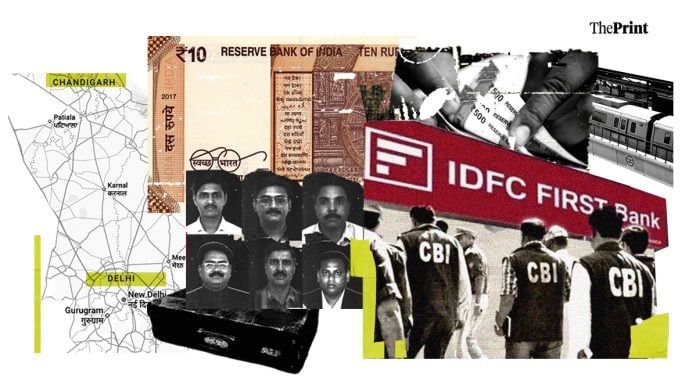
Gurugram: On the evening of 22 January, a young Prashant stood gingerly near the Old Rajinder Nagar metro station. That was allegedly for a carefully coordinated operation whose tentacles spread far beyond the Delhi locality known for its UPSC coaching centres.
Unbeknownst to the onlookers, he was there to collect money in three tranches of Rs 1 crore, Rs 50 lakh, another Rs 50 lakh, from hawala operators working out of Chandni Chowk. Each time, the code was the same: a ten-rupee note whose serial number had been shared in advance.
Turns out, Prashant is the son of Ram Kumar Singh, a promoted IAS officer of the Haryana cadre of the 2012 batch, who was Commissioner of the Municipal Corporation, Panchkula, when the money went missing from the civic body’s account.
The CBI’s supplementary chargesheet in the IDFC-AU Small Finance Bank case, filed before the Special Judge, CBI, Panchkula on 2 September, reconstructs the delivery using call detail records, WhatsApp chats recovered from the phones of couriers and hawala operators, and signed receipts seized from Delhi’s cash-exchange network.
The modus operandi, according to the chargesheet, followed a pattern: eleven days earlier, on 11 January, a courier walked with Rs 50 lakh in cash into Ram Kumar Singh’s official residence in Sector 19-A, Chandigarh, after a call was placed to the officer’s own number to confirm the drop.
The cash delivered to Prashant took the hawala route. On the afternoon of 22 January, banker Ribhav Rishi’s two ‘couriers’ allegedly raised the money locally: Rs 50 lakh from Bansal Associates in Sector 47, Chandigarh, and Rs 30 lakh and Rs 20 lakh from two collections at a shop in Sector 28 and in Industrial Area Phase 2. A separate Rs 1 crore was picked up from Mega Store outlets in Chandigarh and Mohali, according to the CBI chargesheet.
The entire money was allegedly handed to Lalit, a hawala operator, in two installments of Rs 1 crore each. The CBI has his phone records and WhatsApp calls showing him at the handover at both 2 pm and 4 pm that day.
Lalit then rang his counterparts in Delhi’s hawala market to disclose the serial number of the Rs 10 note that Rishi, the former branch manager of IDFC First Bank’s Sector 32, Chandigarh, specified as the identification code.
Acting on that code, Vishal Patel handed Rs1 crore to Prashant; Jayesh Patel arranged a further Rs 50 lakh at the same spot; and Haresh Patel handed over the final Rs 50 lakh at his shop in Kucha Ghasi Ram Lane, taking Prashant’s signature on a receipt.
Each leg of the chain is backed by seized receipts, call records or WhatsApp chats recovered from the phones of operators and couriers. This is one of the many threads mentioned in the chargesheet that runs into several hundred pages.
Together with the chargesheet, the supplementary chargesheet and the final report (running into 196 and 568 pages) cover the alleged diversion of over Rs 400 crore of the Haryana government’s money out of accounts opened at the IDFC First Bank and, later, AU Small Finance Bank.
In April, the CBI took over the probe into the embezzlement of funds from the government’s accounts in IDFC First Bank.
One branch, eight govt treasuries
What makes the CBI’s account striking is not any single bribe but the scale of institutional capture it mentions.
Investigators say the fraud involved the accounts of eight organisations of the Haryana government—the Haryana State Pollution Control Board (HSPCB), the Haryana Power Generation Corporation Limited (HPGCL) along with its Dry Fly Ash Fund and Employees Pension Fund Trust, the Haryana School Shiksha Pariyojna Parishad, the Haryana State Agricultural Marketing Board (HSAMB), the Development and Panchayats Department, the Panchkula municipal corporation, the Kalka municipal council, and the Haryana Labour Welfare Board—spread across 12 bank accounts.
A common design runs through all eight cases: bank officials misrepresented interest rates and won government business; officials opened accounts bypassing rules; funds were moved in violation of deposit ceilings; internal alerts and red flags were ignored/suppressed; forged bank statements and fake fixed deposit receipts were used to paper over what had already been siphoned off; and the stolen money was laundered, partly recycled to other departments to make the books look normal, and partly converted into cash, gold and property.
Rishi, who later moved to AU Small Finance Bank, was identified as the alleged architect. Around him, the CBI says, functioned a network of relationship managers, authorisers and tellers, middleman Manish Jindal who ferried instructions and gratification between the banker and government officials, a Chandigarh jeweller through whom stolen funds were converted into gold, and hawala operators in Chandigarh and Delhi.
‘Cheques signed at home’
The Panchkula municipal corporation (PMC)’s account tells the story of the fraud at its most brazen. The chargesheet records that Rs 100 crore was allegedly siphoned off from a single PMC account between November and December 2025, spread across 22 fraudulent transactions, with the money routed to entities such as Durga Foods, Tirupati Foods, Balaji Foods, Garg Overseas and Jhimjham Enterprises. In reality, these trading firms had no genuine business with the municipal corporation.
To cover the trail, four fake fixed deposit receipts (FDRs) worth Rs 20 crore each were shown as having been created against the missing money. Investigators say the cheques for these were collected in person: on 24 December, 2025, an official identified as Naresh Kumar allegedly went to Ram Kumar Singh’s residence and came away with four signed cheques, which he photographed and sent to another banker Abhay Kumar.
The chargesheet reproduces Abhay Kumar’s reply, sent over WhatsApp: ‘Kya baat hai (That’s amazing),’ followed by ‘maza aa gaya (This is awesome)’. No fixed deposits were ever created against those cheques.
When PMC staff found the numbers did not add up, the CBI says a note was put up recommending that the corporation’s account be shifted to a different branch, citing poor service, a move that investigators describe as an attempt to keep the missing FDRs from being noticed, rather than a genuine complaint.
The chargesheet holds Ram Kumar Singh responsible for Rs 100 crore loss to the corporation, along with another Rs 18.46 crore that went missing from the Kalka municipal council which was also under his supervision. Two days after the Kalka amount went out, the CBI says, the Rs 2 crore hawala delivery to his son was done in Delhi.
‘Gold coins delivered in garden’
The PCB’s account is where the fraud reaches its highest quantified figure: nearly Rs 160 crore, made up of lost interest, misappropriated principal and money parked in a savings account beyond the prescribed limit.
Investigators found seven FDRs worth Rs 201.42 crore, allegedly placed with IDFC First Bank with the personal approval of then-HSPCB chairperson Vineet Garg. But the bank has no record of these FDRs.
Garg, a 1991 batch IAS officer, could have been vying for the Haryana chief secretary’s post had this scam not come to the fore. The PCB chairperson allegedly received two 50-gram gold coins about four-five days before Diwali in 2025.
A courier working for Rishi collected the coins from a Chandigarh jewellery shop and delivered them to a house in Sector 7A, Chandigarh, where they were handed over in a garden to a man whom the courier addressed as ‘Sir’, according to the chargesheet.
Cellphone tower data, the CBI says, places the phones of Vineet Garg, the courier and the middleman Manish Jindal at the same location.
HPSCB member secretary and IAS officer Pardeep Kumar, along with two other departmental officials, Parveen Kumar and Saurav Sharma, are named as accused.
The CBI accused them of either facilitating the opening of the irregular account or continuing to sign off on fixed deposit placements without ever verifying that the FDRs actually existed.
Even ash fund not spared
At HPGCL, the CBI estimated a loss of Rs 59.46 crore to its Dry Fly Ash Fund, a dedicated account where revenue or environmental compensation collected from thermal power plants is stored.
Mohammed Shayin, the then MD and IAS officer of 2002 batch, was named as an accused, along with the company’s Chief Accounts Officer Rajesh Goyal and Director (Finance) Amit Dewan.
Shayin, according to the chargesheet, allowed HPGCL’s funds to be misappropriated from the Dry Fly Ash Fund and the Employees Pension Fund Trust. This included Rs 19.71 crore taken through nine fraudulent debits from the trust’s IDFC First Bank account, Rs 25 crore withdrawn in a single debit from its AU Small Finance Bank account, and another Rs 1.66 crore lost due to a premature withdrawal, it added.
Investigators alleged that the Fly Ash fund account was opened and the deposits placed on Shayin’s approval without the matter ever being referred to the Finance Department.
His driver, Hemraj, has told the CBI that he dropped Rishi outside Shayin’s residence on eight-nine occasions, and that Rishi would allegedly tell his colleague Abhay Kumar over the phone, ‘Shayin Sahab ke ghar chalna hai, meeting hai. (We need to go to Shayin Sir’s house, there’s a meeting).’
The chargesheet quantifies the undue advantage Shayin received from Rishi at Rs 1.67 lakh.
At the Haryana Labour Welfare Board, the chargesheet quantifies a wrongful loss of Rs 50.05 crore. Deputy Labour Commissioner Surinder Kaur was allegedly told in person in October 2025 that no fixed deposit existed in the Board’s name and that the bank official she had been dealing with had already left the job.
Yet, Kaur, according to the chargesheet, kept the file pending for more than a month before informing the bank. She also allegedly did not send it to the Welfare Commissioner, as well as continued to communicate with the former bank employee, who allegedly visited her in January.
Two other officials, Amit Kumar and Jugal Kishor, were also chargesheeted for their alleged role in the account’s opening and the use of forged fixed deposit paperwork.
Also Read: Chandigarh admin funds also hit? Haryana Vigilance chief’s revelation in IDFC First Bank fraud
‘Raita na phailne do’
A third department, the Development and Panchayats Department, finds its way into the chargesheet through a single word.
Saket Kumar, who held additional charge as Commissioner and Secretary of the Development and Panchayats Department and, at the same time, served as HPGCL’s MD, is accused of selecting the two banks to keep funds for the Mukhya Mantri Gramin Awas Yojana 2.0, a scheme to give residential plots to rural families.
The 2005-batch IAS officer allegedly cleared the file with just the word ‘Seen’.
Rs 75 crore (Rs 50 crore given to IDFC First Bank and Rs 25 crore to AU Small Finance Bank) of the scheme money, the CBI alleged, was moved into the two accounts even though no development work was approved and no payment was due.
The investigations revealed that D.K.Bahera, then Director of the Department, mentioned on the note that “as per discussions with the C&SDP (Saket Kumar’s designation), the infrastructure development funds to be kept in IDFC First Bank and AU Small Finance Bank.
The federal agency said that the remark “seen” by Kumar indicated that the matter was already decided and Saket Kumar agreed to the note of Bahera and that Saket Kumar directed the choice of banks.
However, like in the case of funds of the other departments, a substantial part of funds of the Development and Panchayat Department too vanished from the banks.
Rs 89.23 crore was later siphoned off from the IDFC account and Rs 71.61 crore from the AU account through fraudulent debits, of which only Rs 1.27 crore was ever recovered, according to the federal agency.
When the shortfall threatened to surface, investigators say, Kumar approved the fraudulent withdrawal of Rs 25 crore from HPGCL’s EPF Trust account, which was routed into the housing scheme’s account for closing it without an apparent loss.
“Such an inter-departmental transfer of a huge amount of funds exhibits that the IAS officers were allowing a mammoth fraud to happen with impunity,” a retired IAS officer told The Print.
To be sure, Kumar was also additional principal secretary to the Haryana Chief Minister, a post that meant few officials below him were in any position to question his decisions.
A recorded conversation between co-accused, Naresh Kumar and Ribhav Rishi, cited in the chargesheet, attributes Kumar sending the instruction ‘raita na failne do, isko niptao, ye raita faila dega (Don’t let this spill over, shut it down, or it will spread).’
Fraud debits
Pankaj Agarwal, who has held charge as Principal Secretary of both Agriculture and Farmers Welfare Department and the School Education Department at different points, faces the widest set of allegations among the accused IAS officers.
The 2000-batch IAS officer is accused of causing a loss of Rs 50.54 crore to the Haryana School Shiksha Pariyojna Parishad through 101 fraudulent debits. He is also accused of allowing another fraudulent debit of Rs 10 crore from the Haryana State Agricultural Marketing Board’s account. The bank later returned the Rs 10 crore with interest, after another official reported the matter to law enforcement.
The chargesheet alleges that he redirected a formal banking proposal away from the officer who should ordinarily have approved it, had an existing notesheet withdrawn and replaced with an antedated version, and later played down the fraud when it was reported to him rather than ordering that a complaint be filed.
‘W-3’
The CBI chargesheet alleges that Pankaj Agarwal visited Jade Manor, a private property in Zirakpur, in November and December 2025, where a woman identified as ‘W3’ was present. Investigators allege that he did so with an “intent to insult her modesty, and intrude upon her privacy”.
‘W3’, according to the chargesheet, came to Jade Manor after a man named Kabir sent her on the instructions of accused Naresh Kumar and Ribhav Rishi. Each time, a man identified as Rakesh Kumar alias Chacha, picked ‘W3’ up and dropped her at the property.
In her statement, ‘W3’ alleged that on both occasions she was in a ground-floor room when Agarwal came in and stayed with her for some time. She was allegedly paid Rs 10,000 and Rs 12,000 in cash on the two occasions.
The chargesheet records a third arrangement made at Chandigarh’s Hotel Novotel on 24 December, 2025, a meeting that, hotel and phone records show, did not take place.
This finds mention in the formal charges framed against Agarwal, apart from the allegations of cash, hospitality and Mujra parties received as gratification, which ThePrint reported in September first week.
IAS officers Ram Kumar Singh, Pankaj Agarwal, and Pradeep Kumar (retired on the day of his arrest), bankers Ribhav Rishi and Abhay Kumar are among the accused in judicial custody. Three other IAS officers, Vineet Joshi, Mohammad Shayin and Saket Kumar, have not been arrested.
The offences invoked include criminal conspiracy, criminal breach of trust by a public servant, cheating, forgery of valuable security and the giving and taking of illegal gratification under the Prevention of Corruption Act, alongside the relevant provisions of the Bharatiya Nyaya Sanhita.
(Edited by Tony Rai)