



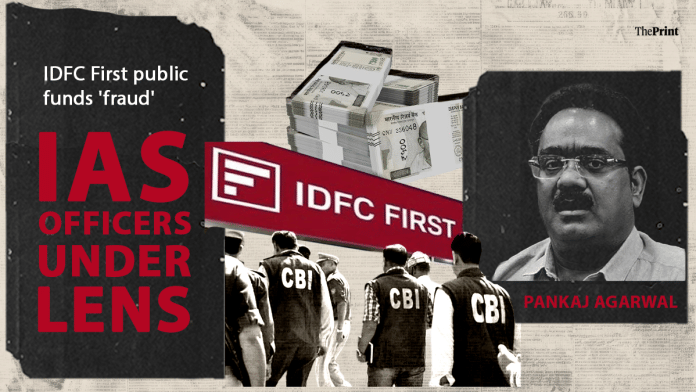
Chandigarh: It was a little before 11 am on the last working day of 2024. Executive engineer Bhupinder Singh was sitting in the chamber of Pankaj Agarwal, then Commissioner and Secretary of the School Education Department in Haryana. Bhupinder was being relieved from the department that very day.
Randhir Singh, the controller of finance and accounts at the Haryana School Shiksha Pariyojna Parishad (HSSPP), walked in with a file.
According to Bhupinder’s statement to the CBI, Agarwal asked Randhir about the IDFC First Bank account that a banker named Ribhav Rishi had proposed. Randhir said the state project director was away but had returned that day and would sign the file. After that, Randhir added, the file would go to the finance department for approval.
Agarwal got angry, the statement says. He told Randhir that if the proposal went to the finance department, it would never be approved. Randhir then pointed out that finance department circulars did not allow more than Rs 50 crore to be parked in such an account.
The CBI records Agarwal’s reply in Hindi: “Jyada kanoon mat sikhao, jab file finance department jayegi hi nahi to 50 crore dalo ya 100 crore.” Translation: Don’t lecture me on rules, if the file isn’t going to the finance department anyway, then it doesn’t matter if you put in Rs 50 crore or Rs 100 crore.
Agarwal then told them, according to the same statement, that the executive engineer was also leaving that day, and that they should go and quickly prepare a new notesheet.
Randhir and Bhupinder left the room. In Bhupinder’s office, along with an accountant named Rakesh Kumar, they drafted a fresh notesheet. It proposed opening the account and moving Rs 100 crore into it. It carried the old dates.
Eight days later, on 8 January 2025, Rs 100 crore left the Parishad’s account at Kotak Mahindra Bank and landed in a new account at IDFC First Bank’s Sector 32 branch in Chandigarh. The first allegedly fraudulent debit went out the same day.
This sequence of events is one of the most detailed in the CBI’s 2 September supplementary chargesheet, filed before the Special Judge, CBI, Panchkula, which names 19 more accused, including six IAS officers, in a fraud in which funds of eight Haryana government bodies were moved to IDFC First Bank’s Sector 32 branch in Chandigarh, and then allegedly siphoned off.
Pankaj Agarwal’s lawyer, Vishal Garg, had earlier termed the allegations against his client baseless, and he is innocent, while speaking to The Print in September.
He had maintained that no recovery had been made from Agarwal, even during the searches carried out at his residence.
Who is Pankaj Agarwal?
Pankaj Agarwal, a 2000-batch IAS officer born in 1974, is Accused No. 30 in the case. The chargesheet lists his address as Sector 19-B, Chandigarh.
He was arrested on 22 June this year and sent to judicial custody on 25 June. The CBI had earlier sought and received approval under Section 17A of the Prevention of Corruption Act to investigate him.
The agency says he held two posts that matter here. He was Commissioner and Secretary, School Education, when the HSSPP account was opened, and later Principal Secretary, Agriculture and Farmers Welfare, when an account of the Haryana State Agricultural Marketing Board (HSAMB) was opened. He was also the board’s chairman, the chargesheet says.
Interestingly, Agarwal was one of the most trusted civil servants of the BJP government in Haryana, entrusted with the task of holding assembly elections in 2019 and then again in 2024 as chief electoral officer ahead of the polls. Not just that, he was also appointed as returning officer for the 2026 Biennial Rajya Sabha election for Haryana where the BJP had almost managed winning the second seat that had then seemed easy for the Congress, based on numbers. Later, the Congress had raised serious questions Agarwal’s conduct as returning officer.
The CBI says he is liable to be prosecuted under Sections 61(2), 241, 316(5), 317(4), 318(4), 336(3), 338, 340(2) and 344 of the Bharatiya Nyaya Sanhita, and Sections 7(c), 7A, 8, 9, 10 and 13(1)(a) of the Prevention of Corruption Act. For substantive offences, it names Sections 316(5), 241 and 79 of the BNS, and Sections 7(c), 12 and 13(2) read with 13(1)(a) of the PC Act.
In plain terms, these provisions cover three kinds of wrongdoing. The first is about the fraud itself. Section 61(2) of the BNS deals with criminal conspiracy, which means agreeing with others to commit an offence. Section 316(5) is criminal breach of trust by a public servant, which applies when an officer entrusted with public money allows it to be misused, and it carries up to life imprisonment.
Section 318(4) is cheating that leads someone to hand over property. Section 317(4) concerns dealing in property known to be stolen. The second kind is about papers and records. Section 336(3) is forgery meant for cheating, Section 338 is forgery of a valuable security, Section 340(2) is using a forged document as genuine, and Section 344 is falsifying accounts. Section 241 deals with destroying or removing a document to keep it from being used as evidence, and the CBI invokes it for the replaced notesheet.
The third kind is about corruption. Section 7(c) of the Prevention of Corruption Act covers a public servant who performs a public duty improperly or dishonestly in return for an undue advantage, a term that includes any gain, not only cash. Section 7A covers taking an undue advantage to influence a public servant by corrupt means or personal influence. Section 8 is giving an undue advantage to a public servant.
Sections 9 and 10 deal with bribing a public servant on behalf of a commercial organisation, and with the person in charge of such an organisation. Section 12 punishes abetment of these offences. Section 13(1)(a) is criminal misconduct, which applies when a public servant dishonestly misappropriates property entrusted to him or lets another person do so, and Section 13(2) prescribes the punishment, which is imprisonment of four to ten years.
Agarwal has also been charged for crimes against women. Section 79 of the BNS is the one tied to W-3’s account. It covers a word, gesture or act intended to insult the modesty of a woman, or an intrusion on her privacy.
These are the agency’s allegations. Agarwal has not been tried, and the chargesheet’s findings are yet to be tested in court. The chargesheet does not carry any statement of defence from him.
Also Read: A ‘seen’ file noting did in Haryana IAS officer. Tried to bury IDFC scam before raising alarm—CBI
The proposal in his chamber
The CBI’s account of the HSSPP episode begins on 17 December 2024. That day, Randhir Singh asked an accountant, Anita Negi, for a statement of balance in every bank account of the parishad. She sent him an Excel sheet the same day.
The CBI says nothing on the parishad’s file that day called for such a statement. The money was sitting in accounts at Kotak Mahindra Bank and IDBI Bank, about Rs 230.9 crore in all, and the offices were being served from those accounts. No new scheme had been sanctioned, and no officer had asked for a new account.
On the same date, 17 December, a letter appears from Ribhav Rishi, then branch manager of IDFC First Bank’s Sector 32 branch. It was titled ‘Banking Proposal’, and addressed to the Commissioner and Secretary, Education.
On 19 December, the CBI says, Rishi went to Agarwal’s office at Shiksha Sadan and handed it over personally. Randhir Singh was present. Agarwal received the proposal and marked it the same day to the state project director and to the controller of finance, with a direction to do the needful.
The CBI treats this as a break from routine. The HSSPP is a field office. The officer who normally decides on opening its bank accounts is the state project director. An administrative secretary has no day-to-day role in its finances. The chargesheet says the natural course would have been to tell the banker to approach the project director. Agarwal, it says, did not do that.
The CBI adds that no quotations were ever invited from other banks, though the executive engineer had noted on the file that quotations be collected from empanelled banks. In the agency’s reading, the decision had already been taken outside the file, and the file was moved later to give it a look of propriety.
The call records, which the CBI has reproduced in the chargesheet, show a pattern. Randhir Singh’s phone received calls from Agarwal’s mobile and office landline, and from Rishi, over the next days. On 23 December, a call came from Agarwal’s landline to Randhir. The CBI says it was to ask why the proposal was not being processed.
Crucial call
The CBI says Agarwal then did something that it considers central to its case.
On 20 December, he phoned Kiran Lekha Walia, then chief financial adviser in the finance department, from his own mobile phone. The call lasted 5 minutes 51 seconds, call records show.
Walia, whose signature appears on the circulars governing bank accounts, told him two things, according to her statement. The proposal must go to the finance department for approval. And the limit was Rs 50 crore, so funds beyond that should not be transferred.
The chargesheet says Agarwal asked whether Rs 100 crore could be put into the IDFC First Bank account. She told him that it could not.
The CBI says parishad officials had already told Agarwal the same rules. They had also told him how the finance department had earlier refused post facto approval for a Kotak Mahindra Bank account. Even so, the agency says, he stayed fixated on the Rs 100-crore figure.
What happened to Walia’s advice is the next point in the chargesheet. It was not put on the file. It was not passed on to the officers processing the matter. And it was not acted upon, the CBI says.
One notesheet becomes two
The original notesheet, drafted by the accountant Rakesh Kumar and forwarded by the executive engineer, proposed taking the finance department’s approval before opening the account.
During custodial interrogation, the CBI says, Randhir Singh disclosed that there were two sets of notesheets. He said the original was altered at Agarwal’s instance. The CBI says Haryana Police recovered a copy from the drawer in Randhir’s office, and the original from his home.
The CBI also points to the file movement history in the government’s online system. It carries the remark “File may be sent to CFA for further necessary action please”. That remark matches the original notesheet and is missing from the replacement. The agency says Rakesh Kumar, the accountant, confirmed that the note had been changed.
The replacement note gave a reason for choosing IDFC First Bank: its higher interest rate. The CBI says this reason was never tested. No bank was asked for a quotation, and no comparison of rates was put on file.
There is one more detail. State project director Jitender Kumar was the officer competent to approve such a proposal. He did not. He marked the file to Agarwal, and Agarwal approved it himself, the chargesheet says.
Rs 100 crore, and two short replies
The account, No. 10211500056, was opened on 4 January 2025. The authorised signatories were Randhir Singh and an executive engineer, Gaurav Bargujar. The registered mobile number was Randhir’s, the chargesheet says.
On 8 January, Rs 100 crore moved from Kotak Mahindra Bank in three transfers: Rs 40 crore, Rs 40 crore and Rs 20 crore. The CBI says the bank’s limit for this account was Rs 50 crore.
The CBI says Randhir Singh kept Agarwal informed on WhatsApp at each step. On 4 January, Agarwal replied, “That’s fine. Thanks”. On 8 January, after Randhir shared the bank statement showing the Rs 100 crore, Agarwal wrote: “Noted. Thanks.”
The debits began on 8 January itself and went on until 17 September 2025. They went, the CBI says, to entities controlled by Ribhav Rishi and others, including Capco Fintech Services, RS Traders, Swastik Desh Projects, Maa Vaibhav Laxmi Interiors and SRR Planning Gurus Pvt Ltd. The money was often returned in part and taken out again, to keep the account looking healthy and the parishad’s genuine payments going.
The CBI puts the parishad’s net loss at Rs 50.54 crore, or Rs 53.86 crore with interest, according to the department’s own ledgers. It says 83 of the fraudulent debits, adding up to Rs 134.94 crore, took place between 10 December 2024 and 16 June 2025, while Agarwal held charge of the department.
The CBI is open about one gap. No document bearing Agarwal’s signature on any debit exists, it says. The debits went out on Real-Time Gross Settlement (RTGS) letters and debit notes, and the two authorised signatories told investigators they had not signed them. In the agency’s words, the withdrawals were designed to stay outside any file he would have to touch, so no such document is to be expected.
The other department
The chargesheet then moves to the Marketing Board in Panchkula.
Agarwal joined the agriculture department in June 2025. IDFC First Bank had sent the board a banking proposal on 21 May, offering 7 per cent interest on savings accounts. It had lain unattended.
On 1 July 2025, the CBI says, Agarwal sent Rishi’s name and mobile number on WhatsApp to Rajesh Sangwan, the board’s controller of finance and accounts. The first call between Rishi and Sangwan was logged the next day. A WhatsApp call between Agarwal and Sangwan followed the sharing of the number.
The agency reads this as an introduction, made before any proposal for an IDFC First Bank account had begun moving within the department.
On 2 July, Rishi and Shamim Dar, an area head of the bank, visited the Board’s office. A notesheet was prepared the same day. On 4 July, the Chief Administrator, Mukesh Kumar Ahuja, approved it. The account was opened on 10 July at the Sector 32 branch in Chandigarh.
The CBI lists what was unusual. The board already had 11 savings accounts, holding about Rs 281.94 crore between them. The note recorded no reason for a twelfth, beyond the interest rate. No approval was taken from the finance department, and no other bank gave a quotation. An IDFC First Bank branch stood in Sector 11, Panchkula, two to three kilometres from the board’s office, but the account was opened in Chandigarh.
Ahuja told the CBI that Sangwan came to him three or four times, saying that Agarwal was “pressuring” for the account with IDFC First Bank. Ahuja also claimed that in an official meeting, Agarwal directed that the account be opened with that bank, and that he then told Sangwan to process the proposal.
Ahuja called Agarwal’s interest unusual, the chargesheet says. He said it was not what one would expect from an officer of such seniority.
Funds began to flow in. By August 2025, the balance had touched Rs 50 crore and was being brought down by debits.
The Rs 10-crore debit
On 14 January 2026, Rs 10 crore left the board’s account on a cheque numbered 000006. The CBI says this cheque had been cancelled months earlier because of a date error and replaced by the next one in the series. The money went to SRR Planning Gurus (Rs 9.75 crore) and Mannat Contractors (Rs 25 lakh). SRR, the CBI says, is owned by Ankur Sharma and Kamlesh Rishi, Ribhav Rishi’s mother.
The CBI adds that the debit voucher attached to the cheque was forged and that the bankers’ “confirmation call” was staged. It makes those allegations against the bankers. For Agarwal, it points to what happened that morning.
At 10.54 am on 14 January, Rishi sent Agarwal an SMS. It read: “Bhaiya good morning! Balance is 12.23 cr only, it was correct and I am sitting with Sangwan ji.” Agarwal replied: “Good mrg, mujhe jab bat karna hoga bata dena (Tell me when I need to talk).”
Surveillance footage seized from HARCO Bank, which faces Sangwan’s office, shows Rishi entering the cabin at 10.51 am and leaving at 11.24 am.
The CBI reads the messages as signs of closeness. It says the word “Bhaiya” shows proximity, and that Agarwal’s reply shows he was ready to bring Sangwan around if needed. It also notes that calls between Agarwal, Rishi and Sangwan were logged on 13 and 14 January. These are the agency’s inferences, and the chargesheet states them as such.
What he said when the fraud surfaced
The cashier, Anita Devi, spotted the debit on the January statement in early February. The matter reached Sangwan.
On 17 February, Sangwan messaged Agarwal asking for time. He went to Agarwal’s residence at about 9 pm, the chargesheet says. According to Sangwan, Rishi was also there. Agarwal told him not to panic and to collect the bank documents, the chargesheet says.
Two days later, on 19 February, Sangwan and Anita Devi went to Agarwal’s office at the Mini Secretariat. They had found that SRR Planning Gurus had a director, Kamlesh Rishi, who was related to Ribhav Rishi.
Agarwal showed them a state government letter that gave a month, until 4 April, for reconciliation, and said the matter was already being handled at the government level, the chargesheet says. Told of the Rs 10 crore, he said, according to Sangwan: “Ye toh pehle se hi hota aa raha hai (This has been happening for some time).” He also described Rishi as well-connected, someone for whom Rs 10 crore to Rs 20 crore was no big matter. He assured them the money would come back.
Agarwal, the administrative secretary of the department, neither told Sangwan to file a complaint within the department nor spoke of going to the police, the CBI says. He advised them to keep quiet, it adds.
Sangwan then went to Ahuja, who told him to file an FIR at once. Sangwan suggested approaching the bank first. Ahuja scolded him for having sat on the matter for days. A complaint went to the bank by email on 20 February, at Ahuja’s instance and not Agarwal’s, the CBI says.
On 23 February, officials of the Board met IDFC First Bank officials at the Haryana Public Service Commission’s office. The bank was told to return the amount with interest. The same day, it returned Rs 10 crore along with Rs 7,28,227 in interest. The CBI’s phrasing is that the money came back only after Agarwal was bypassed.
One more piece of footage figures here. CCTV from the Koyo restaurant at Hyatt, Chandigarh, shows Agarwal meeting Rishi and Abhay Kumar, another accused banker, on 6 February this year. The CBI says both had by then left IDFC First Bank, and that Agarwal knew this. Yet he kept directing his officers to deal with Rishi on banking matters.
Party people
The second half of the CBI’s case concerns what it calls undue advantage. The agency says Rishi and his associates paid for it, almost wholly in cash.
Its main allegation is about parties at Jade Manor, a farmhouse in Zirakpur. The venue’s records show ten such parties between July 2025 and January 2026, booked in the name of a woman the chargesheet calls W-1, or of another person. W-1 was a friend of Rishi. She has told the CBI that she booked the venue and arranged dancers on his instructions and with his money.
Four of those parties, on 1 November, 9 November and 13 December 2025 and 16 January 2026, were organised on Agarwal’s demand and attended by him, the CBI says. It cites W-1’s statement, as well as statements by Rishi’s driver, Hemraj, by the caterer’s manager and by Jade Manor’s then manager. Call and internet records of Agarwal’s phone, obtained from Vodafone, place him at the farmhouse on those nights, the chargesheet says.
According to W-1, Rishi sometimes added Agarwal to their WhatsApp calls, and Agarwal would ask about the next party.
W-1 also described two encounters with him. She told the CBI that on 1 November 2025, Rishi introduced her at the party to Agarwal, whom he presented as a senior officer of the Haryana government. She said Agarwal called her aside and asked her to send the girls to his room.
On 9 November, she said, she was standing alone on the party floor, with Rishi nearby, when Agarwal came up to her, gestured towards a room and asked her to go in with him. She refused. Rishi stepped in, she said, and told Agarwal that she was his friend and that he could engage with another girl. From Agarwal’s words and manner, W-1 said, it was clear he had an inappropriate motive. She told him she did not do such work.
The chargesheet records her saying she felt insulted, ashamed and humiliated.
The CBI also cites another woman, W-3, who says Agarwal came into the room where she was, at Jade Manor, on two occasions in November and December 2025. The agency has invoked Section 79 of the BNS, which deals with insulting the modesty of a woman, against him on the basis of W-3’s account.
The chargesheet lists three more instances:
24 December 2025, Hotel Novotel, Chandigarh: The CBI says W-3 was called to the hotel on Agarwal’s demand through Naresh Kumar, another accused and a Haryana government official, and Abhay Kumar. A room was booked in Naresh’s name. Agarwal reached the hotel between 9.43 pm and 10.11 pm, the records show, but the meeting did not happen, the CBI says, because Agarwal got delayed due to the VIP movement of the Union Home Minister Amit Shah, and W-3 had some other commitment to keep.
10 January 2026, Hotel Wyndham, Mohali: The CBI says W-2 was brought from Delhi for Agarwal and was paid Rs 75,000 in cash. That night at 10.51 pm, Naresh Kumar messaged Abhay Kumar: “pankaj sir saath hain (together with Pankaj).” Records show an Uber ride from the hotel to Agarwal’s home in Sector 19, Chandigarh, at 10.56 pm. The CBI says the phone, hotel and cab records place him at the hotel from about 8.30 pm to 11 pm.
8 and 9 October 2025: Andaz by Hyatt, Aerocity, New Delhi: A room was booked by Rishi on his HDFC Bank credit card, at Agarwal’s demand, the CBI says. His identity proof was submitted at check-in.
The CBI also cites a party for Agarwal’s wife on 1 October 2025 at Hotel Novotel, Chandigarh. The Rs 19,399 bill was paid in cash by Rishi, the agency says, and the hotel’s food and beverage manager has said so in a statement.
The CBI says the cash came from the siphoned government money, which was converted to gold and then back to cash. Only two payments in this whole chain can be traced to a bank or UPI record, the chargesheet says: the Rs 1 lakh cheque for the 9 November dinner and a Rs 40,000 UPI transfer from Abhay Kumar.
How the CBI reads it
The chargesheet sums up its case against Agarwal in a long passage. It says he went out of his way at every stage. He took the proposal in his own chamber, which a secretary does not do for a field office. He called the finance adviser looking for a way around the ceiling. He kept the file away from the finance department. He got the notesheet replaced and approved it himself. In the marketing board, he introduced the banker and directed the account. When the Rs 10 crore went missing, he did not report it, the CBI says.
It argues that these acts cannot be explained as a favour to a branch manager chasing deposit targets. The risk to rules and public money was far greater than any such favour would justify, the agency says.
It also argues that his conduct at the end shows his role. Someone misled at the start, the CBI says, would not behave this way when the fraud came out.
Much of the CBI’s account of the 31 December meeting rests on the statements of two officials who were in the room, Bhupinder Singh and Randhir Singh. Randhir is himself an accused. The CBI says the original notesheet, the system’s file history and Rakesh Kumar’s statement support the claim that the note was changed.
(Edited by Nardeep Singh Dahiya)
Also Read: IDFC First Bank scam: Pardeep Kumar, IAS officer under scanner, ‘on the run’ as CBI closes in